January 15, 2026
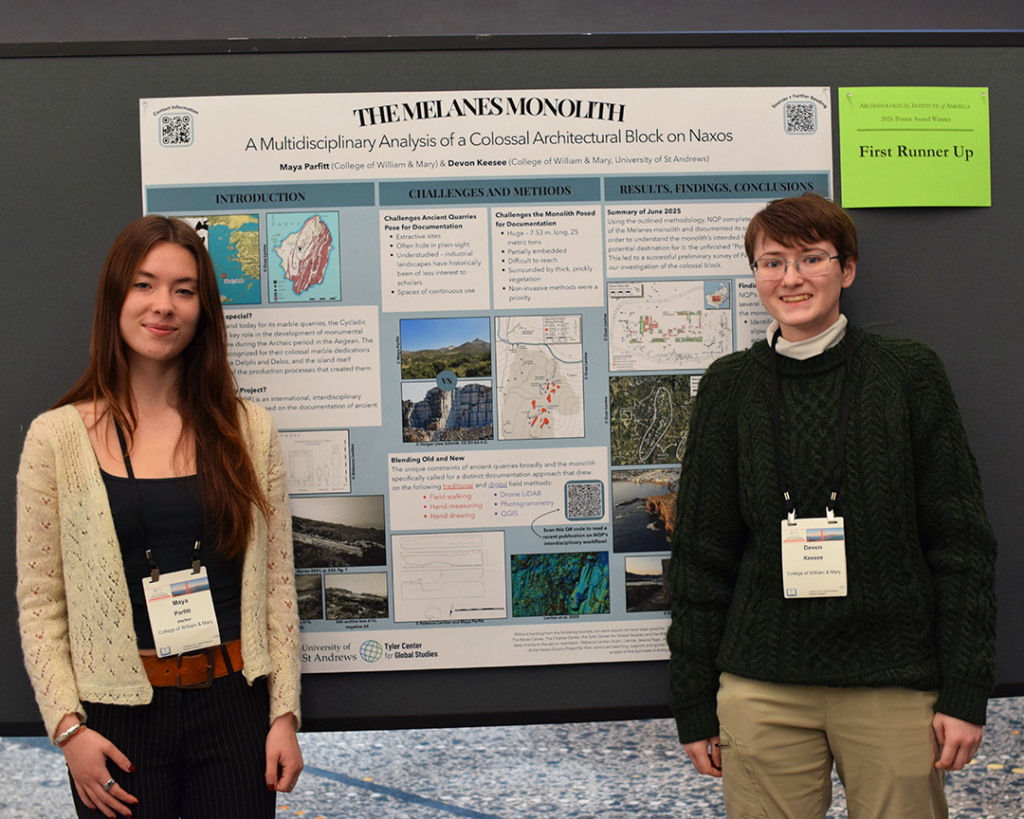
At the 2026 AIA Annual Meeting in San Francisco, attendees explored a dynamic range of posters showcasing research from around the world. Presented in a visual format, the poster session highlighted the breadth and diversity of work being done across the field.
Three Poster Awards were presented during the Poster Award Sessions: the Best Poster Award, First Runner-Up, and the Student Poster Award.
First Runner-Up Poster Award Recipients: Devon Keesee, Maya Parfitt, Jessica Paga

“The Melanes Monolith: A Multidisciplinary Analysis of a Colossal Architectural Block on Naxos”
Well known in antiquity and today for its marble quarries, the Cycladic Island of Naxos played a key role in the development of monumental sculpture and architecture during the Archaic period in Greece. During its 2025 season, the Naxos Quarry Project (NQP) investigated the remains of a colossal marble architectural block that remains in situ in the ancient quarry of Melanes. The block, abandoned in antiquity, is largely ignored in modern scholarship due to its context (see brief mentions in Welter 1924; Gruben and Königs 1970; Korres 2021). In previous studies of the Naxian quarries, abandoned sculptures have received more attention than architectural elements like the monolith (Kokkorou-Alevras 1992; Korres 2021). The NQP team—an international group of students and scholars—used a unique, multidisciplinary approach for archaeological documentation on Naxos in order to ascertain the block’s extraction point, its intended purpose, and the reason for its abandonment. In addition to traditional field methods like hand drawing, measuring, photography, and field walking, the team also used digital technologies like drone LiDAR, GIS, photogrammetry, and digital modeling to produce the first full-scale study of the monolith and to map the surrounding quarry area. The most likely candidate for a final intended destination for the monolith is the unfinished archaic temple on the Palatia islet (known as the “Portara”). With evidence gained through archaeological autopsy and archival material, the NQP team assessed this potential connection in conjunction with documenting the monolith.
This poster details the advantages of documenting archaeological remains with a multidisciplinary approach, and how using traditional and digital field methods can provide a more holistic understanding of ancient quarried landscapes. It also demonstrates how the thorough analysis of the abandoned monolith in the context of its possible relationship to the “Portara” necessitates a reexamination of the unfinished temple itself.