April 16, 2026
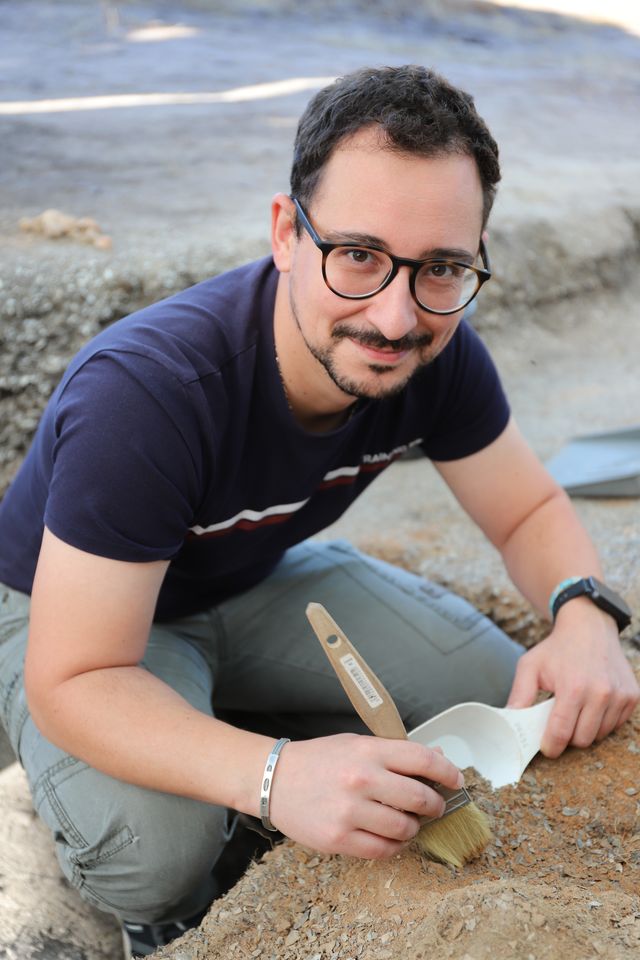
To celebrate our 2026 Fellowship recipients, we connected with this year’s awardees to learn more about their projects and the unique paths that led them into the field of archaeology.
We’re thrilled to introduce Dany Coutinho Nogueira, recipient of the prestigious 2026 Archaeology of Portugal Fellowship!
Dany Coutinho Nogueira (CIAS – Research Center for Anthropology and Health – University of Coimbra)
Tell us about your project:
Along the banks of the Tagus River in central Portugal lie the Muge shell middens, remarkable Mesolithic sites that hold the stories of some of Atlantic Portugal’s last hunter-fisher-gatherers. Our project revisits the lesser-known sites of the Muge complex with state-of-the-art analysis to better understand who these people were, how they lived, and how they were connected.
By combining cutting-edge biomolecular science (ancient DNA), detailed osteological study, and advanced digital documentation, we are building a comprehensive chronological framework for the Muge communities. This allows us to explore how different burial sites relate to one another and how these groups adapted during a time of profound environmental and cultural change at the end of Mesolithic period.
Beyond new analyses, we are creating open-access digital resources to ensure that this invaluable heritage is preserved and accessible to researchers, students, and the public worldwide. In doing so, we’re not just studying ancient lives, we’re reconnecting a crucial chapter of Portugal’s deep past to today’s global conversations about resilience, mobility, and community.
How did you get your start in archaeology?
My path to working in archaeology and doing fieldwork was not linear.
I began my studies in biology and geology. It was through a course on the Quaternary period that I first became deeply interested in human evolution, particularly Homo sapiens and the paleodemes that coexisted with our species across Eurasia, such as the Neanderthals and the Denisovans. That course was a turning point for me. I later completed a summer internship at PACEA (University of Bordeaux, France), which confirmed my desire to pursue Biological anthropology and Prehistory. Being based in the Bordeaux region, so rich in prehistoric sites and spectacular decorated caves, further strengthened my commitment to this field.
I went on to complete a PhD focusing on some of the earliest Homo sapiens populations outside Africa, in the Levant, exploring questions of dispersal and interaction among ancient human groups.
After my doctorate, I wanted to return to Portugal and became interested in the Mesolithic sites of the Tagus Valley. I joined the excavation team at Cabeço da Amoreira, one of the Muge shell middens.
For the past five years, I have continued researching these communities, among the last hunter-fisher-gatherers of Western Europe, combining fieldwork and laboratory analyses, to better understand their lifeways, mobility, and networks.
Where in the world has archaeology brought you (fieldwork, research, conference travel, etc.)?
I completed my studies and my first excavation experiences in France. During my PhD, I studied early Homo sapiens fossils from the Levant, which gave me the opportunity to travel there to examine the original fossils in person. For the past five years, I have been based in Portugal for my postdoctoral research. I have also traveled to several countries in Europe for conferences, including Lithuania, Belgium, Italy, and Ireland. In 2017, I went to the United States to attend the annual meeting of the American Association of Biological Anthropologists, the largest international conference in biological anthropology. Overall, archaeology has allowed me to work and travel across Europe, the Levant, and the United States.
What is one of the most memorable things that has happened to you in the field?
One of the most memorable moments for me in the field was the discovery of the first Mesolithic burial uncovered since I joined the excavation project. Many burials had already been found at the site before my time, but this was the first one discovered while I was part of the team.
Although I did not personally found the skeleton, I was directly involved in the excavation of the remains and their surrounding context. It was the first time I participated in every stage of the process, from the careful work in the field, to the laboratory analyses, and finally to the publication of the results.
Being involved from excavation to publication made the experience especially meaningful. It gave me a full understanding of how a single discovery moves from the ground to becoming part of the scientific record, and it reinforced why I value both fieldwork and lab research so deeply.
How has the AIA contributed to your success/professional goals?
This project will consolidate my research profile in Iberian Mesolithic bioarchaeology by completing a synthesis of human remains from both the classic and lesser-known Muge sites. This project will integrate the results of my post-doctoral research on Cabeço da Amoreira and Moita do Sebastião. As a focused, interdisciplinary study, it will serve as a proof of concept for future, larger-scale funding applications, such as Fundação para a Ciência (FCT) or European Research Council (ERC) projects, aimed at integrating additional Mesolithic contexts from the Sado Valley, non-shell midden sites, and Epipaleolithic sites of central Portugal into a broader reconstruction of prehistoric population dynamics and transitions.
Learn more about what Fellowship and Grant opportunities are available through the AIA.