May 21, 2026
To celebrate our 2026 Fellowship recipients, we connected with this year’s awardees to learn more about their projects and the unique paths that led them into the field of archaeology.
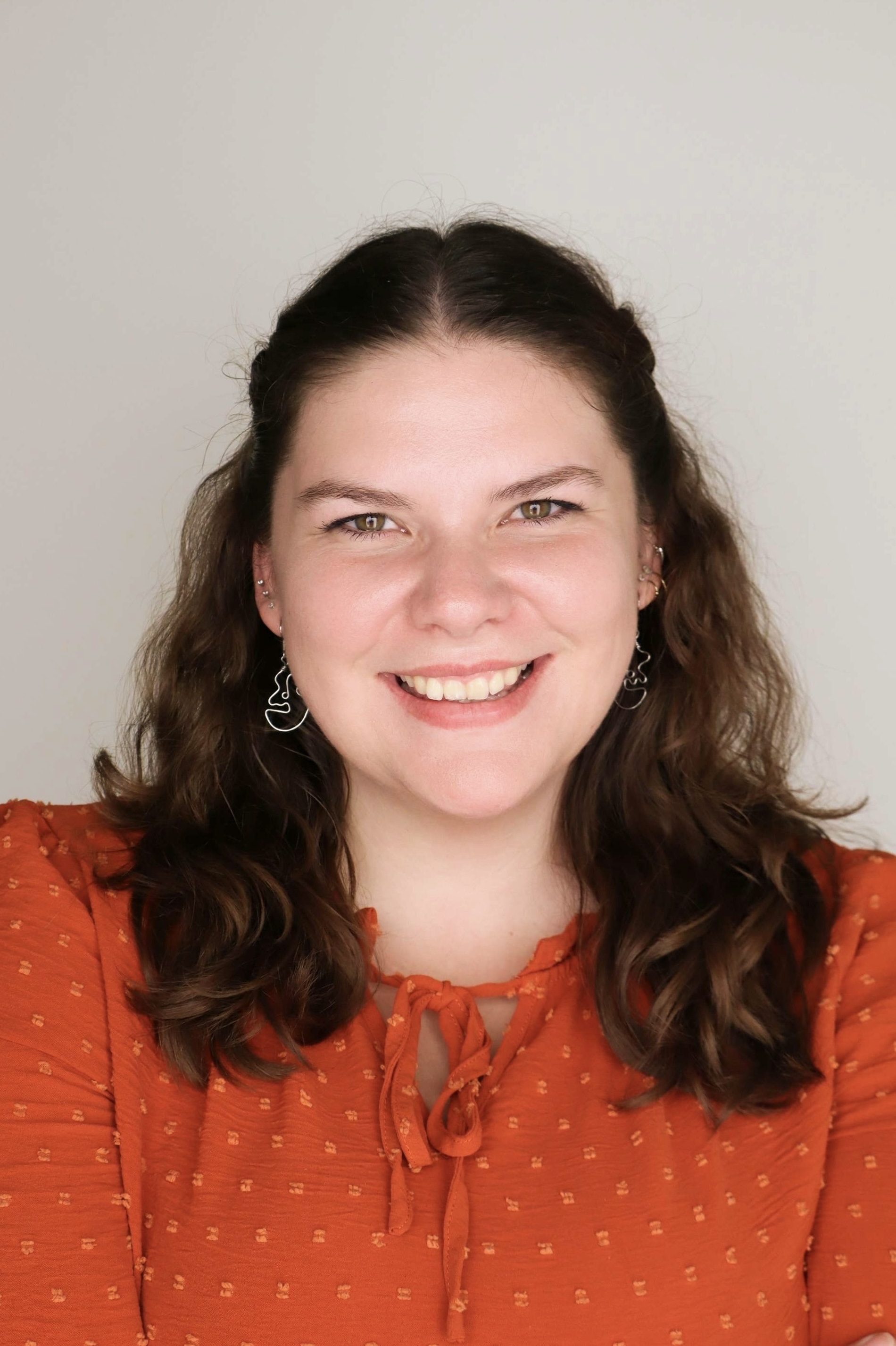
We’re thrilled to introduce Katrina Kuxhausen-DeRose, recipient of the prestigious 2026 Anna C. and Oliver C. Colburn Fellowship!
Katrina Kuxhausen-DeRose (UCLA)
Tell us about your project:
Monuments in Motion: Reuse and Negotiation of Itinerant Sacred Architecture in Roman Greece
What tales do “wandering” monuments tell? Scholars have long debated whether architectural spolia primarily reflects pragmatic recycling or ideological motivations. However, repurposed religious buildings are not so easy to put in a box.
Katrina Kuxhausen-DeRose (UCLA), recipient of the 2026 Colburn Fellowship, is tracing the exceptional journeys of reused sacred monuments in Roman Greece in order to follow how temples and altars were selected, dismantled, transported, and rebuilt under imperial rule.
With support from the AIA, Katrina will travel to Greece to reconsider legacy data from the early Athenian Agora Excavations a century ago, combining architectural materials analysis with spatial reconstruction to understand the behaviors, movements, and transformations enacted on reused blocks.
Her research treats material reuse as an active, risky, and diversely meaningful process of negotiation. As reused sacred architecture gathered or lost meaning through movement, ancient people could shape cultural heritage, ritual, identity, and authority across communities and generations.
How did you get your start in archaeology?
In 2018, I was fortunate enough to get a scholarship to go on a summer Study Abroad trip. The course was called “City as Text” and we followed the Roman Empire of old from Italy to Spain to England. Although I started my undergraduate studies as a History Major, I was more interested in U.S. History than Europe at that point. That summer, I found myself on a journey that I never expected to take. As a first-generation, low-income student, traveling was a romanticized fantasy in my mind. But when I arrived in Rome, all of those imaginative narratives of mine came alive. I saw the silhouette of the Colosseum, backlit by the sun as if even nature adored its awe-inspiring facade. I could almost hear the sounds of the gladiator fights echo through the past, mimicking my heartbeat pounding in my ears. An indescribable feeling overtook me, some mixture of joyous disbelief and monumental relief, as I stood in a place that had weathered thousands of years of history. That first step convinced me that I was merely scraping the surface of the wonderous knowledge that the ruins of the ancient world could offer me. The moment I returned to campus, I added on Anthropology as a major and I have never looked back!
Where in the world has archaeology brought you (fieldwork, research, conference travel, etc.)?
My fieldwork with excavations and cultural heritage projects has brought me to Campo della Fiera (Orvieto, Italy), Poggio del Molino (Piombino, Italy), Mount Lykaion (Arcadia, Greece), Valle Gianni (Gradoli, Italy), Geraki (Laconia, Greece), Athenian Agora (Athens, Greece), and Masis Blur (Yerevan, Armenia).
What is one of the most memorable things that has happened to you in the field?
In 2025, I was supervising a trench in the Athenian Agora and we were excavating in a deep pit. Based on two corners discovered in earlier excavations, we knew spatially that the back wall of the Stoa Poikile once ran directly underneath this pit. As we dug deeper through mixed fill contexts, we compared our elevations to the blocks in situ outside our trench. We hit the level of the highest wall block, but no orthostate in sight. We continued down, figuring that it may have been removed in the construction of the pit. We took another test elevation a few days before the end of the season, and we were rocked by disappointment once again. We had surpassed the wall’s foundation level by 2 cm already, so it was time to wrap up. However, when we began closing procedures the following day, the pit’s elevation was recorded as 5 cm HIGHER than the foundation level. Apparently, our total station had misrecorded the first test elevation (probably because it was knocked off level slightly–take this as a sign to always double check your work). My assistant and I decided to squeeze into the pit together to dig the last few centimeters in the morning. As I was scraping away, the mixed soil was chunky with materials (pebbles mostly) and impossible to excavate level. I switched to a triangle trowel and noticed a marked improvement. “Wow,” I thought, “I am such a skilled trowel wielder, I can make anything flat.” WRONG. In the next second, I realized it was becoming perfectly flat because I was removing dirt from the surface of a block. The toichobate–in situ! I started outlining the edge as my assistant and I began laughing (cackling, perhaps) in disbelief. My co-supervisor popped her head over the edge of the pit and realized our discovery, calling all the other volunteers over to see. After 8 long, tiring weeks, we had been ready for a bittersweet goodbye. Now, everyone was celebrating, joking, laughing, and telling stories about their own shifts in the hot, damp pit. It felt amazing to see all of our work lead to an exciting conclusion.
How has the AIA contributed to your success/professional goals?
When I first joined the Archaeological Institute of America, I was an undergraduate student regularly attending the local lectures of the AIA Society of Tucson and Southern Arizona. I was encouraged by my advisor to join the board as an Undergraduate Liaison, where I would get the chance to help organize and publicize our events. I met so many wonderful speakers as I led tours around campus, joined dinner conversations, and set up event spaces. The AIA gave me my first experiences with networking in a professional setting and I wanted to become a part of this scholarly community. Over the years, I continued attending webinars and in-person events, even as I moved to a new society–the AIA Society of Los Angeles. I attended my first AIA conference in January 2025, where I participated in a roundtable about cultural heritage, museum collections, and pedagogy. Seeing all of the inspiring and exciting projects on display in the sessions, I decided to submit a poster for the 2026 Annual Meeting. Since all of my previous poster presentations had been online during COVID, this was my first chance to give my elevator pitch to visitors in front of my poster. I was intimidated, at first, but every foray into conversation with meandering scholars was met with genuine interest, questions, and support. I improved my public speaking skills immensely and I gained confidence in myself when I was awarded with the Best Grad Student Poster Award. In April 2026, I was a graduate mentor at the AIA-LA Undergrad-Grad Research Workshop, where I presented on my research process to help undergraduates understand the arduous, yet often messy reality of long-term projects. I have found the AIA community has helped push me towards my goals at every step along my academic path, be it pursuing graduate studies in Classics and Archaeology, testing ideas before publication, or learning what it means to make a career out of research and teaching. Now, the Colburn Fellowship is offering me support as I focus on the next hurdle to triumph over-my dissertation research!
Learn more about what Fellowship and Grant opportunities are available through the AIA.