April 16, 2026
To celebrate our 2026 Fellowship recipients, we connected with this year’s awardees to learn more about their projects and the unique paths that led them into the field of archaeology.
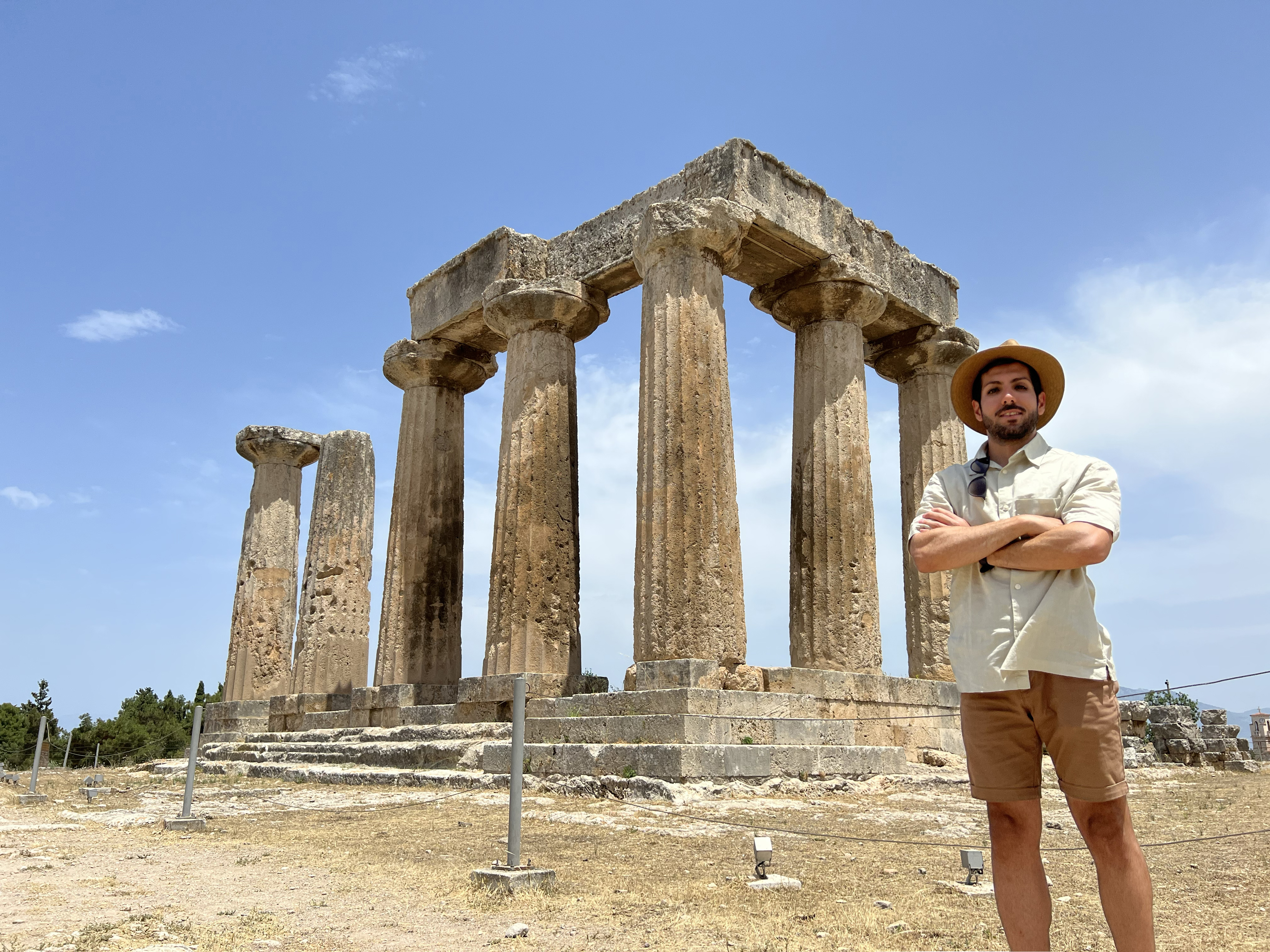
We’re thrilled to introduce Ehsan Behbahani-Nia, recipient of the prestigious 2026 John R. Coleman Traveling Fellowship!
Ehsan Behbahani-Nia (University of Wisconsin-Madison)
Tell us about your project:
My research investigates the movement of Greek stonemasons and workshops across the Mediterranean during the late Archaic and early Classical periods, from the palaces of Achaemenid Persia to mainland Greece and the monumental temples of Magna Graecia. By closely examining construction techniques (tool marks, joint methods, lifting techniques, quarrying practices, etc.), I aim to identify shared technical signatures that may reveal the work of mobile groups of artisans. Through this fellowship, I will conduct in situ field observations in Sicily and southern Italy, documenting the stoneworking techniques of major Archaic and Classical monuments at sites such as Agrigento, Selinunte, Segesta, and Paestum. By comparing this material with my existing documentation from Persia, Lydia, and mainland Greece, the project seeks to illuminate the networks of craftsmen and knowledge that connected the ancient Mediterranean world.
How did you get your start in archaeology?
I originally trained in architecture and design, but my path toward archaeology began while working as a tour guide for a travel agency during the summers. Traveling to historic cities such as Rome and others exposed me directly to ancient monuments and made me realize that I did not want to practice architecture in the conventional sense; instead, I wanted to study ancient architecture and its historical context. Although this decision was not initially supported by my family, I pursued my interest by applying to a master’s program in “Architecture and Archaeology” at the University of Strasbourg in France. It was there that I formally oriented my academic career toward archaeology and the study of ancient architecture.
Where in the world has archaeology brought you (fieldwork, research, conference travel, etc.)?
I began with excavations and architectural studies at small Gallo-Roman sites in France, such as Mandeure. Since then, because of the nature of my research and my interest in cross-cultural interactions in the ancient world, my work has taken me to many sites across the Mediterranean. I have conducted research and fieldwork in Turkey, Greece, France, Italy, Serbia, and Iran. Today, I am a member of the Sardis excavation in Turkey and the Isthmia excavation in Greece, and I also collaborate with the Persepolis and Pasargadae research projects in Iran.
Last year, while based in Athens as a regular member of the American School of Classical Studies, I traveled extensively throughout Greece, and as an associate of the Getty-sponsored Beyond the North Aegean program, I also visited important ancient Greek and Roman sites in Turkey, Romania, and Bulgaria.
In terms of my academic journey, archaeology first brought me from Iran to France for my master’s, then to the USA for my PhD, and to Greece for a study-abroad fellowship at ASCSA. Now, thanks to the John Coleman Fellowship, I will continue my work in Italy next year. Along the way, I’ve presented my research internationally and had the chance to meet colleagues and make friends in every place I’ve visited and worked.
What is one of the most memorable things that has happened to you in the field?
Some of the most memorable experiences I’ve had in the field weren’t about a discovery or a find, but about the people I worked alongside. Sitting with local workmen in Turkey, Greece, or Iran after a long day of digging or recording, and sharing meals, stories, and laughter, gave me a deeper sense of connection to the places I work and study. I believe these moments of genuine exchange made archaeology more pleasant (especially under the 40-degree summer sun in Turkey or Greece!) and more like a shared human experience.
How has the AIA contributed to your success/professional goals?
I think one of the greatest contributions of the AIA is the opportunity to network and connect with other scholars and colleagues, especially at the annual meetings. Last January, I presented my work for the first time at the 2026 AIA/SCS Joint Annual Meeting, and the feedback and encouragement I received were incredible, as was the chance to learn about other scholars’ research. The American Journal of Archaeology is also an invaluable resource that I rely on regularly. And finally, with the traveling fellowship I am receiving, the AIA will play an essential role in supporting the completion of my dissertation.
I am extremely grateful for this opportunity and look forward to learning more about the architecture of Greek colonies in Italy and Sicily. I am also excited to share the observations from this upcoming travel research at future AIA meetings.
Learn more about what Fellowship and Grant opportunities are available through the AIA.