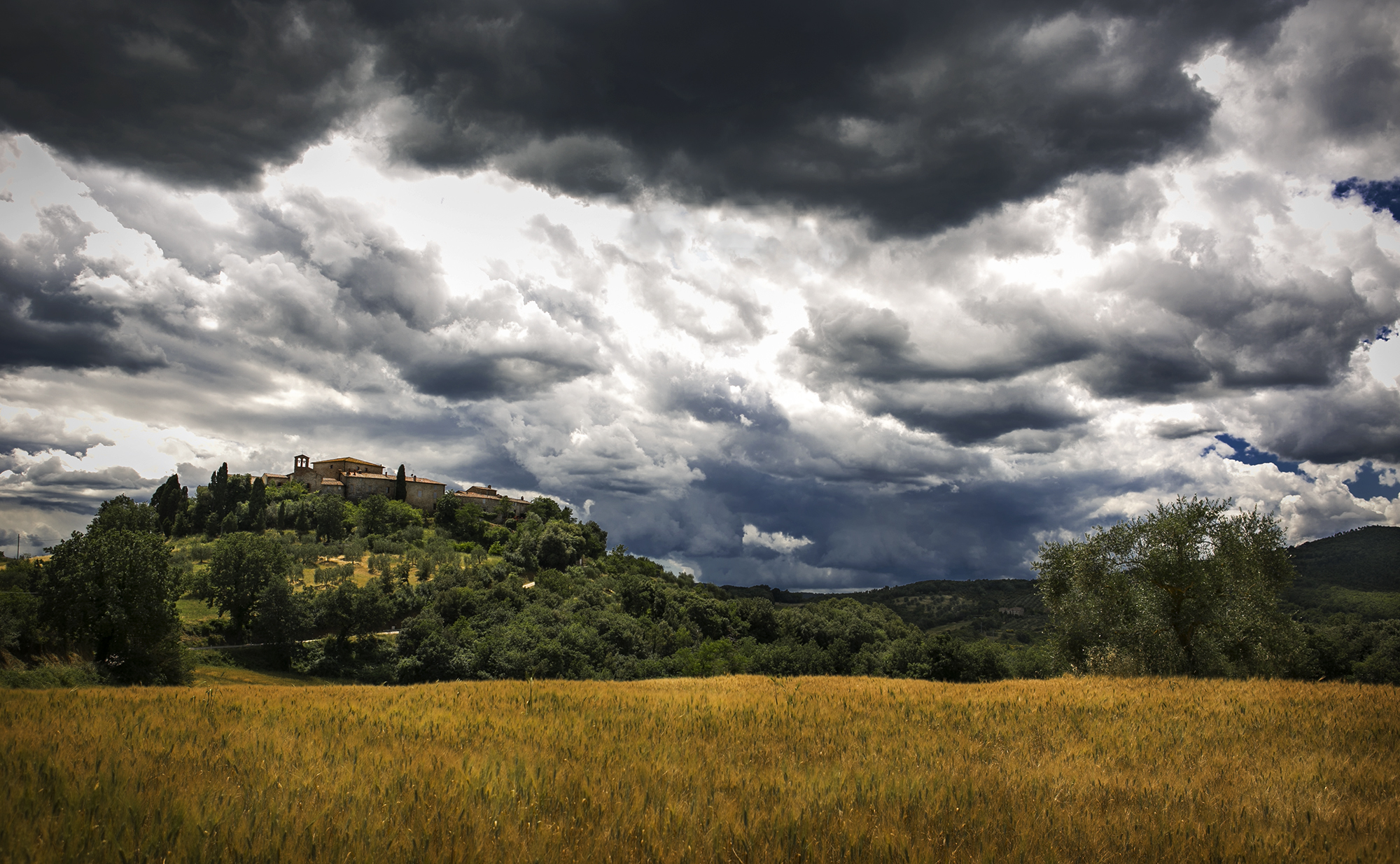
Location: 53016 Murlo, Province of Siena, Italy
Season: June 25, 2026 to August 3, 2026
Application Deadline: May 1, 2026
Deadline Type: Rolling
Website: https://www.poggiocivitate.com/
Program Type:
Field School
RPA Certified:
No
Affiliation:
UMass Amherst
Project Director:
Dr. Anthony Tuck
Project Description:
The 2026 field season marks the 60th year of archaeological exploration at Poggio Civitate (Italian for “Hill of the Civilization”) located in central inland Tuscany. The Poggio Civitate Archaeological Field School is among the oldest and most respected archaeological programs in the world. Our training provides students and archaeology enthusiasts the opportunity to excavate at the site under the direction of a staff of professional archaeologists, conservators, illustrators, and photographers. Participants receive training in all aspects of fieldwork, including excavation and data collection, archaeological survey and drawing, objects conservation, illustration, photography, and cataloguing.
At Poggio Civitate, we believe that the best field experience is comprehensive. Students are encouraged to work directly with directors of excavation units and to follow artifacts from discovery through conservation and into cataloguing. Most of our participants come with no field work experience – many have never even taken an archaeology or classics course –and by the end of the season, we believe, each comes away with a foundation in Etruscan Archaeology and field methods, as well as a rich appreciation for Italy and rural Italian culture.
Work on site or in the laboratory (called the magazzino) will constitute the majority of your “classroom” experience. Participants will work side by side with professional archaeologists, conservators and other members of the excavation team on projects integral to the functioning of the dig as a whole. While the majority of this time will be spent on the hill, working in the trenches, there is a weekly rotation into our magazzino where students will work in conservation, data entry, photography, cataloguing or illustration. These days students will also assist with chores, food prep, and service of breakfast and dinner. As we are in a communal living environment, everyone will be helping with chores around the house, kitchen, and lab daily.
Fieldwork and excavation experiences are supplemented by lectures and a more traditional educational program. Weekly lectures by Professor Tuck or other members of the excavation staff cover a broad range of topics, from a general history of Etruria to the social and political implications of bucchero pottery from Poggio Civitate. Visits to the museum that houses material from our excavation, as well as other regional museums, occur frequently. There is also ample free time, including weekends, for participants to explore the Commune of Murlo, Siena, Tuscany, and further afield in Italy.
The 2026 field season will continue our exploration of the eastern edge of the plateau locally known as Piano del Tesoro – the Plateau of the Treasure. Excavations in this area in 2024 and 2025 revealed traces of a large structure dating to the sixth century, Archaic occupational phase. Based on preliminary excavations, this structure appears to be a well-constructed house, perhaps occupied by a well-to-do family working in service of the aristocratic family that lived in the contemporary Archaic Building This same area also preserves evidence of Poggio Civitate’s destruction in the second half of the sixth century BCE. Deposits associated with the destruction of the site will be a major focus of excavations in 2026.
Period(s) of Occupation: A Brief History of Poggio Civitate The 2026 field season marks the 60th year of archaeological exploration at Poggio Civitate (Italian for “Hill of the Civilization”) located in central inland Tuscany. Excavation began in 1966 under the direction of Dr. Kyle M. Phillips, Jr. of Bryn Mawr College. Work continued under the direction of his student, Dr. Erik Nielsen, and is currently led by Dr. Anthony Tuck of the University of Massachusetts Amherst. The excavations have brought to light a large volume of material from distinct phases of Etruscan occupation. A brief summary of this work is provided below. For further material and articles related to the site, please see the excavation database website – https://opencontext.org/projects/df043419-f23b-41da-7e4d-ee52af22f92f. Early Phase - First Half of the Seventh Century BCE The monumental center of Poggio Civitate is located on the apex of the hill, in an area known as the Piano del Tesoro, or “Plateau of Treasure.” While Poggio Civitate's Piano del Tesoro preserves traces of Iron Age occupation that may extend back into the ninth and eighth centuries BCE, the site emerges as the elite center of a larger, dispersed community at approximately 700 BCE. At this time, a monumental elite home, called Early Phase Orientalizing Complex Building 4 (EPOC4), was constructed on the western edge of the Piano del Tesoro. This rectilinear structure was approximately ten-times larger than contemporary curvilinear huts, indicating that those who lived in this structure were wealthier and more powerful than other members of their community. Unlike contemporary huts, which not only were small, but also built out of ephemeral materials, with thatched roofs, EPOC4 was constructed using more durable materials; specifically, this building was covered with a terracotta tiled roof, the earliest known example of such a structure in peninsular Italy. Finds from within the structure consist of fineware ceramic assemblages, further speaking to the status of its occupants. Traces of an additional structure dating to the first half of the seventh century BCE (Early Phase Orientalizing Complex Building 5, or EPOC5) have been found further to the east, along the southern edge of the Piano del Tesoro. Foundations of this building consist of flat stone pads that likely served as bases for a series of posts or columns that supported the roof of this unwalled, pavilion-style structure. Evidence associated with industrial activities and craft production have been recovered from the vicinity of this building as well, suggesting it may have functioned as an early workshop, producing materials that were utilized and consumed by the elites living to the west, in EPOC4. Around 650 BCE, both EPOC4 and EPOC5 were abandoned and maybe even demolished, with occupants recycling building materials like roofing tiles and rafter beams to construct the three monumental structures of the subsequent Intermediate Phase. Intermediate/Orientalizing Phase – Second Half of the Seventh Century BCE When the two structures of the Early Phase were abandoned, occupants of Poggio Civitate monumentalized the Piano del Tesoro further, marking it as the elite center of a larger community. The first building of this Orientalizing Complex (OC1), a Residence, was uncovered in 1970. Ceramic evidence suggests that OC1 may have been constructed some time in the second quarter of the seventh century BCE; the exact date of construction is debated, and other scholars push the date of construction to the third quarter of the seventh century BCE. This residence likely replaced EPOC4 as the home of Poggio Civitate’s ruling family. This building was elaborately decorated with a sculptural program in terracotta and appears to have served as the residence of a family of regional social prominence. Recovered from the floor of OC1 were cooking equipment, a banquet service of imported Greek and locally produced fine wares, bone, antler and ivory inlays that once decorated furniture, and numerous objects of personal ornament and everyday use. Based on the dating of the Greek pottery recovered from the building, this structure likely was destroyed around the end of the seventh century BCE. In the early 1980s along the southeast flank of Piano del Tesoro, excavations revealed the presence of another building contemporary with OC1, Orientalizing Complex 2 (OC2), that clearly served as the site's primary area of industrial work during the seventh century BCE. This building was constructed just to the south of the earlier industrial structure, EPOC5. Curiously, this building was also elegantly decorated with terracotta sculpture and was substantially larger than the OC1. OC2 was an open-air pavilion, without any walls, and housed numerous types of manufacturing activities, including bronze casting, bone and antler carving, terracotta manufacture, ceramics production, food processing and textile manufacture. This building currently is the earliest known example of such a multifunctional workshop in Central Italy. Despite the number of products this site produced, virtually nothing manufactured at Poggio Civitate has been found at other sites in the region. Excavators now believe that OC2 was intended primarily to support the community of Poggio Civitate itself and perhaps the surrounding hinterland, with virtually all products being locally consumed rather than exported to other sites. From 1996 through 1999, excavation immediately to the south of the Residence revealed the presence of a third building of this complex - a large tripartite structure now referred to as OC3. Although much of the building was destroyed in the subsequent building of the later phase of the site, enough of the floor plan was preserved to allow excavators to reconstruct a building with a large central cella flanked by two chambers precisely half the width of the central room. Both the building's tripartite form and examples of fineware vessels inscribed with dedicatory inscriptions found resting on the floor of the central cella suggest this building may have been an early example of a temple, making it one of the earliest examples of monumental religious architecture in Italy known to date. All three of the buildings of the Orientalizing Complex were destroyed in an accidental fire that appears to have occurred around 600 BCE. On the day the buildings burned down, workers in OC2 were manufacturing roofing tiles and had placed several on the floor to dry in the shade of the roof. In the panic of the unexpected fire, workers fled and stepped on the drying clay and their footprints were fired into the floor. Archaic Phase – Sixth Century BC In the aftermath of the conflagration that destroyed the seventh century complex, the survivors appear to have combed through the destruction to salvage anything of value. Then, the debris was scraped to level and flatten the plateau in preparation for the construction of a massive four-winged building enclosing Piano del Tesoro. Each wing was sixty meters in length and a western defensive work extended that façade an additional thirty meters. Like the buildings of the earlier complex, this structure also was elaborately decorated with terracotta sculpture that sat along the ridge of the roof. In addition, frieze plaques were nailed to exposed wooden beams, a sculpted lateral sima system ornamented the courtyard while gorgon antefixes decorated the building's perimeter. This remarkable building, far larger than any known in the Mediterranean for its time period, has been the subject of considerable debate. Speculation as to its function has led to such theories as a political meeting hall, a religious sanctuary, a palazzo and even an Etruscan version of an agora. Currently, the excavators believe that the building combined the functions of the disparate structures of the earlier phase into a single edifice, dating to the early sixth century BCE. Perhaps the most enigmatic feature of the building involves its final destruction. Based on the latest pottery from the site, some time shortly after the middle of the sixth century BCE, the building was dismantled. The statuary was removed from the roof and smashed, the fragments separated and then buried in pits around the perimeter of the building. The walls were knocked over and the site was never reoccupied. Vescovado and the Later Phases Evidence of occupation around Poggio Civitate has long suggested subsidiary communities were located on surrounding hilltops, such as those of Vescovado di Murlo, Lupompesi, Murlo, Castelnuovo Tancredi and Montepescini. Chamber tombs dating from the fourth to third centuries were found in Vescovado di Murlo in 1960 and a ceramic kiln Hellenistic in date was discovered during road construction in 1970. In 2006, excavators were given permission to further explore the area around the Hellenistic kiln. This work revealed traces of domestic architecture contemporary with the kiln, as well as sporadic evidence of occupation contemporary with the Archaic phase of occupation of Poggio Civitate. This evidence suggests that ancient occupation of the region not only continued after the final destruction of Poggio Civitate, but also that the monumental buildings of the site did not stand in isolation. Rather, they can be considered a nucleus of a broader community, with the elites of Poggio Civitate at the center of a dispersed population clustered around the hill.
Project Size: 50+ participants
Minimum Age: 17+
Experience Required: None Required!
Room and Board Arrangements:
Murlo and Vescovado di Murlo
Excavation takes place on a forested hill in the Commune of Murlo, outside the town of Vescovado di Murlo (pop. 1200). We are located approximately 25 km south of Siena, and 90 km south of Florence. We reside in a villa across the street from the Albergo di Murlo, the local hotel owned by the Rubegni Family. Participants are housed in double, triple or quadruple rooms, each with its own bathroom and shower. We have a large common kitchen and dining room located below the building.
Meals
All meals are provided Monday through Friday, and are prepared by our excavation chef. Participants who are assigned to the magazzino also help with preparation of meals, assisting with breakfast and dinner preparation and cleanup; many have left with a new appreciation for cooking and Italian food. We make every effort to meet the dietary restrictions of participants, and there is always a vegetarian option available. Most also take advantage of the various local restaurants for favorites, such as pici al tartufo (handmade pasta with truffles) and pizza alla diavola (pizza with spicy sausage).
Recreation
As a 60+-member excavation in a town of 1200, we significantly change the dynamics of the community during our stay in Vescovado. Luckily, we are well liked in town, and are invited to the many festivals and events put on in the comune. Traditionally, we are in town for various festivals and concerts, as well as wine tastings in the medieval town of Murlo.
Down time is utilized by participants in many ways - catching up on sleep, practicing Italian with native speakers, or reading a good book from the excavation library. There are also many opportunities available for local travel – walks, bike rides, and hikes – within a short walk from the dig house. There also is a pool at the hotel, across the street from our dig house, that can be used for a nominal fee.
Travel
The weekends are free for excavation members to do as they desire. Excavation members frequently have used the time off on weekends to explore Tuscany, as well as locations further afield such as Rome, Pompeii, Venice, and Naples. Buses run from Vescovado to Siena, where you can catch trains or buses to anywhere in Italy.
Academic Credit:
6 Credit Hours, UMass Amherst