December 4, 2025


Congratulations to all the individuals, projects, and publications honored with AIA Awards! These outstanding contributors to our field will be formally celebrated at the 2026 AIA Awards Ceremony during the 127th Annual Meeting. We’ve reached out to this year’s winners to learn more about the discoveries that drove their projects, the experiences that shaped their journeys, and the inspirations that sparked their passion for archaeology. Stay tuned as we share their stories!
Caitie Barrett (Cornell University)
Award: James R. Wiseman Book Award
What drew you to archaeology?
I’m interested in archaeology because I’m interested in people. When we explore the enormous variety of ways that people have organized their societies, in different times and different places, we may be less likely to assume that our own way of life is the best or only option. And I find household archaeology – the study of everyday, domestic life – an especially powerful tool for rewriting the stories we tell about the past. Traditional histories are often dominated by the lives and perspectives of the wealthy and powerful. Studying households and daily life helps us to broaden that picture, putting the focus on everyday people across the social and economic spectrum. Whether we’re digging through the ruins of someone’s house or examining family archives to reconstruct the history of a family’s marriages, divorces, and disputes with their in-laws, the traces of ancient daily life have extraordinary power to impact our imaginations and engage our empathy for people in the past.
Tell us about your history with the AIA:
I have been an AIA member since 2004, when I was just starting out as a graduate student! Going to AIA annual meetings was a big part of my education in grad school – I really appreciated the opportunity to learn from this amazing annual snapshot of current research in the field, and some of my own first conference papers were delivered at AIA annual meetings. Since then, AIA has continued to be central to my work and research. This particular book project was supported by an AIA Publication Subvention Grant, and the conference that gave rise to the book received support from the AIA Finger Lakes Chapter. I regularly deliver papers at the AIA annual meetings, and I’ve been an AIA National Lecture Program speaker twice, in 2017–18 and 2022–23. I’ve been a member of the AIA Finger Lakes Society ever since I came to Ithaca in 2011, and I served as the secretary in 2017-2018. I’m also a long-term member of a number of AIA interest groups: the Coroplastic Studies Interest Group (for which I was Chair from 2014–2018), the Ancient Painting Studies Interest Group, and the AIA-CfAS (Coalition for Archaeological Synthesis) Working Group. More recently, I’ve joined the Managing Committee for the American School of Classical Studies at Athens, which holds events at the annual AIA meetings. I’m very grateful for all the support that AIA provides, both for my work and for archaeological research more generally!
What’s next for you professionally?
I’m currently co-directing a field project at Pompeii: the Casa della Regina Carolina Project (https://blogs.cornell.edu/crcpompeii), which excavates a large house and garden at Pompeii. We recently held our fifth excavation season and are preparing to go back into the field this summer. I’m also finishing a new book on the archaeology of ancient Greek household religion. Those two projects take me to different parts of the ancient world – Italy and Greece, rather than Egypt – but they come from the same starting point as this book: studying everyday people and everyday experiences in domestic settings.
How did you get started with your project/publication?
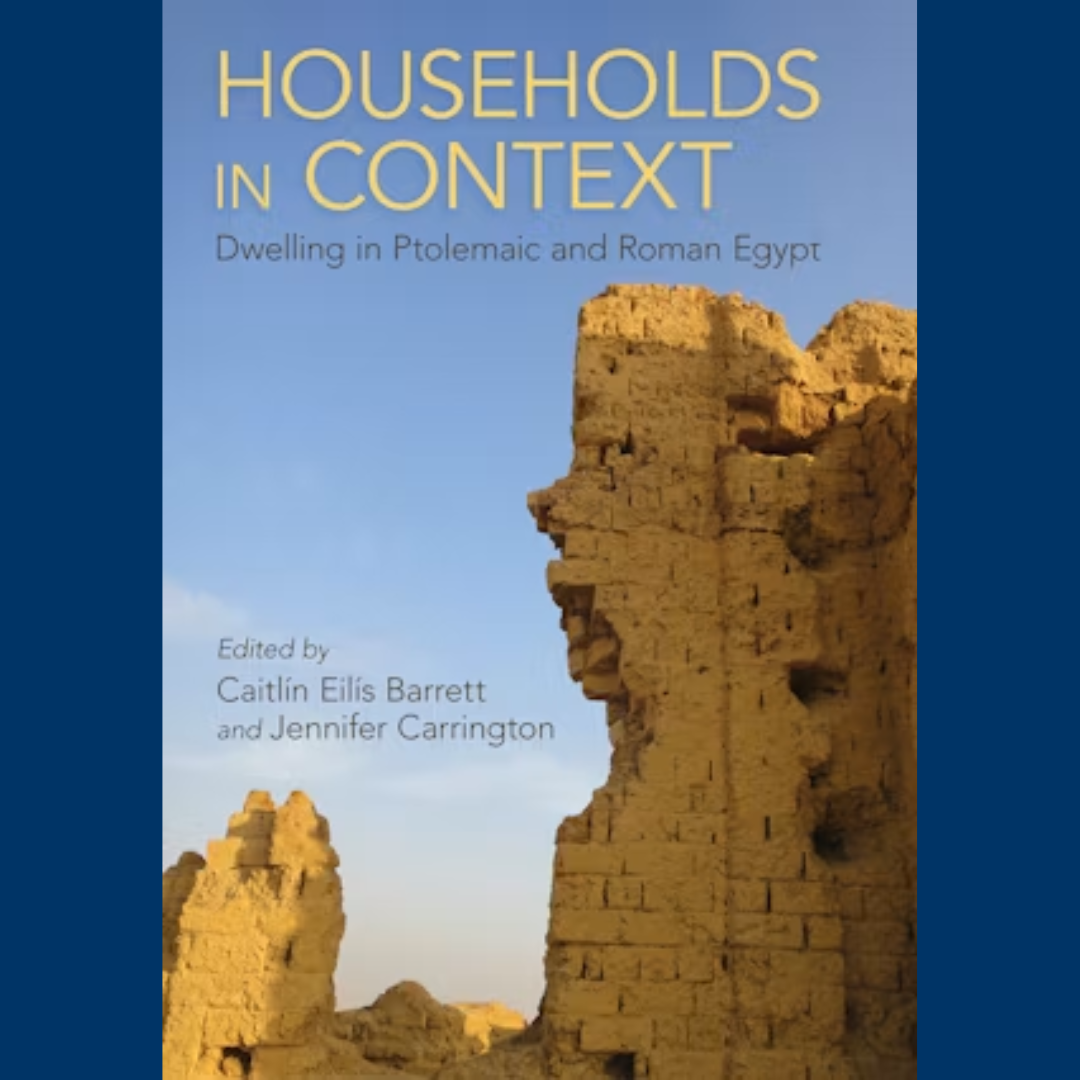
Originally, this book was born from the fact that my co-editor and I wished that a book like this existed, so that we could use it in our own research and teaching! Before we started this project, there was no single book-length study of houses or households in Ptolemaic and Roman Egypt. So we wanted to address a gap in scholarship – both concerning ancient houses and families, and also concerning Egypt’s relationship to the Greco-Roman world. For almost 1000 years, Egypt was subjected to first Greco-Macedonian, then Roman, rule. The Ptolemaic and Roman periods were a fascinating and turbulent time for Egypt, whose diverse population included not only people who identified as Egyptians and Greeks (and often both simultaneously), but also substantial numbers of people of Nubian, Levantine, and many other backgrounds. So Ptolemaic and Roman Egypt is an important case study for the study of cultural entanglement, empire, globalization, and the ways that people negotiated power relations and identities in antiquity. But much less has been known about how these dynamics played out in the everyday world of people’s domestic lives.
So in 2018, Jenny Carrington and I co-organized a conference at Cornell and invited a range of colleagues working on different aspects of household studies in Ptolemaic and Roman Egypt. That conference led directly to this book project. Jenny and I are honored that so many brilliant colleagues have been kind enough to share their work with us and to contribute to this project, and we’re very excited to be able to bring their work to the world!
Jennifer Carrington
Award: James R. Wiseman Book Award
What drew you to archaeology?
An interest in how people over time have changed and exchanged the objects they use in daily life.
How did you get started with your project/publication?
The volume began as a conference in 2018 that brought together scholars of material culture, art, architecture, social history, and documentary texts of Ptolemaic and Roman Egypt, to explore how comparing and combining approaches could lend new light to the study of houses, households, and everyday domestic living.
Questions? Learn more about AIA Awards here or reach out to awards@archaeological.org