This listing expired on April 30, 2026. Please contact Kelton.Meyer@uwyo.edu for any updated information.
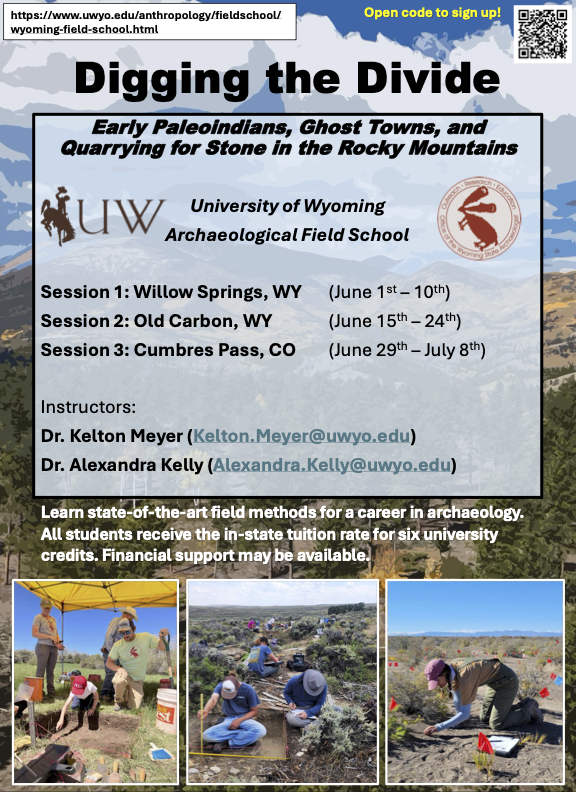
Location: Wyoming, USA
Season: June 1, 2026 to July 8, 2026
Deadline Type: Rolling
Website: https://www.uwyo.edu/anthropology/fieldschool/wyoming-field-school.html
Program Type:
Field School
RPA Certified:
No
Affiliation:
University of Wyoming
Project Director:
Kelton Meyer, Alexandra Kelly
Project Description:
The University of Wyoming Archaeology Field school provides professional training in field research methods. Students will learn techniques applicable to career paths in academic research as well as public lands and cultural resource management. We provide instruction on fine-grained sampling and exploratory strategies including block excavation, test excavation, shovel probing, augers, soil coring, and a wide range of pedestrian survey techniques. During this process students will learn how to identify different examples of material culture – including chipped stone tools and lithic debris, pottery, ground stone, faunal remains, and historic artifacts. Additionally, students will become familiar with using advanced geospatial technologies in fieldwork, including total stations, sub-meter GPS units, drones, and handheld photogrammetry.
All students receive the in-state university tuition rate for 6 credits. This year’s field program will be in the following locations:
Willow Springs, WY (Session 1: June 1st – 10th)
Willow Springs is a densely occupied multi-component campsite spanning 12,000 years of Wyoming prehistory. The 2026 investigations will focus on excavating a block over a newly discovered Paleoindian component buried around a meter deep. Students will learn how to excavate, take notes, plot artifacts with survey equipment, identify artifacts, stabilize fragile faunal remains, and other skills necessary to conduct data intensive archaeological block excavation. This effort is being conducted in collaboration with Office of the Wyoming State Archaeologist. Students will stay at the University dorms during this session.
Old Carbon, WY (Session 2: June 15th – 24th)
Old Carbon was one of the first coal mining towns established along the UPRR in Wyoming in 1868. Research questions center on tracing capitalist expansion, global processes of migration and consumption, settler colonialism and frontier ethnogenesis. The 2026 session will focus on a previously unexcavated neighborhood and students will learn skills related to test excavation around structures and historical artifact identification. Students will be camping remotely for this session.
Cumbres Pass, CO (Session 3: June 29th – July 8th)
Cumbres Pass is a high-altitude landscape on the Continental Divide (10,000 ft asl) at the Colorado-New Mexico border. Native American hunter-gatherers used the pass as a migratory route over the San Juan Mountains for nearly 12,000 years. We will be exploring evidence of ancient lithic quarrying practices and stone tool production on Cumbres Pass, with research questions focusing on forager mobility patterns and toolkit gearing-up strategies. Students will learn to apply fine-grained systematic surveys as well as reconnaissance surveys to detect lithic workshops in a high-density lithic landscape. Students will also learn how to formally record new sites using SHPO guidelines and how to assess site eligibility according to the NRHP criteria of significance. Students will be camping remotely for this session.
Period(s) of Occupation: PaleoIndian to Historic
Project Size: 1-24 participants
Experience Required: none
Room and Board Arrangements:
Students stay in UW dorms for first session (costs included), field camp for second two sessions
Academic Credit:
6 credits
Kelton Meyer
Dept. 3431, 1000 E. Univ. Ave
Laramie
WY
82071