January 15, 2026
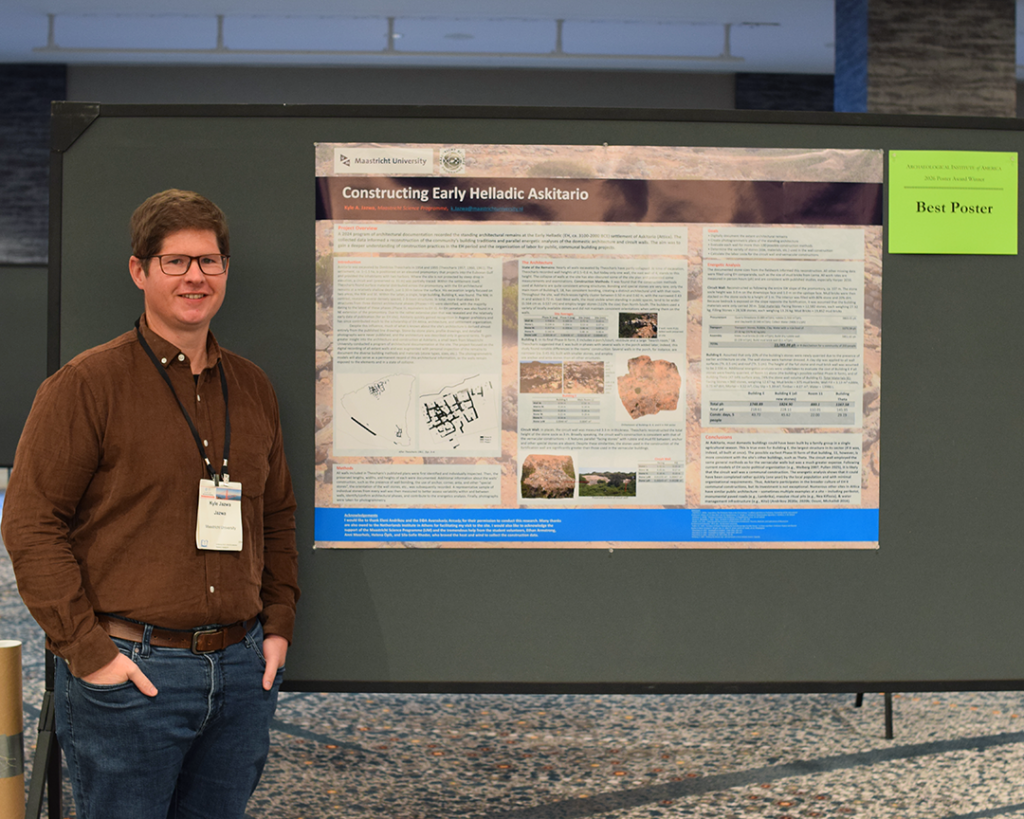
At the 2026 AIA Annual Meeting in San Francisco, attendees explored a dynamic range of posters showcasing research from around the world. Presented in a visual format, the poster session highlighted the breadth and diversity of work being done across the field.
Three Poster Awards were presented during the Poster Award Sessions: the Best Poster Award, First Runner-Up, and the Student Poster Award.
Best Poster Award Recipient: Kyle A. Jazwa, Maastricht University

“Constructing Early Helladic Askitario”
This poster presents the results of a program of architectural documentation at the Early Helladic (EH) site of Askitario in northeastern Attica. Askitario was first excavated three-quarters of a century ago by D. Theocharis and, since then, has figured prominently in most discussions of EH architecture and settlement organization. Focus has largely been on the site’s coastal setting, fortification walls, layout, and buildings’ ground plans. Despite Askitario’s role in the period’s archaeology, the architecture remains only preliminarily published with line drawings complemented by very brief descriptions. Therefore, this project aimed to systematically record each building, wall, and room at the site and create three-dimensional models of the architecture using photogrammetry. With the former, particular focus was dedicated to documenting information about wall dimensions, stone sizes and placement, and the various building techniques (e.g., wall bonding/abutting, use of “anchoring stones,” placing larger stones in lower courses) employed in the construction. We found that there was considerable consistency in the construction methods employed within each phase at the site, despite differences in building size, shape, and placement on the promontory. This consistency contrasts with the results of a complementary energetics analysis that demonstrates more diversity among structures. Whereas some structures would have required minimal effort for construction by a small nuclear family, others show a greater investment with an increase in the size of the building and its constituent parts and the employment of special building features such as ceramic roofing tiles. Despite all residents drawing from a common building tradition, therefore, some chose to incorporate specialist and extrafamilial laborers to mark social differences with their domestic architecture.
How long have you been a member of the AIA?
I have consistently been an AIA member since I began my graduate studies, ca. 2008. However, I am fairly confident that I also joined for a few years when I was in high school and attended lectures organized by the Philadelphia chapter.
How many Annual Meetings have you attended (in-person or virtually)?
Previously, I attended almost annually, but, since moving to the Netherlands, I try to attend every other second year. In total, I have been to about 11 meetings.
How did you first come to this project/topic?
I was studying the Early Bronze Age roofing tiles from several sites in Attica (including Askitario) and decided to expand my study slightly to include the broader architectural contexts of the early tile-roofed buildings. Because there is no published stone-by-stone plan of the EH architecture, I applied for a permit to study the standing remains to gain a better understanding about the building construction. I plan to extend this study to other EH sites in Attica.
What is one cool fact or interesting result from this project that didn’t make it onto the final poster?
We made some nice 360-degree videos of the site that (for obvious reasons) did not make it onto the poster.
What is your advice to students/new authors who are preparing posters for upcoming conferences?
Finish working on the data analysis and text early – it takes more time than you would think to design the poster well and to make everything fit in the limited space!