Location: Septemvri, Bulgaria
Season: August 29, 2026 to September 19, 2026
Session Dates: Aug 29 - Sep 19, 2026
Application Deadline: July 30, 2026
Deadline Type: Rolling
Website: https://www.bhfieldschool.org/program/roman-excavations-bona-mansio
Discount for AIA members: 5% off of regular admission
RPA Certified:
No
Affiliation:
Balkan Heritage Foundation; Septemvri Archaeological Museum "Prof. Mieczyslaw Domaradzki", Bona Mansio Excavation Team from the National Archaeological Institute with Museum, Bulgarian Academy of Sciences, Pazardzhik Regional Museum of History and New Bulgarian University (Bulgaria).
Project Director:
Alexander Manev (PhD Candidate in Archaeology, Department of Classical Archaeology, National Institute of Archaeology and Museum, Bulgarian Academy of Sciences)
Project Description:
Via Diagonalis (Via Militaris) became the most important road through the Balkan Peninsula in Roman times. It connected Singidunum (modern Belgrade, Serbia) on the Danube River with Byzantium (Istanbul, Turkey)—the city that would later become the capital of the Eastern Roman Empire. The road stretches approximately 1,000 km (600 miles) and passes through major Roman cities including Naissus, Serdica, Philippopolis, and Hadrianopolis. It served as the fundamental link between the western and eastern parts of the Empire and was the official route for armies moving throughout the provinces.
Mansio Lissae, later renamed Bona Mansio (Latin for “Good Station”), is one of the few archaeologically researched Roman road stations on Via Diagonalis. The site’s original name derives from the Thracian settlement of Lissa, whose exact location remains unknown. The road station sits in the Thracian Valley, between the Roman cities of Serdica (modern Sofia) and Philippopolis (modern Plovdiv). In the fourth century, it became a fortified structure—one of many built to safeguard the main road. The station takes the form of an irregular quadrangle surrounded by thick walls with corner towers. The ruins of the fortification are still visible high above ground.
Initial archaeological exploration of the site began in 2002 through test soundings conducted during a collaborative Bulgarian-French expedition investigating the region’s ancient heritage. These preliminary excavations uncovered a cultural deposit exceeding 3 meters in depth and exposed fortification walls surviving to heights of 4 meters. While the roadside complex encompasses a considerable area, excavation efforts since 2016 have focused on the fortified settlement that served as the administrative and residential center during the 4th-6th centuries CE. Continued investigations are progressively clarifying the site’s chronological development and cultural significance.
Although no modern construction threatens the Roman cultural legacy, the site is considered endangered. Over recent decades, it has become a training ground for treasure hunters drawn to Roman archaeological valuables. The threat of further destruction, combined with scientific interest, set this project in motion. Through the first archaeological campaigns in 2016–2019, BHF aimed to draw the attention of the local community and surrounding municipalities to prioritize this endangered site for cultural heritage protection.
Period(s) of Occupation: Roman; Late antiquity
Notes:
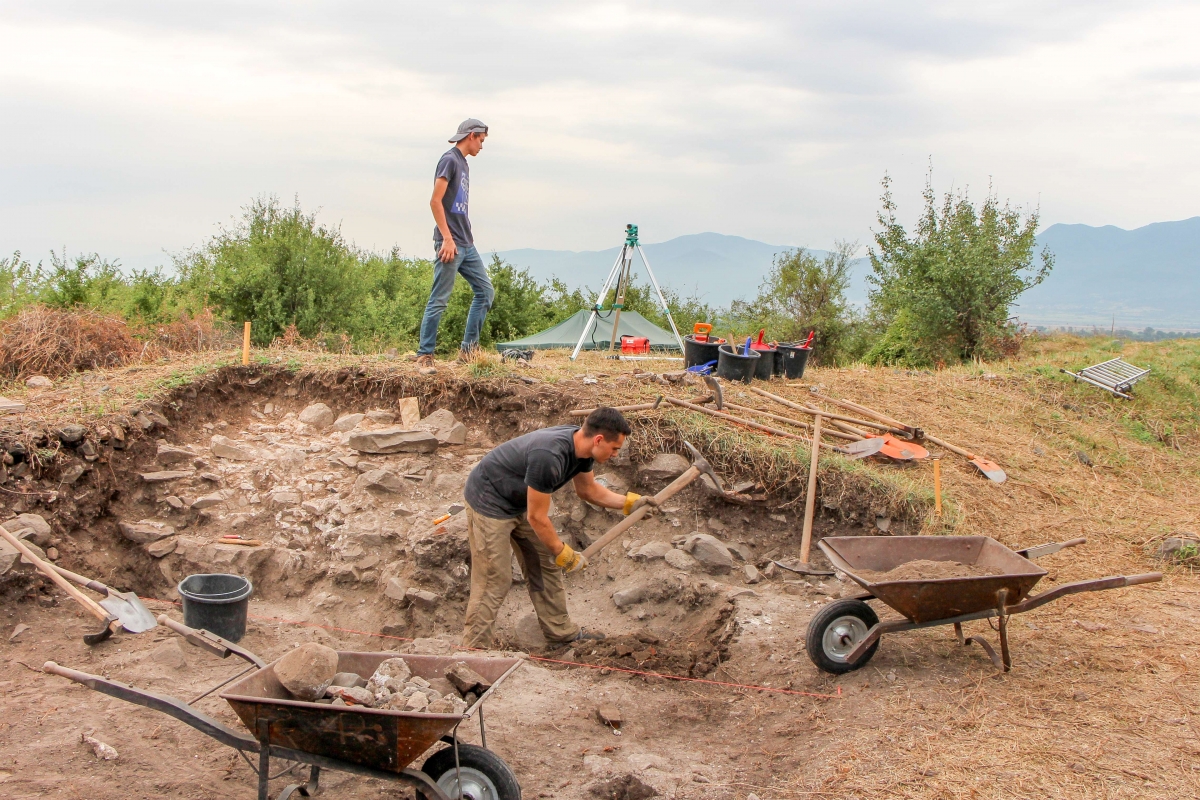
The practical goal of the 2026 campaign is to continue excavating in front of the fortress's main gate and to uncover the fortification wall. The long-term objective is to create a strategy for preserving the settlement's architectural elements. The scientific aspect aims to gather information about the site's character and chronological development, contributing to the study of the Roman road system in Thrace. In accordance with these objectives, the project's starting campaign is set with the following tasks: Create a master plan of the existing fortification structures; Conduct excavations within and outside the fortification wall; Map the excavated area on the master plan; Process and document all collected material from the excavations; Develop a general stratigraphy for the site.
Project Size: 1-24 participants
Minimum Length of Stay for Volunteers: 3 weeks
Minimum Age: 18 (16, if the participant is accompanied by an adult family member)
Experience Required: No previous experience is required.
Room and Board Arrangements:
Accommodation*: Villa Velis, Karabunar, Bulgaria- in comfortable rooms with two, three to four beds (bathrooms with shower and WC), with A/C and TV in a local newly built hotel. The hotel has a small swimming pool and SPA, free of charge for the participants in the field school. There are cheap laundry services and free Wi-Fi is provided. Extra night - 80 EUR (per night per person), Single room - 800 EUR (for four weeks).
*Subject to change. May be substituted with similar level accommodation.
Meals: Three meals (fresh, organic Bulgarian homemade food) per day are covered by the reimbursement payment and usually take place in the hotel’s restaurant. Requests for vegetarian food are accepted. Brown-bag lunches are provided during the excursions.
Participants must pay on their own for extra days and for single room accommodation as well as for extra meals, beverages, services and products!
Academic Credit:
New Bulgarian University grants 9 ECTS credits for attending the three-week session. Transcripts of Records (ToR) are available upon request for an additional tuition fee.
Balkan Heritage Foundation
7 Tulovo, 4th Floor, Apt 6
Sofia
1504
Bulgaria