April 22, 2026
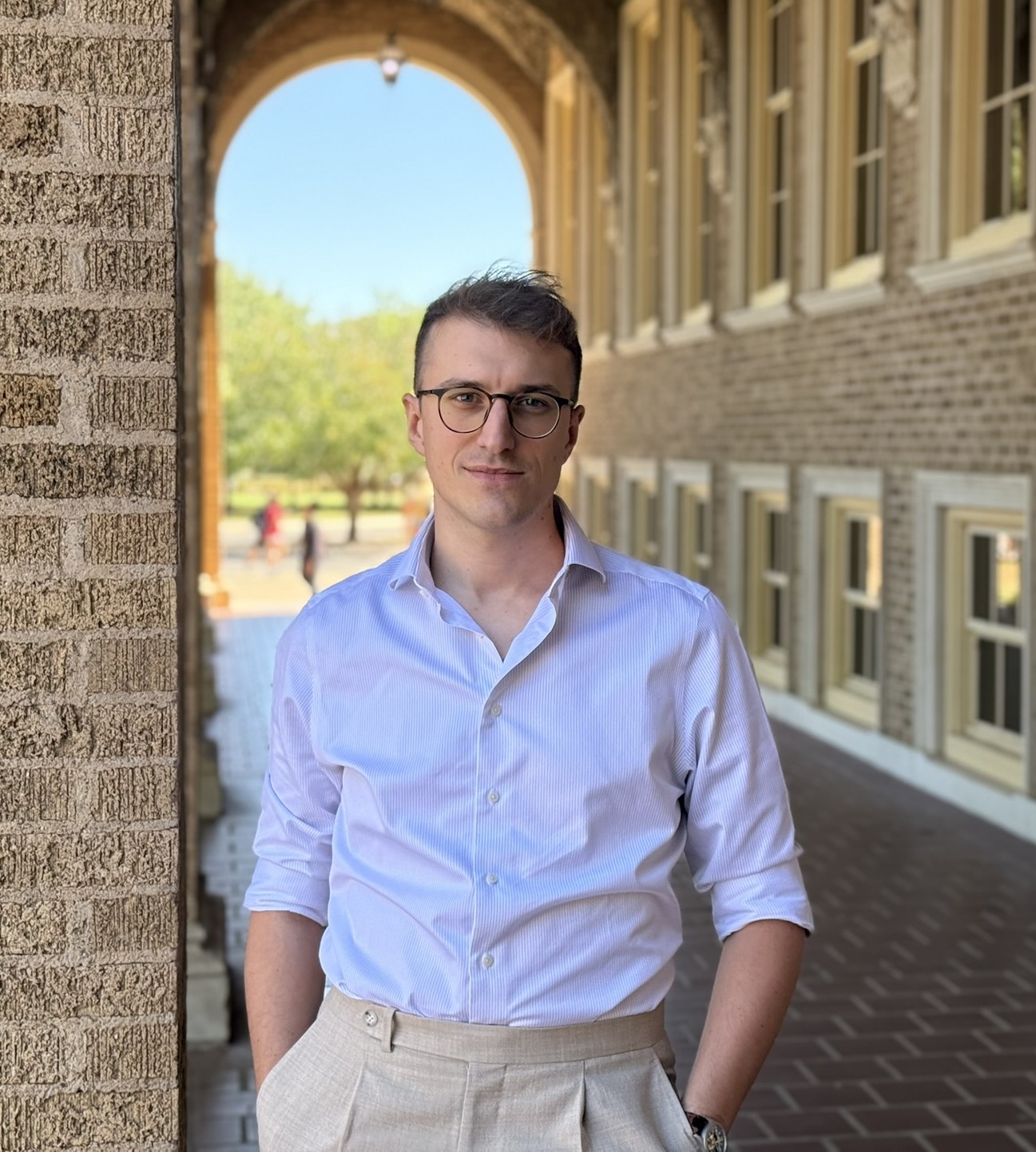
To celebrate our 2026 Research Grant recipients, we connected with this year’s awardees to learn more about their projects and the unique paths that led them into the field of archaeology.
We’re thrilled to introduce Giacomo Fontana, one of three recipients of the prestigious 2026 Ellen and Charles Steinmetz Endowment for Archaeology Grant!
Giacomo Fontana (Texas Tech University)
Tell us about your project:
Today the majority of the world’s population lives in cities, and much of how we understand urban organization traces back to models rooted in Graeco-Roman urbanism. In the central Italian Apennines, this framework has shaped the interpretation of Monte Pallano, one of the largest hillforts of the ancient Samnites, long cited as a key site for pre-Roman urbanism. But my research across the Samnite landscape has been challenging this narrative. Fieldwork at multiple hillforts shows that most of these sites lack evidence of permanent settlement and instead appear to have functioned as pastoral enclosures. New LiDAR data from Monte Pallano suggest the same pattern. Most of the 50-hectare enclosed area appears empty, with only a small zone showing traces of organized occupation, and that dates to after the Roman conquest. Thanks to the support of the AIA Ellen and Charles Steinmetz Endowment for Archaeology, this project will be the first to systematically investigate the entire site, using remote sensing, geophysics, survey, OSL dating, and ceramic provenance analysis to test whether Monte Pallano was really a town, or something very different from what we’ve assumed.
How did you get your start in archaeology?
Almost by chance. In Italy, my high school was preparing me to become a land surveyor and then a civil engineer, but I was always very interested in the past. During my last year, I decided to try joining an archaeological project. I reached out to several university teams across Italy and beyond — even as far as Cahokia! Understandably, I didn’t have much success, as these were all research projects rather than field schools, with one exception. A University of Bologna project working at the medieval castle of Rontana had a student leave after a few days due to the spartan living conditions — conditions that I later realized are actually very standard for archaeological fieldwork. So they called me, and the day after I was there. It was there that I discovered how much of what I had learned as a land surveyor — GIS, spatial analysis, topographic mapping — was actually very useful in archaeology, and it’s what is at the base of my career today.
Where in the world has archaeology brought you (fieldwork, research, conference travel, etc.)?
My research interests revolve around non-urban and nomadic societies — alternative ways of organizing communities that don’t conform to urban systems, especially in environments often considered marginal, such as deserts and mountains. Combined with my focus on computational methods, this has allowed me to work across very different landscapes and contexts. After a few dozen excavations and surveys across Italy, Spain, and Greece, I spent several years in the Arabian Peninsula — first in rescue excavations in the Sultanate of Oman, then in research there and in Saudi Arabia focused on nomadic societies. For my PhD I went back to Italy, but this time looking at mountainous areas and asking the same questions about non-urban forms of organization — which is where this new project at Monte Pallano comes from. Alongside all of this, I’ve been involved in digital cultural heritage work in South Africa, and with my latest appointment, also in Texas. The farthest I’ve been? Probably New Zealand a few years ago for the CAA conference — and I’d love to work there one day too!
What is one of the most memorable things that has happened to you in the field?
Some of my fondest memories are from the Omani coast at Ras al Hadd, waking up early to work on surveying sites as the sunrise slowly warmed the air and everything came back to life. I was still an undergraduate then, and it was my first trip outside Europe, so there was something magical about the whole experience. But the best part of it, as with so many of the experiences I’ve been lucky enough to have, was finding true friends, both among the archaeological team and among the locals. That’s probably one of the real reasons I love archaeology: bonding with colleagues over hard work, and getting to know people from completely different parts of the world over months of fieldwork, people you would never have met as a tourist.
How has the AIA contributed to your success/professional goals?
Having developed my career in Europe, this is the first time I’ve really become involved with the AIA, beyond a talk I gave for the AIA Lubbock chapter and an annual meeting I attended. Despite this, I’ve been struck by the organization’s commitment to supporting fieldwork-based research at all career levels. I have several students for whom AIA fieldwork grants could be transformative, the kind of opportunity that opens doors early in a career. For me personally, this grant is instrumental in continuing a research program I began during my PhD and bringing it to a new stage from my position at Texas Tech, where I’m building new international collaborations around landscape archaeology. I’m very eager to become more involved with the AIA community going forward, as it’s exactly the kind of organization that bridges the gap between American and international archaeological research, and I’d love to contribute to that.
Learn more about what Fellowship and Grant opportunities are available through the AIA.