April 16, 2026
To celebrate our 2026 Fellowship recipients, we connected with this year’s awardees to learn more about their projects and the unique paths that led them into the field of archaeology.
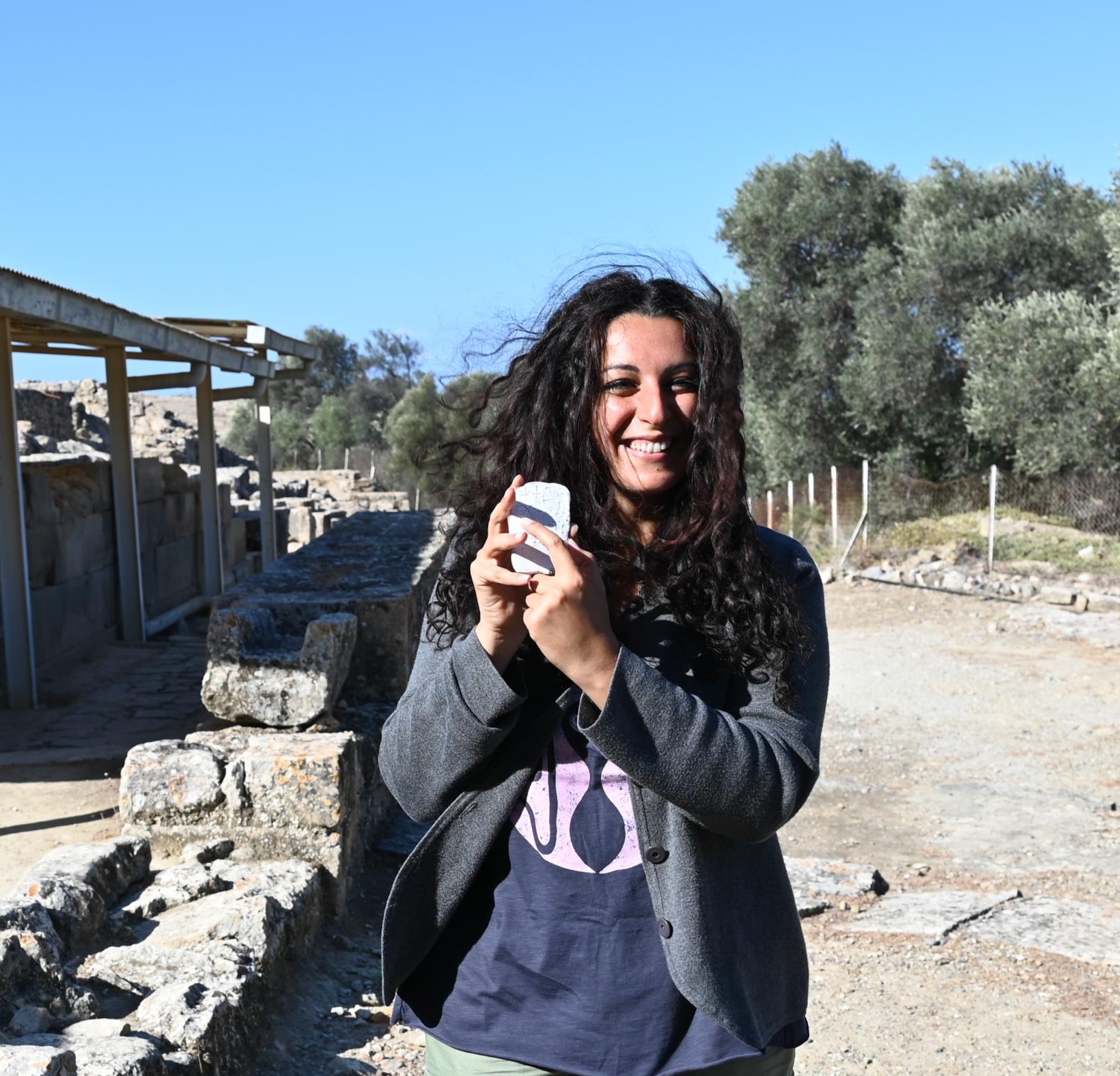
We’re thrilled to introduce Giulia Paglione, one of the two recipients of the prestigious 2026 Harriet and Leon Pomerance Fellowship!
Giulia Paglione (University of Cincinnati)
Tell us about your project:
My project applies a multidisciplinary approach to the study of the Linear B tablets from the heart of the Palace of Knossos: the West Central Insula. These administrative documents, written in the earliest attested form of ancient Greek, provide key information on perfumed oil production and religion, recording offerings to both Greek gods and Minoan deities. However, the chronological and administrative relationships between these deposits remain unclear, hindering our understanding of religious continuity and bureaucratic practices after the introduction of a new regime at Knossos (ca. 1450 BCE). My project, supported by the AIA fellowship, reexamines the tablets’ taphonomy and chronology, administrative practices, and shifts in Cretan religion through archaeological and textual analysis, RTI imaging, and clay studies.
How did you get your start in archaeology?
Despite growing up in Rome, I had always been fascinated by Greek mythology and felt drawn to Greece since childhood. My passion ignited when I visited Crete for the first time at age 13. Experiencing the landscape in person, with its breathtaking beauty and the warmth of the people I encountered, was really transformative. I found the Minoan sites and artifacts (and their mysterious scripts) completely captivating… I bought a Phaistos Disc necklace that I wore for years as a talisman. I still have it!
I actually began my academic path as a philologist specializing in Mycenaean Greek. But the Linear B tablets left me with more questions than answers, and I realized that to better understand the Bronze Age world behind these documents, I needed to engage with material culture as well. This realization eventually led me to archaeological fieldwork and to pursue a PhD in Aegean Prehistory at the University of Cincinnati. Since then, integrating philology and archaeology has become central to my research on the Bronze Age.
Where in the world has archaeology brought you (fieldwork, research, conference travel, etc.)?
One of the greatest benefits of being an archaeologist is the opportunity to travel widely, live and work in different places, and meet new friends along the way. My first excavation was at a small prehistoric site in southern Italy, where I will never forget my first find: a tiny burnt barley seed that felt like a treasure!
Since then, fieldwork has taken me primarily to the Greek mainland and Crete, where I worked at Pylos, Chania, and Knossos. My studies brought me to the United States, where I am completing my PhD at the University of Cincinnati. For the past two years, I have been based in Athens as a fellow of the American School of Classical Studies, which has allowed me to travel extensively to archaeological sites and museums throughout Greece. Conference travel has also taken me to cities across the United States (New Orleans, Chicago, and San Francisco) as well as to several cities in Europe, including Paris and Heidelberg.
What is one of the most memorable things that has happened to you in the field?
One of the most memorable moments was finding a Linear B tablet at the Mycenaean palace of Kydonia (Chania, Crete). Discoveries like this are extremely rare, and very few Linear B scholars have the opportunity to experience one firsthand. After years of studying these documents only through photographs, I was suddenly holding one in my hands. My director and team were hugging and jumping with excitement!
What is equally meaningful to me is the friendships formed in the field. One special example is my coworker Litsas at the Palace of Nestor excavations in Pylos. He really taught me everything I know about digging. Additionally, we share a love of music and poetry: I would teach him poems in Ancient Greek by Sappho and others, and he would show me songs he had written in Modern Greek. We are still great friends and exchange songs!
How has the AIA contributed to your success/professional goals?
Over the years, being an AIA member has contributed significantly to my professional development and scholarly network. The AIA Annual Meetings have been particularly valuable for my growth as an early-career scholar, providing opportunities to present my work, receive feedback and insights from established scholars and peers, and engage in conversations that enrich my dissertation and ongoing projects. These conferences have allowed me to build and strengthen professional relationships that continue to support my academic career.
In the coming months, the AIA Pomerance Fellowship will provide crucial support for my research in Crete, where I will analyze the Linear B tablets at the Heraklion Museum, and in the UK, where I will inspect original excavation notebooks, sketches, and photographs from the early Knossos excavations held at the Ashmolean Museum.
Thank you again for supporting my research. I look forward to sharing the results of my research at future annual meetings!
Learn more about what Fellowship and Grant opportunities are available through the AIA.