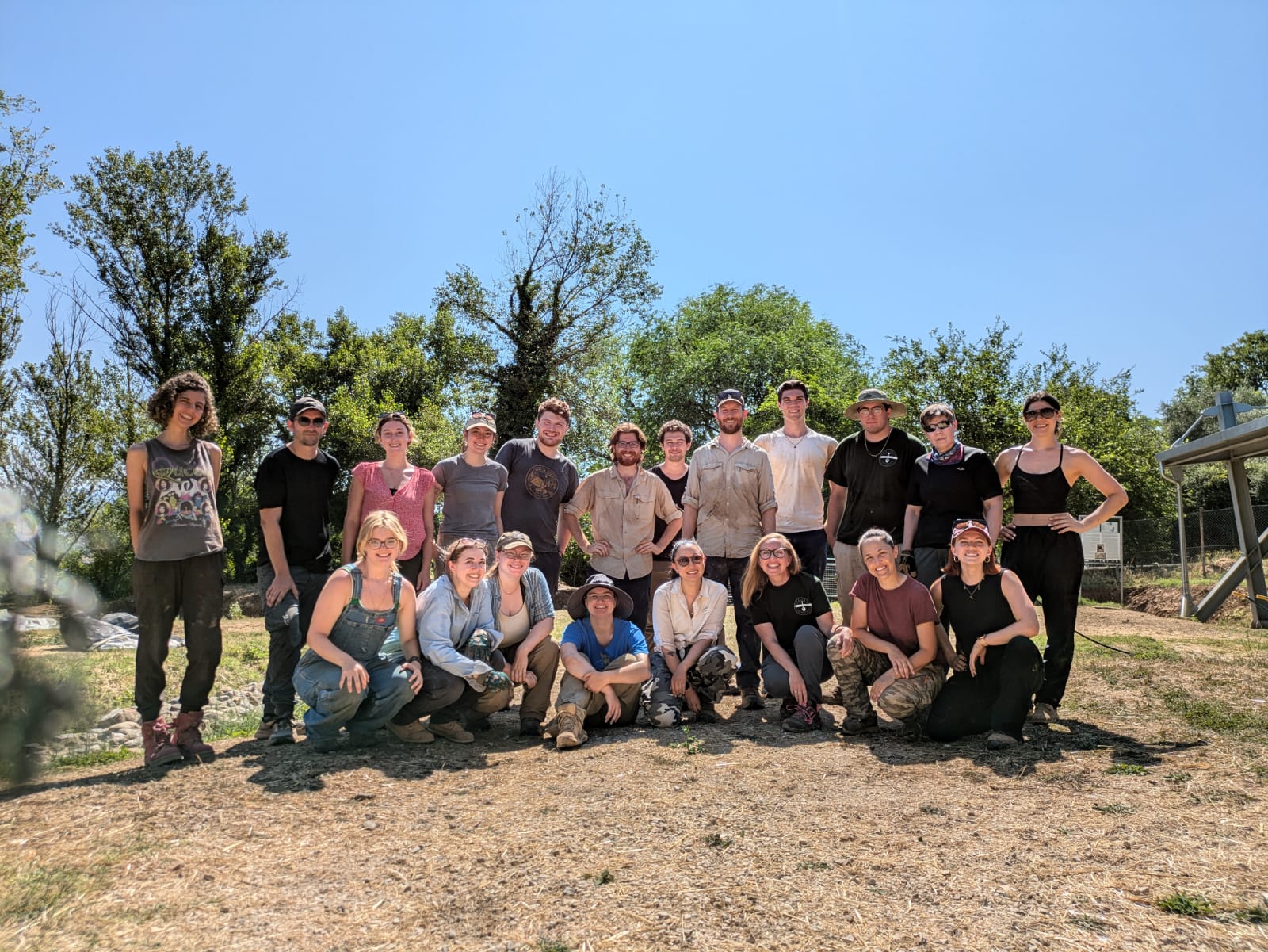
Location: Scavi etrusco-romani di Coriglia, Castel Viscardo, Province of Terni, Italy
Season: May 25, 2026 to June 23, 2026
Application Deadline: March 1, 2026
Deadline Type: Rolling
Website: https://corigliaproject.org/
Program Type:
Field School, Volunteer
RPA Certified:
No
Affiliation:
Kansas City Art Institute
Project Director:
Amanda K. Chen
Project Description:
The Coriglia Excavation Project is an international collaborative project between the Kansas City Art Institute, the Soprintendenza Archeologia Belle Arti e Paesaggio dell’Umbria, and the Parco Archeologico e Ambientale dell’Orvietano. The project investigates the site of Coriglia, an Etrusco-Roman settlement located approximately eight miles from Orvieto, Italy. Volunteers will have the opportunity to gain experience in diverse aspects of archaeology by participating not only in field excavations, but also in the cleaning, identification, and documentation of recovered artifacts.
Since 2006, excavations at Coriglia have uncovered a complex assemblage of monumental structures that resulted from the persistent habitation of the site from as at least the 7th century BCE through the 14th century CE. The major occupation of Coriglia began with an Etruscan phase and reached its peak during the Roman Imperial period. The site occupies a large hillside that is defined by a series of L-shaped terrace walls. The oldest of the two terrace walls is Etruscan, while the more recent retaining wall dates to the Late Republic. A road, water supply pipes, and canals lie to the east of the terrae walls, all of which were repeatedly reworked over centuries. A bath complex occupies the northwestern sector of the upper terrace. While more work is necessary to fully understand the extent and orientation of this complex, its presence suggests a long history of water management on the site. A second bath complex is located on the lower terrace that was reworked several times and has at least three phases from the early Imperial period through at least the 4th century CE. There is also a partially intact subterranean barrel-vaulted storage space in nearby that served the structures above and around it. Evidence found inside this vault and elsewhere on site speak to several catastrophic landslides or earthquakes, yet the inhabitants rebuilt and continued to occupy these areas for centuries. Work in 2025 yielded the discovery of an Etruscan-era kiln situated under Roman era walls and roads. Thus far, the combustion chamber, portions of the firing surface, and parts of the surrounding work surface have been uncovered, but the full nature of the kiln is not yet clear.
The summer 2026 season will continue efforts excavating and studying the Etruscan-era kiln, Roman roads, and water management structures. Additional features may be explored, including further explorations of the barrel-vaulted structure, and new areas to the south and west of the current excavations. Participants will have the opportunity to work in all open areas, in addition to assisting in the lab.
Our staff of American and Italian archaeologists supervise the excavations, offer lectures, and help lead visits to other nearby sites. We are also happy to offer opportunities for graduate students to develop thesis projects or papers, as well as present at venues including the Archaeological Institute of America’s Annual meeting. Project participants will be required to attend regular evening lectures and various short visits to other nearby sites and museums.
Period(s) of Occupation: Etruscan; Roman Republican; Roman Imperial; Late Antique; Medieval
Notes:
Our weekly schedule consists of work in the field or lab Monday through Friday. We leave for the site at 7:30 am on weekdays and work from 8:00 am-5:00 pm. A one-hour lunch break from 12:00 to 1:00 pm takes place at a facility near the site, and lunch is provided. After we return from the field, all participants eat dinner together at 7:00 pm in the convent. Attendance at dinners and lectures are required on weekdays. We are happy to accommodate dietary requests with advanced notice.
Weekends are free for participants to travel, relax, or explore the city. Orvieto's central location allows for easy access to most points of interest in Italy— Rome and Florence can both be reached in two hours by train.
Project Size: 1-24 participants
Minimum Length of Stay for Volunteers: 3 weeks
Minimum Age: 18
Experience Required: No previous experience is required.
Room and Board Arrangements:
Participants will stay at the Convent of San Lorenzo in Vineis, a 15th century monastery located across a small valley from Orvieto. The convent is a 30-minute walk or 5-minute bus ride from Orvieto. The residence has bathrooms, showers, washing machines, and drying racks. The excavations will end on June 23th. Please note that the night of June 24th will be the last night that participants for our project may stay at the convent.