This listing expired on June 7, 2025. Please contact kerosfieldschool@gmail.com for any updated information.
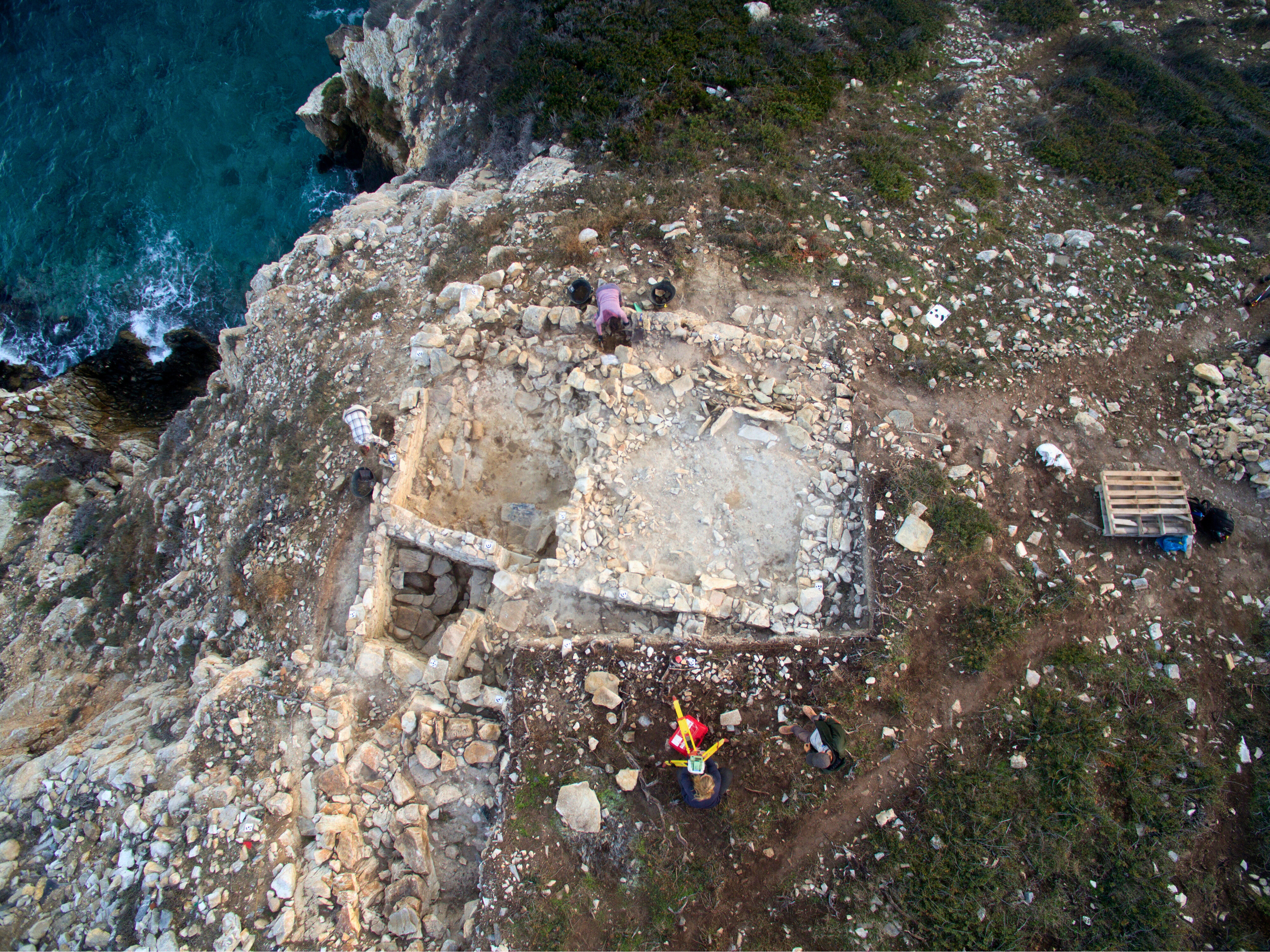
Location: Keros, Cyclades, Greece
Season: April 27, 2026 to May 16, 2026
Application Deadline: January 15, 2026
Deadline Type: Rolling
Website: https://www.cyi.ac.cy/index.php/keros-home.html
Program Type:
Field School
RPA Certified:
No
Affiliation:
The Cyprus Institute and The British School at Athens
Project Director:
Michael Boyd, Evi Margaritis, Demetres Athanasoulis
Project Description:
Keros overview
Keros and the adjacent islet of Dhaskalio comprise the largest settlement and earliest maritime sanctuary of the Early Bronze Age (2800-2200 BC) in the Cyclades, Greece. Looting in the 1950s and excavations in the 1960s revealed unprecedented amounts of broken Early Cycladic marble figurines and other prestige items. Only in very recent years have we begun to understand the nature of this completely unique site.
In 2006-2008, excavations led by Prof Colin Renfrew of the University of Cambridge, defined the nature of the sanctuary and settlement, which feature large and imposing buildings. In 2012-2013, the Keros Island Survey helped us understand the occupation of the rest of the island of Keros and the 2015 survey on the nearby island of Naxos the nature of the wider maritime networks within which Keros was situated. Meanwhile, excavations on Dhaskalio in 2016-2018 revealed extensive monumental walling, an entrance stairway into the site, and extensive metal working.
The terraced construction architectural features on Dhaskalio would have required a controlled master plan, involving the coordination of a substantial workforce operating under some form of authority, at least some skilled labourers and the need for organizational oversight. The sophisticated construction techniques and engineering expertise were matched by the metallurgical knowhow. Renfrew first defined the importance of metalworking for understanding what he termed ‘the emergence of civilisation’ in the Aegean in the third millennium BCE. On Keros two different smelting processes have been identified including imported ore and smelting on site, making Keros the only known smelting site in the Cyclades located at a significant distance from ore sources. Keros was also the location of production of obsidian blades, linking the production of obsidian and metal as resources imported mainly from the western Cyclades. The evidence for metallurgy and obsidian working on Kavos Promontory further emphasised the highly connected nature of the site and its dependence on external resources for its principal functions.
Ongoing work (2025-2029)
In 2025, we began a new, five-year programme of research, which continues into 2026. We use the latest micro-archaeological excavation techniques and all-digital recording, including dGPS, digital recording on tablets, lidar and digital photogrammetry. We aim to understand how all the different parts of the island were utilised in the early bronze age and develop our understanding of the overall structure, function and date of the site.
Keros Field School
Field school participants work with experienced excavators and receive training in the entire excavation procedure including stratigraphic excavation techniques, site recording and survey techniques. The work at the site is combined with activities in the field laboratory. Participants have the chance to work with the many specialists involved in the project to learn about post excavation processing techniques and the different scientific approaches used in a state-of-the-art excavation.
Field school students will be receiving training and assisting with the many aspects of archaeological fieldwork including flotation, sieving, photogrammetry on the field, georeferencing, micromorphology, photographic documentation of finds, soil chemistry.
In addition to on-site training, the field school will organise a series of seminars where visiting experts present their work, giving students unique insights into current research and archaeological practice, the Aegean Bronze Age, and the special place of Keros in the Aegean Early Bronze Age.
Keros on the media
The site can act as a time capsule and an island laboratory for the inception of urbanization in Europe. Due to its importance the project has been the focus of two documentaries (one in the National TV of Greece and one produced by the National Geographic) and various media.
Visit the Keros Field School website for more information and how to apply.
Period(s) of Occupation: Keros is the largest settlement and earliest maritime sanctuary of the Early Bronze Age (2800-2200 BC) in the Cyclades, Greece.
Notes:
Please note that for this year we have a two-stage application submission:
First round: In the first round, we will reviewing applications submitted by 15 January 2026. We will be notifying applicants by the end of January 2026. Successful applicants will have the opportunity to benefit from the early bird tuition fee by transferring a non-refundable deposit by 15 February 2026.
Second round: We will be accepting applications from 16 January 2025 on a rolling basis if places are still available and until spots are filled.
Feel free to get in touch with any questions at KerosFieldSchool@gmail.com.
Project Size: 50+ participants
Minimum Length of Stay for Volunteers: 3 weeks
Minimum Age: 18
Experience Required: The field school is suitable for both beginner and advanced students in archaeology, as well as those interested in Early Bronze Age and Aegean archaeology. The field school is geared towards providing a comprehensive training in field techniques to those new to excavation or in need to enhance their skills to students enrolled in an archaeology degree. If you have some previous field experience there is plenty of interesting archaeology for you to develop and consolidate your skills. The extensive use of digital recording systems will mean that you will have the opportunity to learn and apply cutting edge techniques.
Room and Board Arrangements:
All participants will be staying in rented, en suite accommodation at the project base on the nearby island of Koufonisi.
Academic Credit:
Credit (ECTS - European Credit Transfer and Accumulation System) will be offered by the Graduate School of the Cyprus Institute on the basis of attendance and relevant assignments. Participants can opt to receive 5 ECTS for attending 3 weeks at an additional cost of €300.
Candidates will submit an excavation field journal consisting of a written record of participants’ work and skills acquisition a few days before the completion of the field school, which be will reviewed and graded. The journal will be a daily account of practical training received and skills attained together with a reflective commentary on personal progress and suggestions for further development.
Disclaimer: Training programs offered by The Cyprus Institute, if applicable, will indicate their equivalence in ECTS credits in their description. Participants will be provided with a Certificate of Completion if they satisfy attendance and evaluation requirements. It is the participant’s responsibility, prior to registering for the programme, to verify whether the institution in their home country (or in Cyprus) and the respective national degree accrediting authority will recognize the ECTS earned during the training programme and whether they will be credited toward their degree programme requirements.
Vana Orfanou
CyI Athalassa Campus, 20 Constantinou Kavafi Street
Nicosia
2121
Cyprus