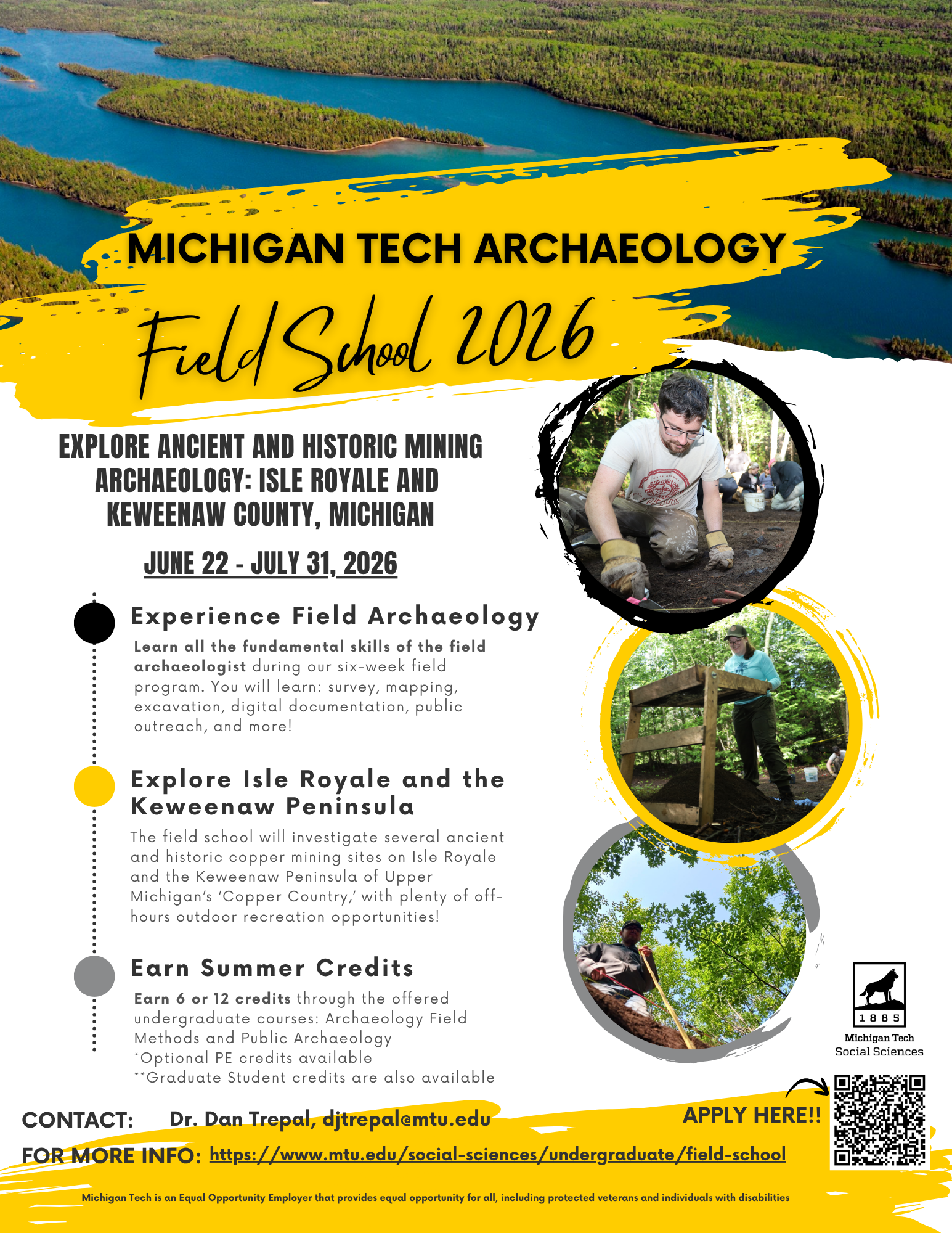
Location: Isle Royale National Park, MI, USA
Season: June 22, 2026 to July 31, 2026
Session Dates: 6/22/26-7/31/26
Application Deadline: March 31, 2026
Deadline Type: Contact for Details
Website: https://www.mtu.edu/social-sciences/undergraduate/field-school/
Program Type:
Field School
RPA Certified:
No
Affiliation:
Michigan Technological University
Project Director:
Dan Trepal
Project Description:
Become part of our immersive, hands-on introduction to the practice of archaeology in the field! We will explore the archaeology of both ancient and historical copper mining in the Lake Superior basin, a region with a deep history of human occupation and use of copper, the first metal to be exploited by humans. Students will learn the fundamentals of archaeological site survey, documentation, remote sensing techniques, excavation, testing, and field lab analysis while working in a backcountry setting. Our partnerships with Isle Royale National Park and heritage sites on the Keweenaw Peninsula will also provide you with opportunities to share your discoveries with the public!
Period(s) of Occupation: Archaic Period, Woodland Period, Historical Period (c. 1840s-1910s)
Notes:
Archaeology on the Keweenaw: Historical Copper Mining
We will begin our program with investigations at the historic Quincy Mining Company. Nicknamed Old Reliable, this copper mine proved to be one of the most successful in the region and was active between 1864 and 1945. We will undertake several investigations at the Quincy Mine site and adjacent properties. As this is a popular heritage tourism site, we will have plenty of opportunities to share our work here with the public.
Michigan’s Keweenaw Peninsula contains the world’s largest know deposit of elementally pure or ‘native’ copper. A globally significant mining district during the latter 19th and early 20th centuries, the Keweenaw Peninsula, a beautiful, rugged peninsula jutting into Lake Superior. This historic mining landscape, often referred to as the Copper Country has since become a popular outdoor and heritage tourism destination.
Ancient & Historic Copper Mining Technology on Isle Royale
We will then travel aboard the Ranger III to Isle Royale to join NPS archaeologists for the majority of our 6-week program in investigating the island’s ancient copper mining landscape. We will also visit sites pertaining to historical 19th century mining activities and fisheries to gain a more complete picture of the human history of this special and nationally significant place.
Geologically related to the Keweenaw Peninsula, Michigan’s Isle Royale emerges from Lake Superior some 60 miles northwest of the Keweenaw. For thousands of years, indigenous people made the hazardous trip by canoe during the summer from the north shore (near modern day Thunder Bay, Ontario) to visit the island. Aside from subsistence activities, these ancient visitors also mined for copper, from which they fashioned tools and ornaments. After the arrival of Europeans, Isle Royale also hosted several historical copper mining ventures, family-run fisheries, and resorts prior to the island being designated a national park and wilderness.
Project Size: 1-24 participants
Minimum Length of Stay for Volunteers: 6 Weeks (full program)
Minimum Age: 18
Experience Required: No prior archaeological experience required. The majority of this field school will involve backcountry camping and fieldwork on Isle Royale National Park. While we will have a pre-departure meeting provide information on how to prepare, applicants should be comfortable with extended outdoor camping and work.
Room and Board Arrangements:
Dormitory-style lodging will be provided on the Keweenaw Peninsula during the beginning and closing weeks of the program. Campsites and a cooking facility will be provided on Isle Royale; students will provide their own personal camping gear.
All meals will be provided (communal cooking) during work days at our Keweenaw-based dormitory (not weekends). All meals (communal cooking) will be provided on Isle Royale.
Academic Credit:
Undergraduate students may choose from a 6 credit option (with two optional 0.5 credit PE courses available) or a full time 12 credit option.
Graduate credits are also available; visit the program website and contact the program director (Dan Trepal) for details.