Location: Pazardzhik, BG
Season: July 4, 2026 to August 1, 2026
Session Dates: Session 1: 04 - 18 July, 2026 Session 2: 18 July - 01 August, 2026 Session 3: 04 July - 01 August, 2026
Application Deadline: June 4, 2026
Deadline Type: Rolling
Website: https://www.bhfieldschool.org/program/first-civilization-in-europe-tell-yunatsite-excavations
Discount for AIA members: 5% discount off the regular admission fee
Program Type:
Field School
RPA Certified:
No
Affiliation:
Balkan Heritage Foundation;
Tell Yunatsite Excavation Team from the National Institute of Archaeology and Museum;
Bulgarian Academy of Sciences;
Pazardzhik Regional Museum of History;
New Bulgarian University (Bulgaria);
Project Director:
Dig director: Associate Prof. Kamen Boyadzhiev (PhD in Archaeology), National Archaeological Institute with Museum, Bulgarian Academy of Sciences
Project Description:
During the 7th and 6th millennia BCE, the Balkan Peninsula was a gateway through which farming, animal husbandry and Neolithization spread from Anatolia and the Near East to Europe. This new population gradually settled down and became familiar with the surrounding region, suitable agricultural areas, raw materials, etc. In the 6th millennium BCE, their economy, social organization, trade and cultural contacts evolved and reached their peak in the 5th millennium BCE. At the beginning of the 5th millennium BCE, the earliest metallurgy in European and global prehistory (the processing of copper and, soon after, gold) appeared in the Balkans. Thus, this period is known as the Copper Age, Chalcolithic, Eneolithic, or Final Neolithic.
The continuous habitation of the same suitable places during these millennia led to the formation of a settlement phenomenon, characteristic of Near Eastern and Balkan prehistory – the multilayered tell-sites.
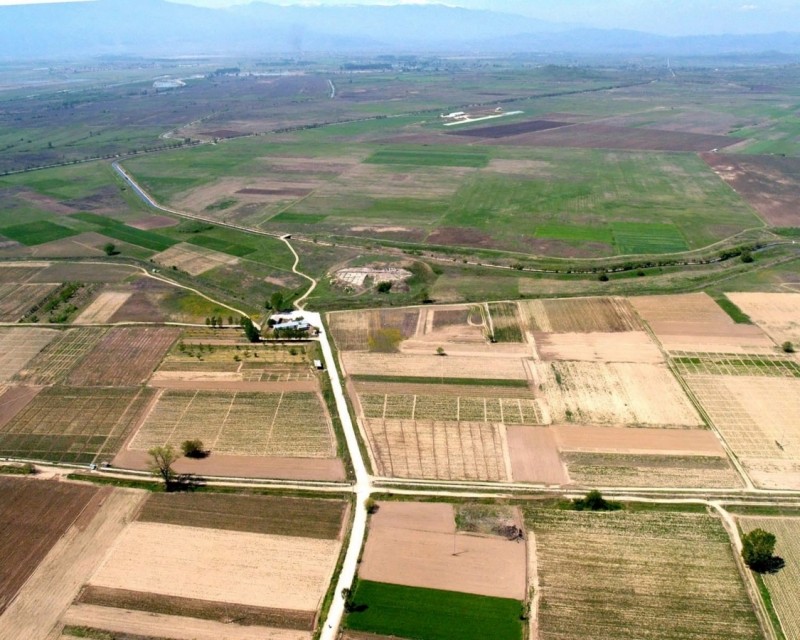
Tell Yunatsite is located near the modern village of Yunatsite in Southern Bulgaria. It is among the largest tells in Europe, with a diameter of approximately 110 m / 360 ft and a height of 12 m / 39 ft above the modern surface. Tell Yunatsite was first excavated in 1939 by the Bulgarian archaeologist Vasil Mikov. In 1976, regular excavations were restarted and have continued to the present day. The current field school will be held for the twelfth year in 2026, and it is a cooperation between the Balkan Heritage Foundation (BHF), the Regional Museum of History in Pazardzhik, the Tell Yunatsite Excavation Team from the National Archaeological Institute with Museum at the Bulgarian Academy of Sciences and the Center for Field Sciences.
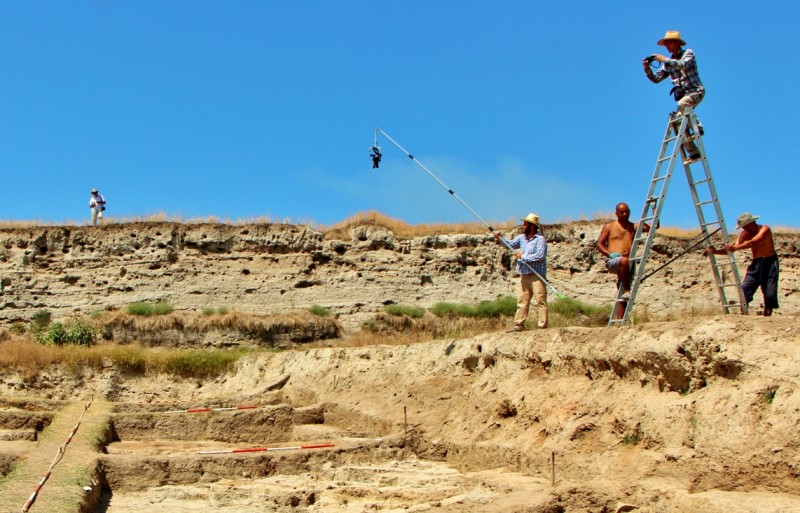
To date, approximately one-third of the tell has been excavated, which has yielded a rich collection of archaeological materials. There is a medieval cemetery at the top of the tell, followed by a Roman period level, two Iron Age levels, a thick layer consisting of 17 levels dated to the Early Bronze Age, and finally a Chalcolithic layer with at least 6 levels attested so far. It is unknown if the cultural history of the tell begins in the Chalcolithic/Final Neolithic period or whether older Neolithic occupation layers exist.
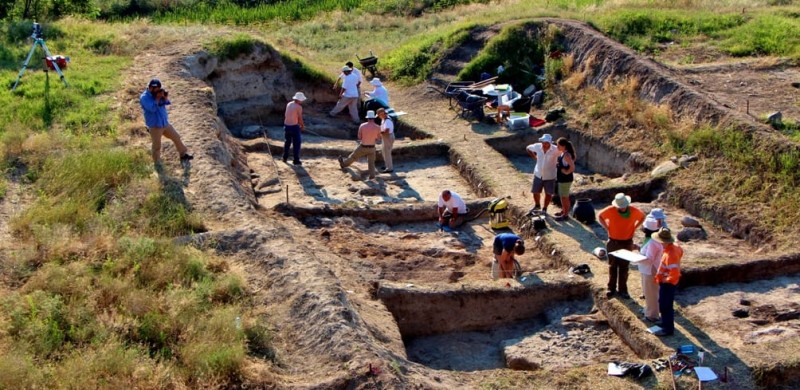
The archaeological field school takes place at Tell Yunatsite’s lowest excavated layer, which corresponds to the time of Europe’s first prehistoric civilization in the 5th millennium BCE. The intensive study of these very first complex societies in Europe began 40 years ago with the excavation of the Chalcolithic necropolis in Varna on the Bulgarian Black Sea coast. It is during this time that metal processing became widespread, and it is also the earliest date for this transformative technological innovation. Data suggests that it is the world’s earliest mass production of both copper and gold (the world’s oldest gold treasure was found in the Chalcolithic necropolis in Varna).
Recent excavations at Tell Yunatsite indicate that the Chalcolithic/Final Neolithic period settlement covered an area far larger than the tell itself and consisted of an upper town (acropolis?) and a downtown district. The uptown section was surrounded by a five-meter-wide clay wall and a broad and deep ditch. Buildings in this part were placed close to each other, creating an almost unbroken urban fabric. The Chalcolithic/Final Neolithic settlement experienced a violent event ca. 4,200-4,100 BCE. There is evidence of a massive massacre and deliberate destruction by outsiders, as many skeletons of children, elderly men, and women were found scattered on building floors. Those who survived returned and resettled at the tell, but soon even they left. At that point, Tell Yunatsite and the area around it were abandoned for more than 1,000 years.
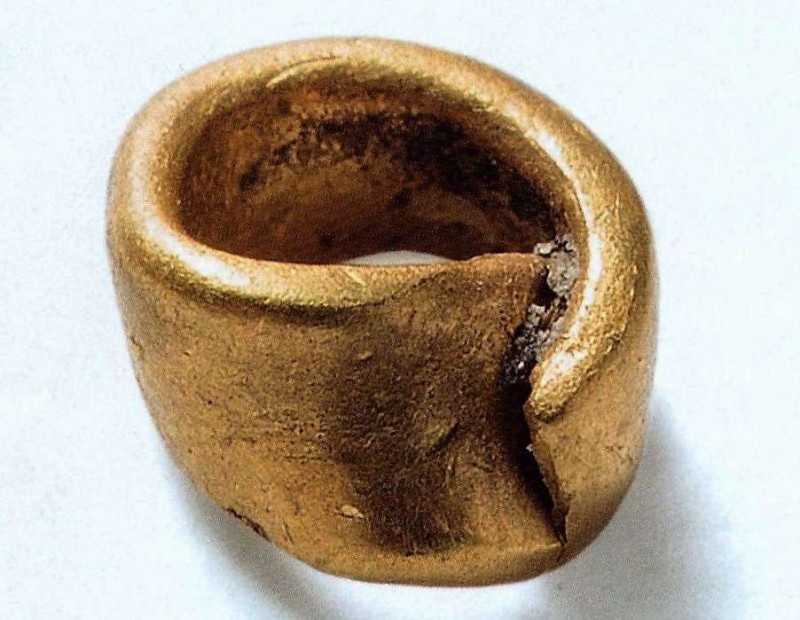
Excavations in the last years have shed new light on the stratigraphy and development of the Chalcolithic/Final Neolithic and brought new interesting discoveries, such as architecture techniques, subsistence practices (including large amounts of charred grains and even fruits), trade connections, and various crafts. Among the most spectacular finds are a golden bead, predating the Varna I cemetery, and a couple of golden amulets, which are among the earliest golden artifacts in the world.
Period(s) of Occupation: Final Neolithic / Chalcolithic, Early Bronze Age
Notes:
The project aims to provide participants with a theoretical background on the development of Neolithic cultures in Southeastern Europe, with a focus on the Final Neolithic/Chalcolithic periods, and with practical experience in excavating a complex prehistoric tell-site.
This field school provides a unique glimpse into the rise and fall of arguably the earliest European civilization. In 2026, field school students will participate in further excavation of the buildings from the burned Final Neolithic/Chalcolithic layer. Faculty and students will work together and explore why and how one of the earliest proto-urban centers in Europe emerged at the beginning of the 5th millennium BCE, and what the reasons were that caused its collapse 800 years later.
There are two field school sessions available (one four-week session and one two-week session). Each of them covers the following three modules:
- Lectures and instructions on prehistoric and field archaeology, finds processing and documentation with an emphasis on the Neolithic and Chalcolithic periods
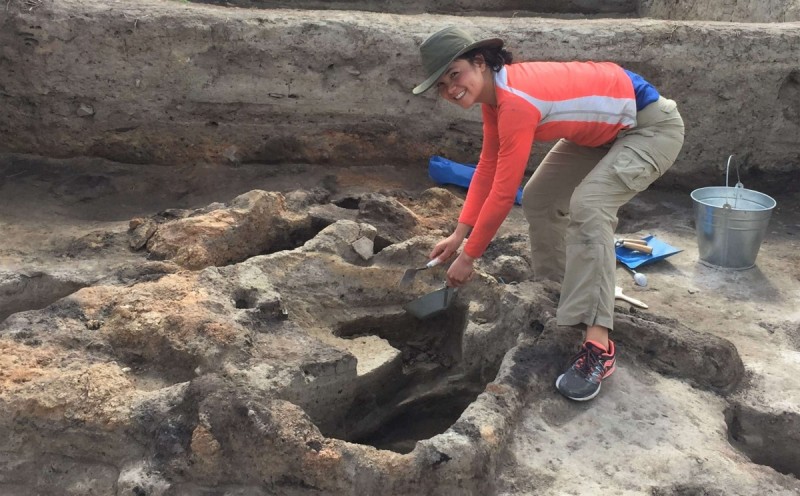
- Fieldwork and workshops, including excavation of the Final Neolithic/Chalcolithic layers and structures, which features practicing basic excavation techniques as well as screening, sifting and flotation; the development of archaeological field documentation by maintaining a field journal daily, filling context sheets and labels, drawing a ground plan/cross-section, 3D positioning of finds, taking coordinates, as well as taking photographs at the site;
- Excursions to the Pazardzhik Regional Museum of History; the ancient town of Philippopolis - present day Plovdiv, including the Archaeological Museum, Old Town Quarter and major Roman monuments; and Stara Zagora, including the Regional Museum of History, Roman monuments and the Museum of Europe's best-preserved Neolithic dwellings (5600 BCE).
Project Size: 1-24 participants
Minimum Length of Stay for Volunteers: Two weeks
Minimum Age: 18
Experience Required: No previous experience is required for applicants for Session 1 and/or 3. However, ONLY Alumni of Tell Yunatsite field school may enroll in Session 2. The participants should have medical insurance including COVID-19 treatment and repatriation. The participants should inform the project staff about any health issues, allergies, and food preferences.
Room and Board Arrangements:
Accommodation*: In comfortable rooms with two to three beds (bathrooms with shower and WC, TV, a/c and free Wi-Fi) at the Hotel Primavera. The hotel is located in the central pedestrian and shopping area of Pazardzhik, very close to everything that the town can offer to tourists (shops, pharmacies, banks, markets, taverns, restaurants, bars, hospitals, cafes, post offices, tourist attractions, parks etc.). Participants are not expected to bring any additional equipment, bed linens or towels. Single rooms are available upon request for the supplement of 175 EUR per week. Staying an extra day at the hotel costs 50 EUR (per night per person).
*Subject to change. May be substituted with similar level accommodation.
Meals: Three meals (organic Bulgarian homemade food) per day are covered by the reimbursement payment. During the workdays, all meals usually take place at the site. The meals during the weekends (except the brown-bag lunches during the excursions) take place at the hotel’s restaurant. This field school can accommodate vegetarians, but vegan and lactose-free diets are harder to maintain. Kosher and gluten-free diets are impossible to accommodate in this location.
Participants must pay on their own for extra days and for single room accommodation as well as for extra meals, beverages, services and products.
Academic Credit:
*IMPORTANT NOTE* Enrollment in the Balkan Heritage Field School (BHFS) through the Balkan Heritage Foundation (BHF) does not include academic credits. Аs part of the BHF–Anthropocene Research Center (ARC) collaboration, US credit units are available to all students. To obtain US credits and certification, apply and enroll directly through the ARC portal; the tuition fee is included in the ARC admission fee. For more information, please visit this page: https://www.bhfieldschool.org/information/academic-credits For students attending European universities, ECTS credits are also available for an additional fee. To receive ECTS credits, enroll directly through the BHFS and declare your request for credits during the enrollment process.
Balkan Heritage Foundation
7 Tulovo St., Floor 4, Apt. 6
Sofia
Sofia
1504
Bulgaria
Phone: +359 988 250 901; +359 898 681 366 (both available on WhatsApp)