January 6, 2026
by Amelia Eichengreen
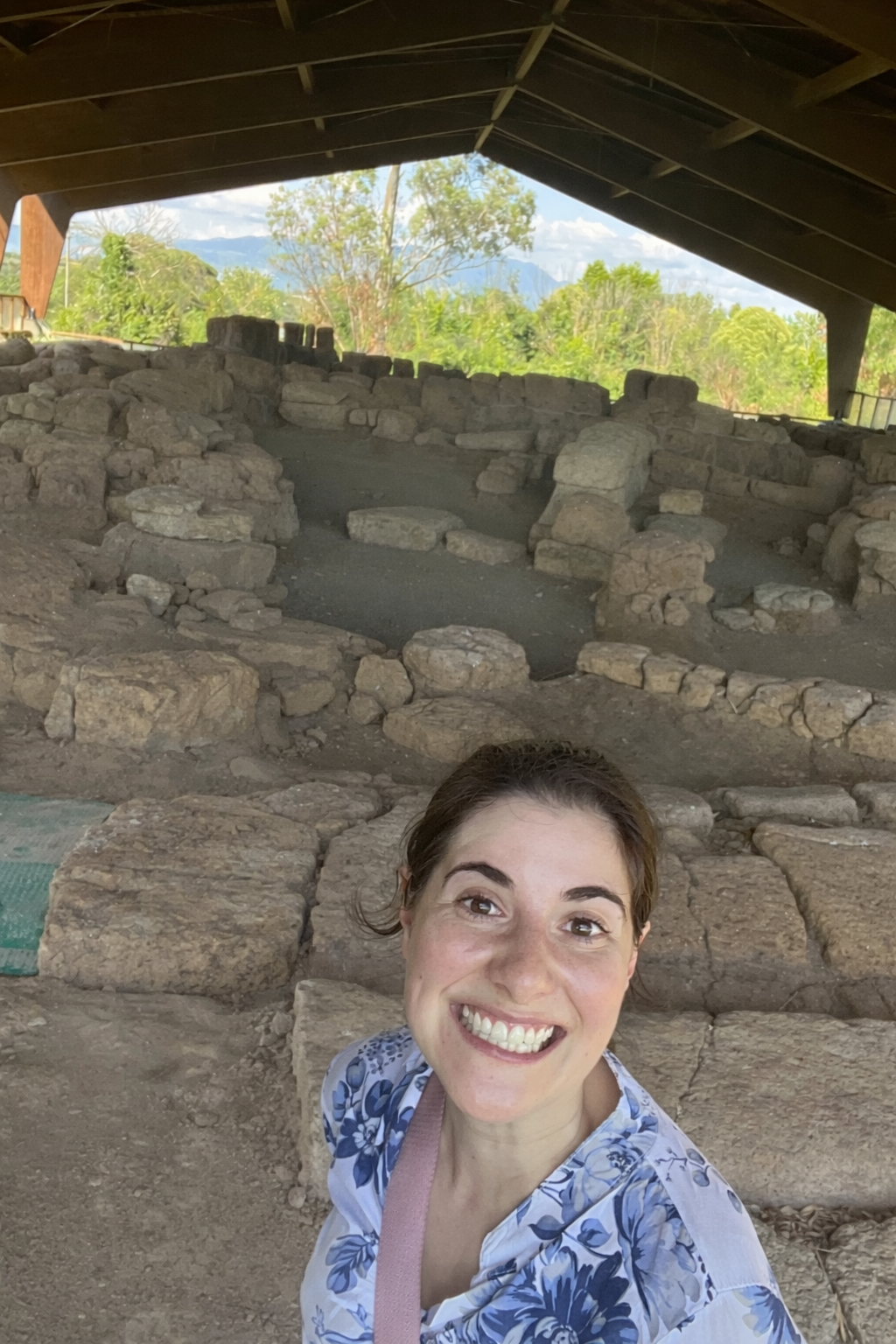
One of our 2025 John R. Coleman Fellowship winners, Amelia Eichengreen, provides us with an update:
The John R. Coleman Traveling Fellowship was used to support fieldwork and archival research in central Italy that was essential to the completion of my doctoral dissertation on archaic domestic architecture. During the grant period, I was based primarily in Rome and undertook a series of targeted site visits and archival consultations that allowed me to reassess key domestic remains and integrate previously underutilized evidence into a comprehensive typology and chronology of urban houses in Latium and southern Etruria.
With the support of the fellowship, I conducted firsthand architectural study at a range of archaeological sites, including Satricum, San Giovenale, Acquarossa, Poggio Civitate, and Marzabotto, as well as several smaller and fragmentary domestic contexts within Rome. These visits enabled close observation of construction techniques, masonry treatments, quarry marks, and spatial relationships to local topography—details that are rarely documented in published excavation reports but proved critical for distinguishing domestic structures from terraces or retaining walls and for understanding building processes during the late archaic period. In several cases, on-site analysis led me to revise earlier interpretations of walls and floor surfaces that had been misidentified or left uninterpreted in the literature.
The fellowship also allowed for sustained archival research at the American Academy in Rome, where I consulted excavation records, plans, photographs, and unpublished notes related to early excavations on the Palatine Hill and other urban contexts. This archival work was especially important for reassessing influential but controversial reconstructions of archaic Roman houses. By correlating archival documentation with physical remains observed on site, I was able to produce new, evidence-based architectural plans that avoid speculative reconstruction and instead integrate stratigraphy, ceramics, mortuary evidence, and topography.
The results of this research have had a direct impact on my dissertation. The grant-funded work strengthened my argument that the transformation of domestic architecture in central Italy was more rapid and socially stratified than previously recognized, supporting a revised model of development from huts to monumental elite residences within a short chronological window. More broadly, the Coleman Fellowship enabled me to shift the discussion of archaic urbanization toward the lived spaces of cities and the social groups that inhabited them.
In sum, the John R. Coleman Traveling Fellowship provided the time, access, and resources necessary to complete a critical phase of my dissertation research and to lay the groundwork for future publication.