January 6, 2026
by Trevor Van Damme
One of our 2025 Richard C. MacDonald Iliad Grant winners, Trevor Van Damme, provides us with an update:
Archaeological fieldwork took place in three campaigns: 1) July-August 2025; 2) September 2025; and 3) November 2025.
1) In July-August 2025, Trevor Van Damme (University of Warwick) and Ben Watts-Wooldridge (Princeton University), conducted statistical analysis (including EVEs, total sherd counts) of 10 distinct pottery deposits totaling 3082 pottery fragments. This analysis shed new light on the introduction and consumption of lustrous decorated Mycenaean style pottery in Attica. It also demonstrated that the domestic rubbish deposits presented in Agora XIII by Sara Immerwahr were much more extensive and varied than expected.
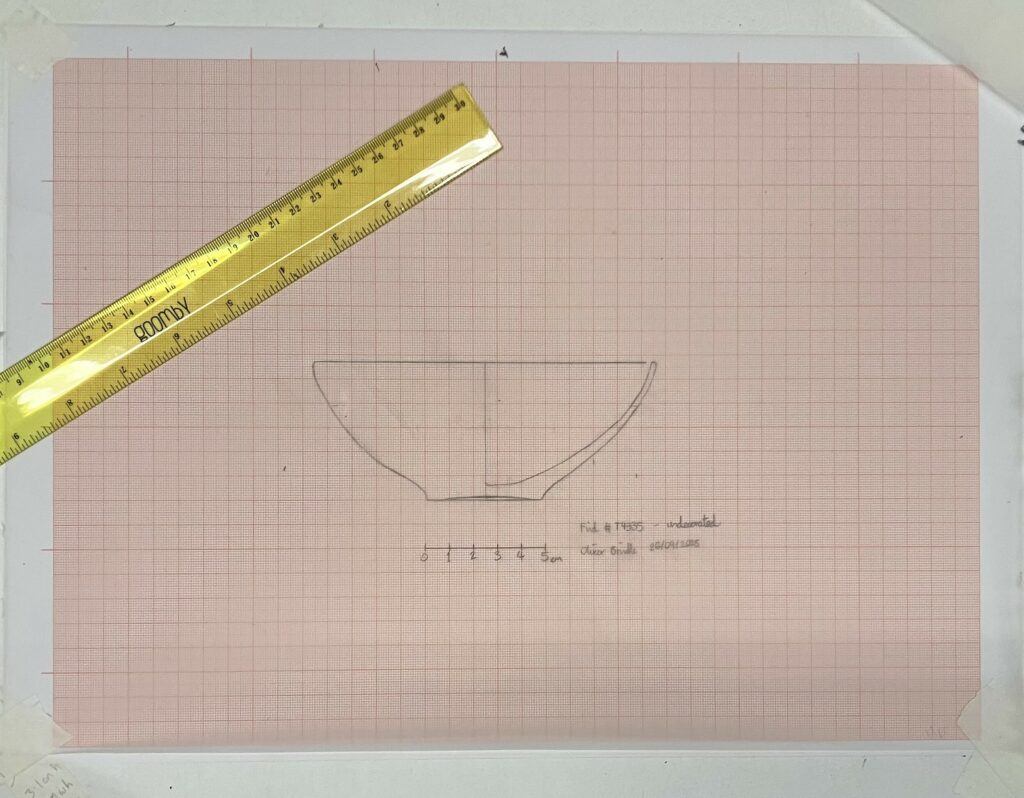
2) In September, Trevor Van Damme (University of Warwick), Cédric Freyd (CY Cergy Paris Université), Lily Birch, Marni Barlow Marshall, Murray Silk, Oliver Brindle, Ethan Hughes, and William Whitmore (all Univeristy of Warwick) carried out additional statistical analyses on a significant LH IIIC Middle well deposit, inventoried 30 complete vessels from the North Slope excavations, and illustrated select vessels (see Image 2). This provided new information about the final abandonment of the houses located on the North Slope of the Acropolis.
3) In November, Johannes Sterba (TU Wien) and I were able to sample 128 pottery fragments from the North Slope and Athenian Agora for Neutron Activation Analysis (NAA), a scientific technique that determines the precise elemental composition of a material by means of nuclear irradiation. These samples will allow major and minor paste recipes present in Attic assemblages to be assigned a more specific provenance. The samples are currently undergoing irradiation in Vienna and initial results should be available in the new year.