July 8, 2025
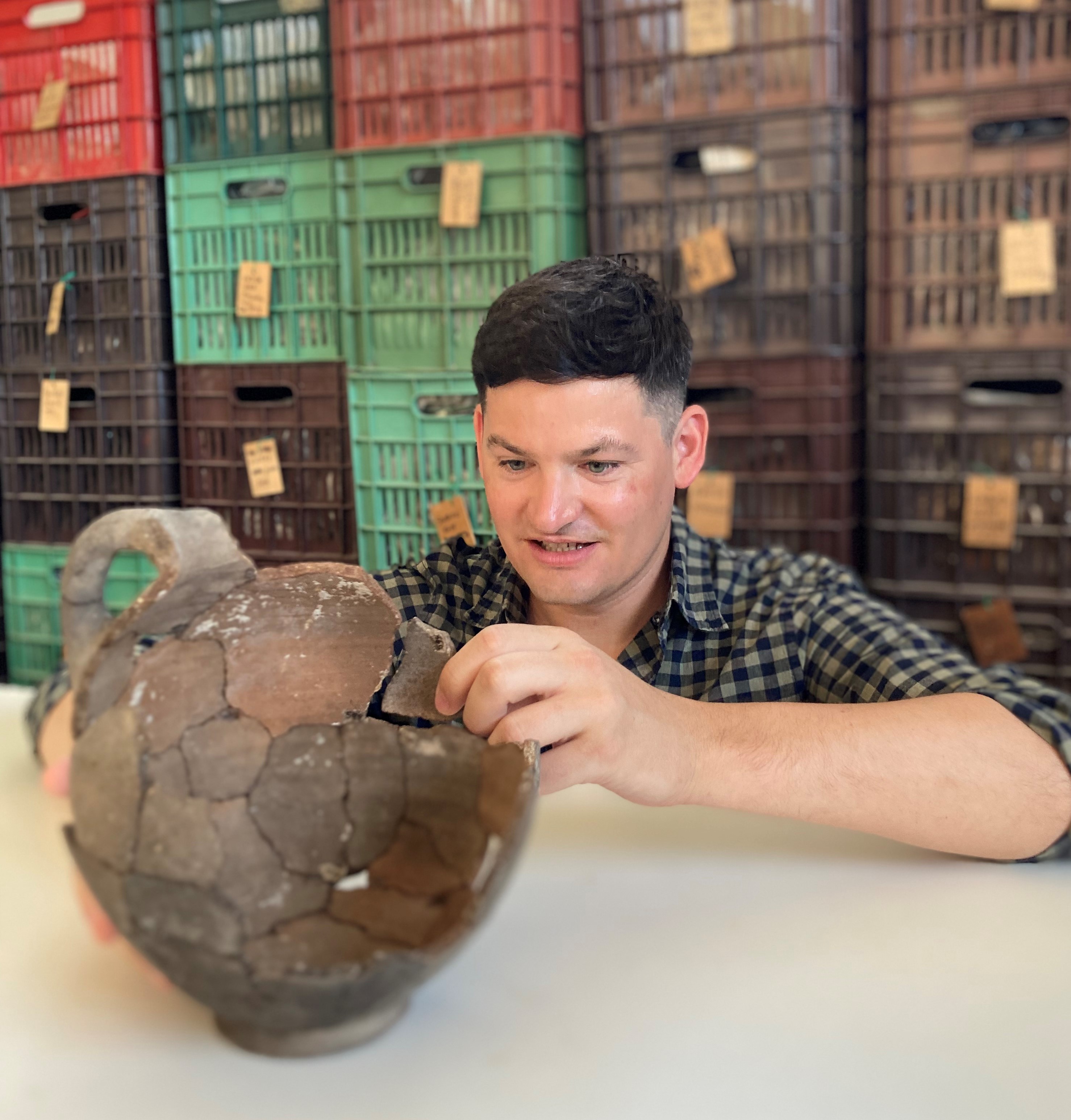
To celebrate our 2025 Grant recipients, we contacted our winners to learn about their projects and and share their unique experiences in the world of archaeology. We’re thrilled to announce Trevor Van Damme, the winner of the prestigious Richard C. MacDonald Iliad Endowment for Archaeological Research for 2025!
Richard C. MacDonald Iliad Endowment for Archaeological Research Grant Winner: Trevor Van Damme (University of Warwick)
With support from the AIA’s Richard C. MacDonald Iliad Endowment for Archaeological Research, the North Slope Publication Project (NSPP) is investigating Mycenaean Athens (1700-1100 BCE). The award winner, Dr. Trevor Van Damme, and his colleagues hope to learn more about the city located on the Acropolis, which existed long before construction of the Parthenon transformed it into a sacred space. The project is investigating the North Slope settlement to understand the political and community structures present in Athens at the time of Homer’s Iliad. The NSPP is using an integrated approach, combining archival study, scientific analyses, and the publication of legacy data.
How did you get your start in archaeology?
When I started at the University of Victoria in 2006, I was an Astronomy and Physics major. I took an introduction to Greek and Roman Studies class and introductory Latin as electives. I very quickly realized that I was much more interested in Greek and Roman Studies than physics. I think the point of no return, however, was when I enrolled in the ‘UVIC in Greece’ summer course led by Prof. Brendan Burke at the University of Victoria in 2008. I fell in love with Greek archaeology and ended up extending my stay in Greece to participate in the Eastern Boeotia Archaeological Project later in that same summer, which at that time was an extensive regional survey. Learning how to read and study the fragments of worn pottery that we found on survey instilled a love of all things ceramic that I maintain today!
Where in the world has archaeology brought you (fieldwork, research, conference travel, etc.)?
I have participated in archaeological fieldwork projects in Greece and Italy. I have visited archaeological sites for study travel and research across the Mediterranean world including the United Kingdom, Spain, Italy, Albania, Greece, France, Hungary, Turkey, Israel, Jordan, Egypt, Ethiopia. Outside the Mediterranean, I have also been able to visit archaeological sites in Canada, the United States, and Mexico. I have given talks or participated in conferences in Canada, the United States, the United Kingdom, and Greece.
What is one of the most memorable things that has happened to you in the field?
Because I work primarily with pottery, the thrill for me is always around piecing together vases from unexpected places. One of my personal highlights was piecing together two halves of a deep bowl that had broken and fallen into two separate rooms of a Late Bronze Age house separated by over 10 meters of intervening space (including an entire third room). One half of the bowl was completely burned and its colors were various shades of gray, whereas the other half was unburnt and bright orange and red. I was putting away the inventoried pottery at the end of the field season and something about the curve of the break edge caught my eye, so I decided to try the two halves and they ended up still fitting perfectly despite the damage caused to the one half by the fire. What was really thrilling about the join, besides the sharp contrast in the surface condition of the two fragments, was the contribution that this single artifact ended up making towards our understanding of the house and its destruction early in the 12th century BCE.
How has the AIA contributed to your success/professional goals?
The AIA had contributed greatly to my professional development as an archaeologist. I have been a member of the AIA since 2012, when I presented my first paper at the 113th Annual Meeting of the Archaeological Institute of America in Philadelphia and I think that I have attended every meeting since then (not always presenting). It has been a really important venue to interact with colleagues from other institutions and maintain friendships forged in fieldwork and graduate school over the years. In 2020, I was also part of a team of scholars from the Eastern Boeotia Archaeological Project that published a fieldwork report on our excavations at the site of ancient Eleon from 2011-2017 in the American Journal of Archaeology, which, thanks to the AIA was published open access. This is a really valuable initiative that helps to break down the dreaded academic pay wall and I hope that the AIA continues to make similar field reports open access in the future.
Learn more about what Fellowship and Grant opportunities are available through the AIA.