Affiliation: Archaeological and Historical Conservancy
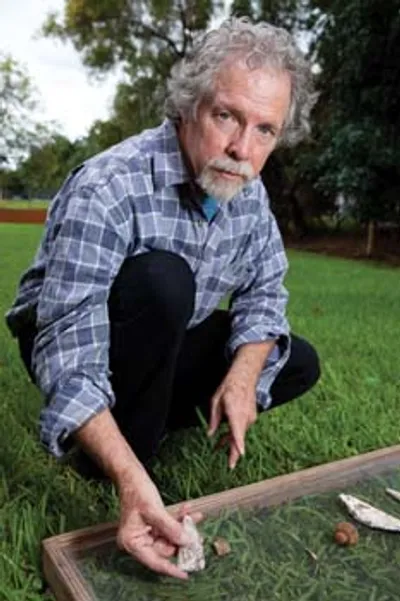
Robert (Bob) Carr co-founded the Archaeological and Historical Conservancy in 1985, and has served as its full-time director since 1999. He has a Master’s Degree in Anthropology from Florida State University. He has worked as an archaeologist with the State of Florida’s Division of Historic Sites, National Park Service and Dade County. He was Miami-Dade County’s first County Archaeologist and became the County Historic Preservation Director. He is the former editor of the Florida Anthropologist and former president of the Florida Archaeological Council. He is a recipient of the Bullen Award and Florida’s Historic Preservation Award.
Archaeological excavations at Brickell Point in 1998, uncovered a circle of postholes and cut basins into the limestone bedrock measuring 11.2 meters in diameter. Within the floor of the feature were the skeleton of a shark, the cranium of a of a bottlenosed dolphin, and the shell of a sea turtle – all aligned in an east – west axis. Artifacts included numerous non-local materials such as basaltic celts from the Appalachian Mountains, copper from the Mid-West, galena, and other exotic artifacts.
Since that discovery twelve other circles have been uncovered at the mouth of the Maimi River. Radiocarbon dates of AD 200-700 indicate that this complex was a major town and trade center 1500 years before the creation of the City of Miami. The evidence of thousands of postholes indicates likely elevated structures paralleling the river. Other postholes may have been supports for extensive fishing nets stretched for mending and to dry. These remains are associated with the Tequesta who, like the Calusa, were a stratified society that did not practice agriculture, and like the people of the Northwest, created a complex society based on maritime resources. The results of excavations at the mouth of the Miami River from 1980 to present provide a view of a previously little known site complex that is the southernmost prehistoric trade center in the United States.
Ponce de Leon’s discovery of Florida in 1513 was no accident. This lecture provides little known facts behind his quest for Bimini, the Fountain of Youth, and his struggle to maintain his charter to colonize Florida that resulted in his death by a poisoned arrow in 1521. My historical research uncovered evidence that Ponce’s charter for colonizing Bimini was always intended to be Florida and not the Bimini of the Bahamas. This research reveals that the 1520 Pineda map had a note “Florida formerly Bimini” written on the depiction of Florida. The intrigues of the Columbus family vying for the Bimini charter from the king of Spain will be discussed. A theory of the origin of the Fountain of Youth will be presented based on archaeological excavations of Mid-Archaic cemeteries in Florida such as Windover, where 6000 to 8000 year old human burials were uncovered. The Southeastern indigenous belief that lakes and rivers are barriers that can separate the living from the dead, and the Tequesta belief that your reflection in the water was one of three souls. Their belief that water is an integral part of the underworld may explain the immortality offered by the “Foutain of Youth” being a miscommunication between indigenous people and Europeans, who did not understand that the sacred waters offered by the mortuary ponds represent the immortality of the soul and not the flesh.
American settlers who first encountered the miles long prehistoric canals in the nineteenth century in South Florida were quick to assert that they were the engineering works of Europeans. Archaeological excavations have proven that they are the creations of indigenous people. They are the longest prehistoric canals in North America north of Mexico. At least six prehistoric canals are reported in South Florida.
I directed investigations at two of the prehistoric canals: The Ortona canals, 8GL43, near Lake Okeechobee and the Naples Canal, 8CR59. The Ortona Canals measured 5.5 km long. They provided access to a major mound complex from the Caloosahatchee River. We excavated a trench bisecting one canal where two radiocarbon dates ranging from 1640+/- 70 to 1880+/-50 BP indicate that the canal was dug about ca. AD300.
The Naples Canal, 8CR59, created a 1.3 km long shortcut connecting the Gulf of Mexico with Naples Bay through what is now the City of Naples. The canal had been filled in by the 1930’s, but when the City replaced its sewer system, archaeologists monitored the trench excavations until it intersected the prehistoric canal. A Radiocarbon date from the upper level of the canal indicated the canal was in use in 1650 AD. A second excavation in a Naples residential yard yielded six radiocarbon dates indicated use of the canal from as early 1240 +/- 30 BP.
Parabolic dunes with their higher elevations provided an ideal location for prehistoric settlements in Florida. It is likely that these conspicuous geographic forms had special meaning beyond providing ideal elevations for habitation for indigenous people. Archaeological testing was conducted at two sites: The Jupiter Inlet, 8PB35, on the east coast and the Bonita Shellworks, 8LL717, on the Gulf Coast .
These excavations demonstrated that the cultural horizons occurred above natural deposits of aeolian sand. Radiocarbon dating at 8LL717 indicated that the site dates from the Late Archaic Period from 3640 +/- 70 BP to 3850+/- 70 BP. In contrast, the Jupiter site was occupied from the Late Archaic Period to the time of European contact.
These landforms likely had a special significance to indigenous people as indicated by their proximity to burial mounds and the appearance of the parabolic form in nature and as expressed in certain ceramic designs, such as Key Largo Incised, and prehistoric earthwork construction.