Affiliation: University of Cincinnati
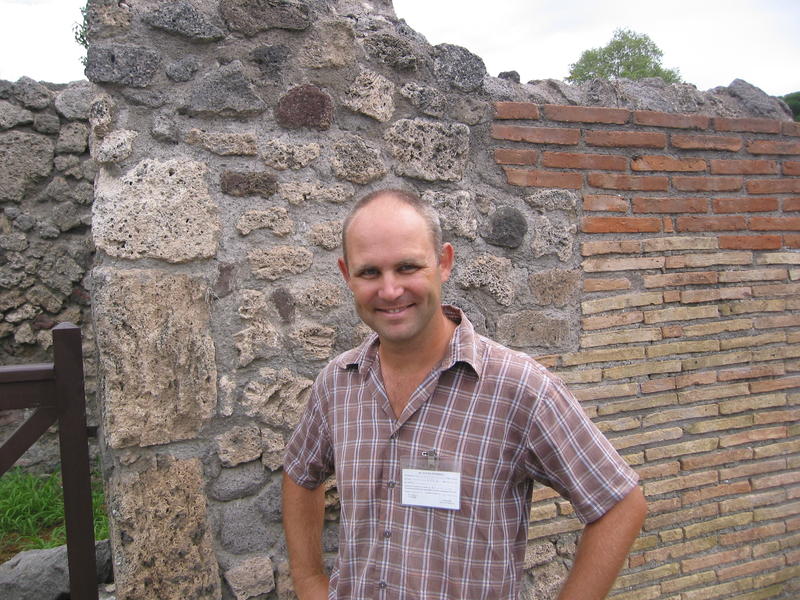
Steven Ellis is with the Department of Classics at the University of Cincinnati, and holds his Ph.D. from the University of Sydney. His areas of specialization include Roman urbanism and social history, ancient architecture, Greek and Roman art and archaeology, and the excavation of complex urban sites; his is the project director for the Pompeii Archaeological Research Project at Porta Stabia, and the East Isthmia Archaeological Project. Professor Ellis has published widely, and has several recent forthcoming works on aspects of his work in Pompeii.
Since its excavation in the 1970s, the East Field at Isthmia has long been dismissed as a jumble of poorly built houses, marginal to the sanctuary proper. Except for a few small-scale excavations and a handful of studies, the site and its excavation data have been largely neglected ever since. Following a reanalysis of the site and its dusty archival records, this presentation disentangles the maze of walls into identifiable structures, setting these within a phased narrative connected to the site’s broader history. The results overturn decades of assumptions, revealing substantial structures central to the sanctuary, some possibly corresponding to buildings otherwise known only from inscriptions: the Stoa of Regulus, the Katalausies of P. Licinius Priscus Iuventianus, and the final site of the Palaimon sanctuary. The presentation offers a radically new understanding of this neglected area of Isthmia and its relation to the sanctuary.
This presentation begins with a behind-the-scenes look at the most recent excavations of the Porta Stabia neighborhood at Pompeii. These excavations, under the auspices of the University of Cincinnati, targeted two town blocks made up of shops, houses, and hospitality establishments. More than charting the centuries-long development of a sub-elite neighborhood, the intention is to demonstrate the value in more broadly contextualizing not just the research and results but equally so the methods and approaches to digging a city. To that end we will situate the Pompeii excavations with another of Cincinnati’s archaeological projects: the new excavations of the Punic-Roman city of Tharros on the west coast of Sardinia. Both projects offer new insights into the social and economic making of Roman urban neighborhoods: from diet and urban consumption to retail investment and civic infrastructure.
“Recent excavations by the University of Cincinnati at Tharros are transforming our understanding of this Punic–Roman city on the west coast of Sardinia. Long known for its unusually rich, Punic-era tombs, the development of the city itself has rarely been tackled through systematic archaeological research. To that end, our ongoing excavations have targeted three different and distant areas of the city—the southern shops, the monumental center, and the Murru Mannu hill—to reconstruct the city’s development from foundation to abandonment.
The results reveal a more complex urban history than previously recognized. While abundant material points to a strong Punic presence, much of the visible city today is the product of large-scale Roman rebuilding, including quarrying, terracing, and the installation of a paved street and sewer system in the early 2nd century CE. These interventions reshaped earlier urban layouts and obscure much of the Punic-era built environment. At the same time, new evidence from architecture, infrastructure, and coin assemblages demonstrates that urban activity declined and effectively ceased by the late 4th or early 5th century CE—centuries earlier than traditionally thought.
Together, these findings offer a more precise and evidence-based account of Tharros’ urban life, challenging long-held assumptions about its development, transformation, and eventual abandonment.”