





Online conference on worked shells in the ancient world. Material, use, typology, chronology and contexts in honour of Jean-Paul Descœudres, University of Sydney
May 20
Sponsored by: Dokuz Eylul University
Call for Papers Deadline: February 1, 2026
Dear Colleagues,
We are glad to inform you that an international e-conference on worked shells in the ancient world (material, use, typology, chronology and context) will take place on May 20, 2026 on Zoom.us. This forthcoming online meeting will be an archaeomalacological workshop in honour of Jean-Paul Descœudres from the Universities of Geneva and Sydney. Papers are invited to present evidence of human collection and modification of shells from all over the ancient world (especially the Mediterranean) and over a large chronological range (from Prehistory to Antiquity with a focus on the Roman world). We are interested in worked shells rather than those used as food or as environmental indicators. Our subject groups are as follows: Phylum Mollusca, mollusc shells, mother-of-pearl, purple-dye production, archaeomalacology, archaeozoology, archaeological raw materials, archaeological artefacts, archaeological small finds, archaeological science, conservation of archaeological shells, physical anthropology, osteoarchaeology, bioarchaeology, palaeohistology, ancient history, history of art and cultural anthropology etc.
An abstract of the proposed contribution should be sent to the organizers by February 1, 2026 at the latest. The Proceedings of the conference will be published in a forthcoming issue of the journal “Mediterranean Achaeology”, cf. .
Ancient worked shells were found in relatively large quantities in the entire Mediterranean, from Spain to Syria and Egypt to France, where they were manufactured between the Neolithic and Medieval periods. However, the spectrum of the worked shells recovered from Anatolia, the Near East, the Black Sea area and the Balkans is very varied, and reflects different characteristics of ancient daily life. In this conference papers dealing with ancient artefacts or objects manufactured from shells or mother of pearl will be included. The main material groups made by shells are as follows: items connected to personal grooming, artefacts used for spinning or in pottery decoration, artefacts related to cosmetics, jewellery, combs, pins for clothing and women’s hair, items related to dressmaking and textile (particularly sewing needles, weaving implements or buttons), amulets and other magical items, knife handles, frames of various kinds (e.g., of mirrors), furniture (including fittings, wood sidings and inlayed decoration), boxes, plaques, liturgical and religious items (e.g., crosses and reliquaries), half-finished products and miscellanea.
So far the study of this material group has been overlooked, whereas there is still a huge amount of unpublished material from excavations, field surveys and museums in the entire ancient world. There is a regular conference series of the ICAZ Archaeomalacology Working Group (AMWG; cf. ) which includes almost all periods and areas. In our e-meeting in 2026 we attempt to set out a comprehensive model for the study of worked shells, including their definition, typology, chronology, contexts, function, regional characteristics, production and distribution patterns in the ancient world, and more particularly in the Mediterranean, the Near East, the Black Sea area and the Balkans. The increasing number of recent finds in these areas over the last thirty years, thanks to the development of preventive archaeology, has tended to challenge our previous observations and assumptions on worked shells.
It is also our intention to create a complete bibliography of previous publications on worked shells for several areas and chronologies.
We warmly invite contributions by scholars and graduate students from a variety of disciplines related to this material group. Intended to bring together scholars of instrumenta archaeology to discuss a range of issues concerning this material group’s characteristics, this video conference should be an excellent opportunity to increase our knowledge about ancient worked shells. The following theme groups relate to the main questions the conference aims to address:
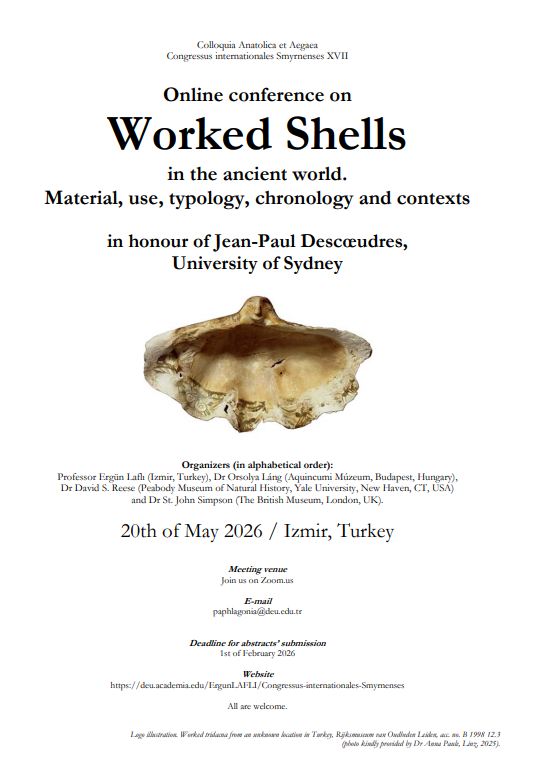
– Worked shells, Phylum Mollusca, mollusc shells, mother-of-pearl and material related to purple-dye production from archaeological field projects, museums and private collections, for example, Tridacnae shells that are occasionally encountered in the literature as objects found in the Mediterranean and Near East, i.e., large shells, decorated with carvings and/or traces of paint,
– Graeco-Roman worked shells in comparison with the worked shells of the Palaeolithic, Mesolithic, Neolithic periods, Bronze and Iron Ages,
– Graeco-Roman worked shells in comparison with the Minoan and Mycenaean worked shells,
– Etymology of worked shells in ancient Near Eastern, eastern Mediterranean and Aegean languages,
– Ancient Greek, Latin and Byzantine textual sources on worked shells,
– Shell depictions on ancient Greek and Roman visual sources (for example on frescoes),
– Typological evolution and design of worked shells,
– Selection criteria for some certain animal genres for shell-working,
– Decoration of worked shells, as detailed chronologies should be established for both the produced forms and their decoration,
– Chronologies of these objects that can highlight the social spread of these products,
– Manufacturing techniques, manufacturing tools, major production centres and workshops of worked shells, their organisation and interactions.
– Distribution of worked shells, economic and social aspects: in what type of socio-economic context are they found?,
– Typological and functional features of worked shells: what might the utilitarian, social and/or symbolic functions or practices of these objects have been?
– Identification of the economic factors that contributed to the standardization in the shell-working,
– Commodities and their trade through worked shells,
– Relations of worked shells to other bone, metal, terracotta, glass, wooden or stone objects: how did this material group fit in with objects made from different materials, particularly metal, glass, or wood? Can any stylistic links be found between them?
– Conservation of worked shells, especially excavated finds: current strategies and future approaches,
– Archaeometric analyses of these objects,
– Miscellanea.
A special focus of the conference is the identification of workshops from different regions, cities and areas, in particular capital cities (such as Byzantium, Ephesus, Pergamum, Antioch-on-the-Orontes, Alexandria, Athens, Rome etc.).
Another important topic is the manufacturing techniques which were varied and depended on the composition and morphology of each raw material type as much as on the artefact to be produced. Regardless of the raw material, the manufacturing process of an ancient shell object was usually multi-stage:
1. Selection and acquisition of the raw material;
2. Preparation of the raw material, including cleaning, drying and cutting into pieces;
3. The appropriate working processes using instruments like knives, chisels, files, lathes and bow-drills;
4. Finishing the worked objects by grinding, polishing and colouring.
The finds suggest that manufacturing techniques were related to organized production where the different manufacturing stages were standardized and predefined, which can be identified as a chaîne opératoire. Particular attention should be paid to these technical aspects, which are the integral parts of the uniqueness of most of the ancient worked shells.
We also need to look at the distribution of these objects on a local, regional, and even supra-regional scale, and trade networks. Some have crossed overseas; how can these exchanges be explained?
Our conference is primarily virtual, and will take place on Zoom; but if any participant wishes to come to Izmir, she/he is welcome to present her/his paper in our conference room to the audience which will also be livestreamed and broadcast simultaneously on Zoom.
All the readings and discussions in our e-conference will be in English, and recorded for later viewing as a podcast on YouTube. The proceedings of the conference will be published in a forthcoming issue of “Mediterranean Achaeology”. The conference is free of charge.
We would be delighted, if you could consider contributing to our conference and contact us with the registration form below until February 1, 2026. Our e-mail address is paphlagonia@deu.edu.tr
For all your queries concerning the conference our phone and WhatsApp number is +90.544.540 78 34. The organizers seek to widen participation at this conference, and would like to encourage colleagues from all parts of the world to attend. We kindly request that you alert any interested researches, colleagues and students within your research community who would be interested in participating at this e-conference, either by forwarding our first circular and poster through your Academia, Researchgate, Instagram, X, YouTube, Facebook accounts, or other similar social media, or by printing them and displaying in your institutions.
We hope that you will be able to join us on Zoom, and look forward to seeing you!

support Us
The AIA is North America's largest and oldest nonprofit organization dedicated to archaeology. The Institute advances awareness, education, fieldwork, preservation, publication, and research of archaeological sites and cultural heritage throughout the world. Your contribution makes a difference.