Affiliation: Woods Hole Oceanographic Institution
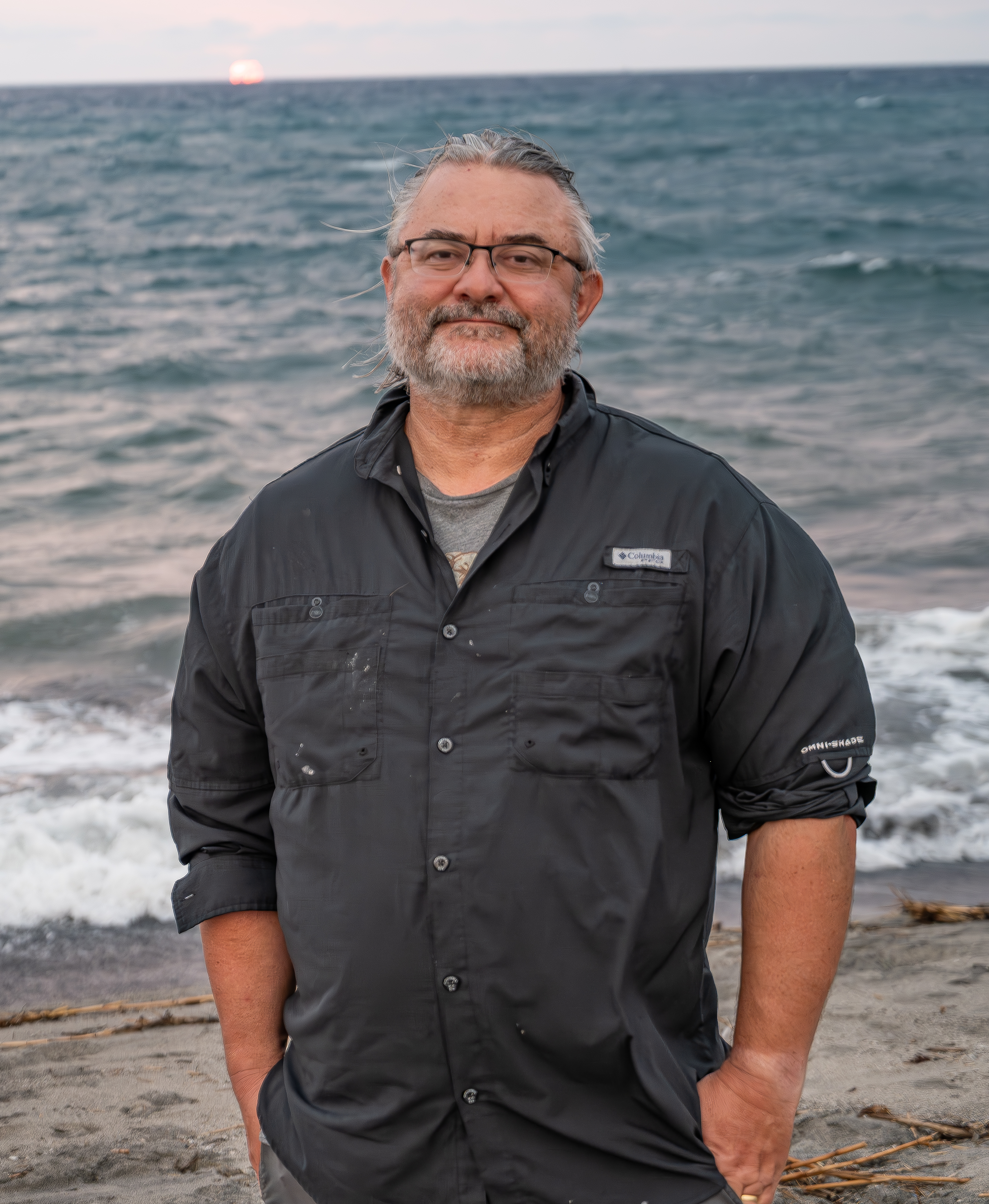
Dr. Calvin Mires is a maritime archaeologist and heritage specialist with nearly three decades of global experience documenting, interpreting, and protecting underwater cultural resources. His work bridges archaeology, marine science, and public storytelling, focusing on how underwater cultural heritage can deepen scientific understanding, inspire education, and connect communities to the past. As a Research Associate at Woods Hole Oceanographic Institution, Mires helped establish WHOI’s interdisciplinary field of maritime heritage ecology, which investigates how submerged archaeological sites function as oases for biodiversity and evolve through natural and cultural processes over time. He also serves as a Lead Archaeologist for the Defense POW/MIA Accounting Agency (DPAA), where he helps locate, identify, and excavate downed WWII aircraft to account for, recover, and repatriate missing U.S. service members. A dedicated educator and public communicator, Mires directs field schools, teaches at universities, develops outreach programs, and collaborates with museums, tribal partners, and marine sanctuaries to expand public engagement with underwater cultural heritage. His research has been published in International Journal of Nautical Archaeology, Journal of Maritime Archaeology, Historical Archaeology, Journal of Archaeological Science: Reports, Trends in Ecology and Evolution, and Marine Ecology Progress Series. His latest book, Intertidal Shipwrecks: Management of a Historic Resource in an Unmanageable Environment, received the 2025 John R. Lyman Book Award in Nautical Archaeology and Maritime Archaeology Honorable Mention.
Across the world’s oceans, UNESCO estimates that more than three million shipwrecks rest on the seafloor. Yet this represents only a fraction of our underwater cultural heritage (UCH). Lakes, rivers, estuaries, and inland waterways hold their own archives of human movement and innovation. Beyond shipwrecks lie submerged airplanes, landscapes, settlements, and industrial sites—a vast, largely unseen record of culture and the pathways people have traveled for generations. These places offer powerful gateways for engaging people of all ages because they naturally connect the humanities and the sciences. They embody the most advanced science, engineering, technology, and problem solving of the past, while advancing innovative STEM applications today. Whether someone is writing coding workflows that help process and interpret data, piloting underwater robotics, identifying objects in underwater photos, building a virtual dive in a game engine, or printing a scaled model of a wreck, these hands on experiences invite people to interact directly with science and history and feel the spark of discovery. Yet it is the shared human experience embedded in these sites— indelible histories of travel, adaptation, ingenuity, and loss—that connects the past with the present and inspires the future. Drawing on more than 30 years in education and maritime archaeology, Dr. Calvin Mires explores how moving beyond shipwrecks expands the possibilities for public engagement. By reframing underwater heritage as a living, interdisciplinary resource, we can spark curiosity across many pursuits of knowledge and connect communities to the waterways around them.
More than 80,000 United States service members remain missing from past conflicts around the world. The Defense POW/MIA Accounting Agency (DPAA) is charged with the solemn mission of providing the fullest possible accounting of these individuals to their families and the nation. Recovering unresolved casualty losses, especially those located at sea —demands a blend of scientific precision, logistical coordination, and ethical responsibility. Since 2022, Dr. Calvin Mires has partnered with DPAA on operations across the Asia Pacific region, including Guam, Chuuk, Thailand, and—most extensively—the Philippines, where more than 11,000 U.S. personnel remain unaccounted for and an estimated 4,000 to 5,000 of those losses lie underwater. In this lecture, Dr. Mires will examine how archaeological methods and emerging technologies are transforming the ability to search for, locate, and recover WWII loss sites. He will discuss missions he has led to identify and excavate downed aircraft using advanced underwater survey systems and technical diving, as well as the 3D documentation of POW “Hellships,” recently highlighted on the Discovery Channel. These projects represent some of the most demanding—and most meaningful—work of his career, blending science, history, and humanitarian commitment in service of America’s promise to leave no one behind.
Mires, Calvin, Evan Kovacs, Megan E. Lickliter-Mundon, and Alba Mazza. “In Tough Seas:
Overcoming Field Challenges Through Innovation and Partnerships With DPAA,” Journal of
Maritime Archaeology. https://doi.org/10.1007/s11457-024-09396-5
https://www.dpaa.mil/
The world’s oceans hold more than three million shipwrecks and other types of underwater cultural heritage (UCH), forming a vast submerged museum of human activity, innovation, and loss at sea. Often described as time capsules, these sites are far more than isolated moments resting on the sea floor. They offer multiple currents of insight into how societies have understood, used, and been shaped by the ocean—past and present. Shipwrecks sit at the nexus of humanities and science: between archaeological processes and evolving biological ecosystems, between the most complex machines of their time and today’s cutting edge technologies. Distributed across depth zones and ocean environments, they form a cultural network of datums that influence connectivity and dispersal, alter local and regional biodiversity, and interact with physical and chemical processes. Dr. Mires highlights the importance of interdisciplinary research and the growing need for collaboration between archaeologists and ocean scientists to address the stressors affecting UCH. Such partnerships are essential for developing ecosystem based management strategies that recognize these sites as both historical resources and ecological structures. This lecture introduces a framework for the emerging field of Maritime Heritage Ecology and presents case studies demonstrating how shipwreck research can inform contemporary management questions in a rapidly changing ocean.
Mires, Calvin H., Benjamin Haskell, and Kirstin Meyer-Kaiser. 2024. “Multi-use and Multi-vocal Challenges of Preserving Underwater Cultural Heritage in Stellwagen Bank National Marine Sanctuary. In Threats to Our Ocean Heritage: Bottom Trawling, Charlotte Jarvis, editor, The Ocean Foundation and Springer Brief Publishing.
Mires, Calvin H., and Kirstin Meyer-Kaiser. 2023. “A Case Study in Maritime Heritage Ecology: Understanding How Structural Changes to the 1898 Shipwreck Portland Affect Biological Diversity and Colonization.” Journal of Maritime Archaeology; ttps://doi.org/10.1007/s11457-023-09359-2
Meyer-Kaiser, Kirstin and Calvin Mires. 2022. “Underwater Cultural Heritage is Integral to Marine Ecosystems” Trends in Ecology and Evolution 37(10):815-818; https://doi.org/10.1016/j.tree.2022.06.014