Affiliation: Bryn Mawr College
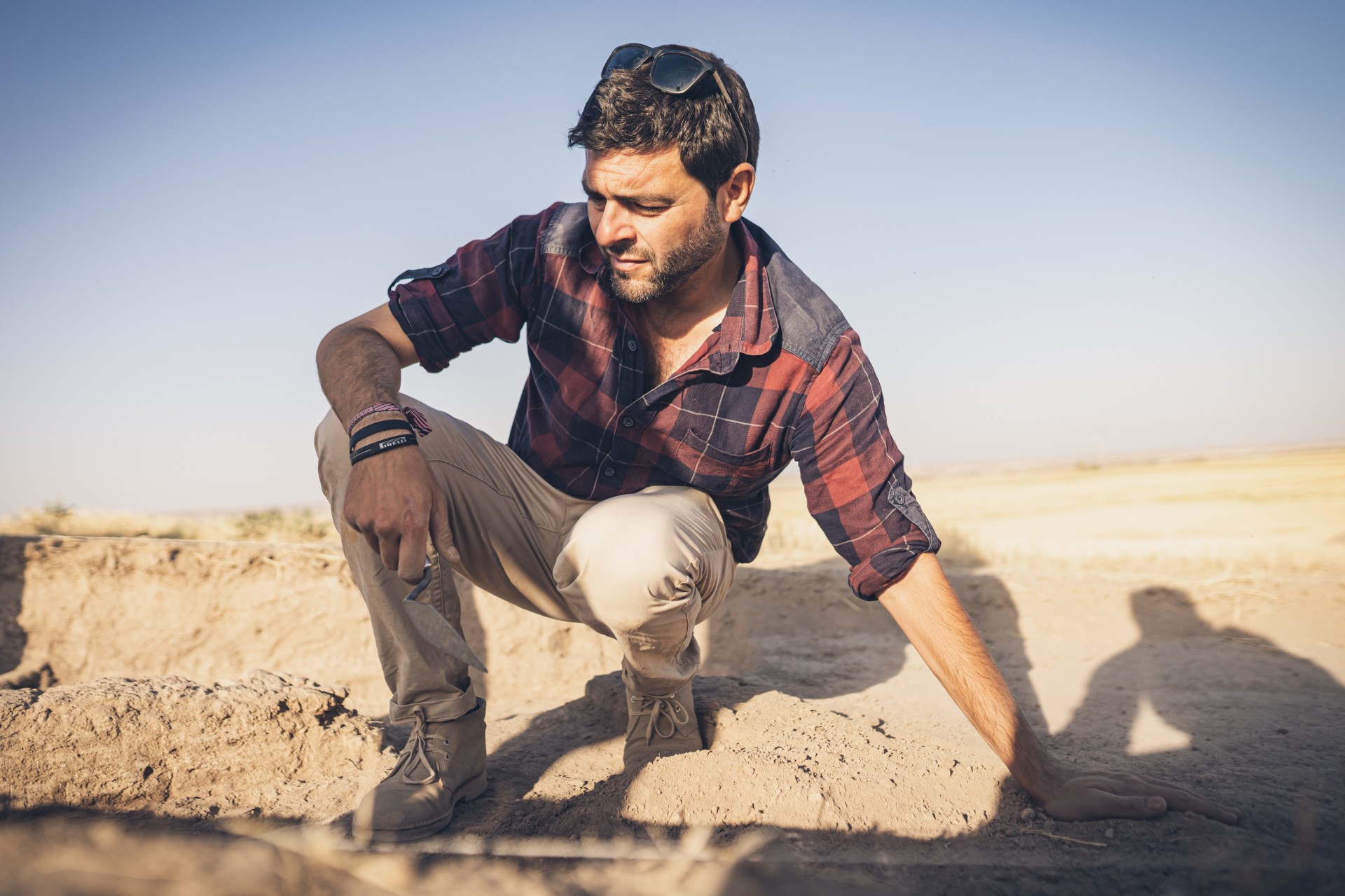
Rocco Palermo is Assistant Professor of Classical and Near Eastern Archaeology at Bryn Mawr College, where he specializes in the archaeology of imperial landscapes and socio-cultural transformation in South-West Asia, and more specifically in Mesopotamia from the Iron Age to the Roman period. His work investigates how ancient empires shaped — and were shaped by — rural communities, local economies, and environmental change across the longue durée.
Before joining Bryn Mawr in 2023, Rocco held academic positions at University of Pisa (Italy) as a Researcher, and at University of Groningen (Netherlands) as a Postdoctoral Fellow. He earned his Ph.D. jointly from the University of Naples Federico II (Italy) and Université Paris 1 Panthéon-Sorbonne (France). His dissertation was then turned into a well-received and extensively reviewed book: On the Edge of Empires. Northern Mesopotamian during the Roman Period (Routledge 2019).
He has extensive field experience across Iraq, Syria, Jordan, Oman, Canada, and Italy. He currently directs the Gird-i Matrab Archaeological Project (GMAP) in the Erbil Plain (Iraqi Kurdistan), a long-term regional investigation on the development of rural communities in times of radical socio-cultural transformation in Mesopotamia, namely the Chalcolithic period (5th – 4th millennia BCE), and the Hellenistic and Parthian-Roman phases (late 4th c. BCE – late 2nd c. CE). He previously served as Associate Director of the Erbil Plain Archaeological Survey (Harvard University), and he was a senior team member of the Land of Nineveh Archaeological Project (University of Udine), both in the Kurdistan Region of Iraq. His research has been supported by major international funding bodies, including the European Science Foundation, the Gerda Henkel Foundation, and, more recently, a 2025 Loeb Classical Library Foundation Fellowship. He regularly publishes in leading peer-reviewed journals and edited volumes. Rocco is currently working on his second monograph, People, Peasants, and the Empire. Landscapes and Settlement Evolution in Mesopotamia from the Iron Age to Rome, under contract with Cambridge University Press.
“This talk examines the landscape transformations of northern Mesopotamia following the collapse of the Neo-Assyrian Empire at the end of the 7th century BCE. Traditionally, the fall of Nineveh has been interpreted as a moment of abrupt rupture and collapse. However, material evidence increasingly points to a more nuanced trajectory of reorganization and adaptation. Rather than witnessing a simple narrative of decline and later recovery, the region experienced a dynamic process of settlement reconfiguration and landscape management that culminated in the emergence of new structures by the time of the Seleucids.
By coupling legacy data from southern Mesopotamia with new evidence from the Kurdistan Region of Iraq—particularly survey data from the Erbil Plain Archaeological Survey (EPAS) and excavation results from Gird-i Matrab—this paper rethinks the late Iron Age transformation of Mesopotamia. The integration of datasets from different parts of the region allows for a more holistic understanding of long-term patterns of habitation and land use.I argue that the political shifts from the Assyrian to the Seleucid periods did not erase local systems; instead, they reshaped them, producing a transformed but resilient settlement fabric, and one that will endure – through further adaptation – into the early 1st millennium CE.”