Affiliation: Cleveland Museum of Art
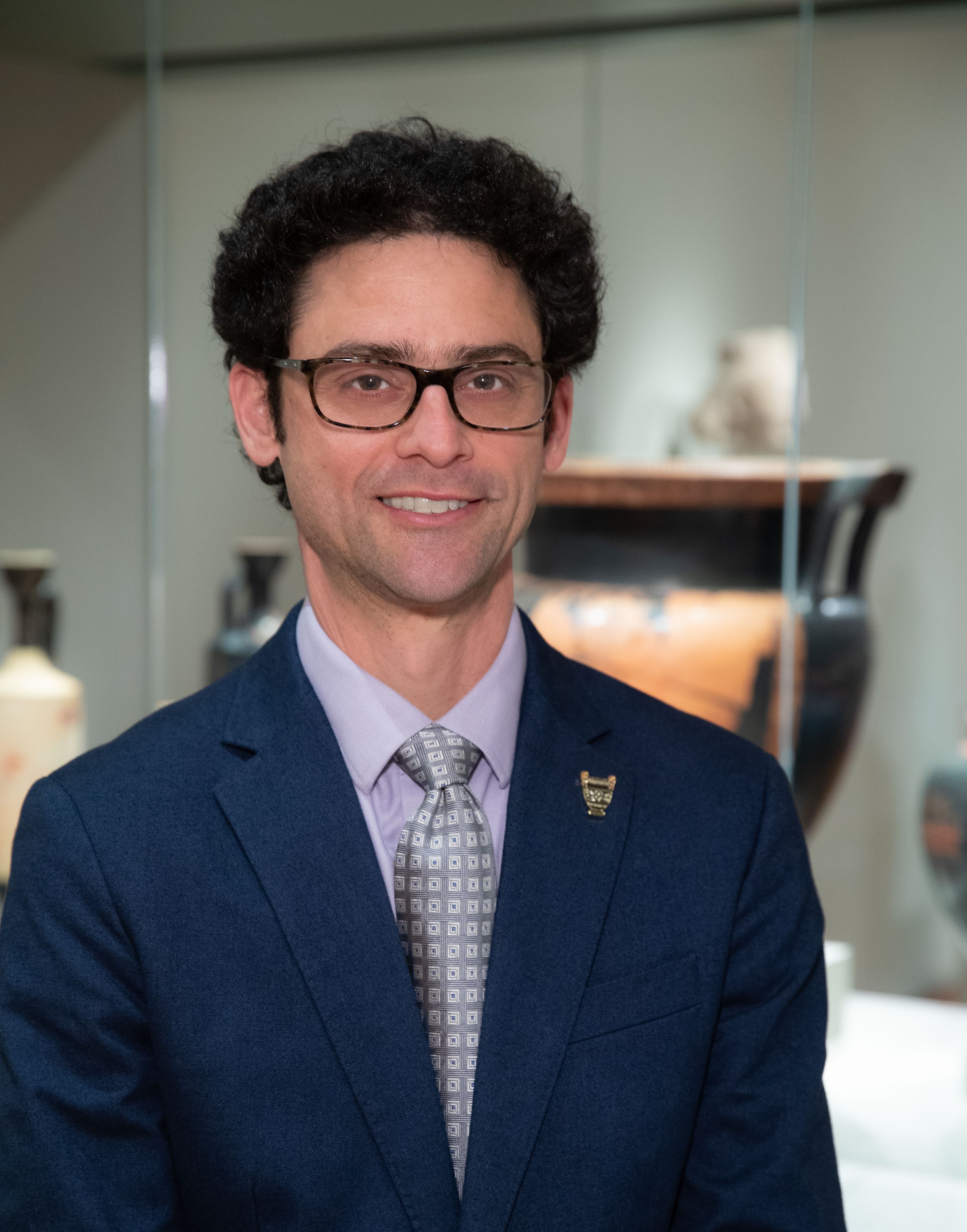
Seth Pevnick is the Alexander Durn Curator of Greek and Roman Art and Chair of Art of the Ancient Mediterranean, Africa, and Europe to 1800, and Decorative Art at the Cleveland Museum of Art, where he has worked since 2019. His primary responsibilities include researching, presenting, and augmenting the collection of art of the ancient Mediterranean world, including Greece, Rome, Egypt, and the ancient Near East. Pevnick has curated numerous exhibitions, including Poseidon and the Sea: Myth, Cult, and Daily Life (2014), for which he edited and contributed to an accompanying catalogue. He has spoken and written widely, particularly on Greek vase painting, bronze sculpture, and the history of collecting. His upcoming 2027 exhibition, titled Named and Unnamed, explores ancient Greek artistic identity and a related paradox—the names that survive in signatures on artworks rarely align with the names of the artists most celebrated in ancient literature.
Prior to his employment at Cleveland, Pevnick worked at the Tampa Museum of Art (2009-19) and the J. Paul Getty Museum, Getty Villa (2008-09), as well as on archaeological excavations in Greece and Albania. He holds a PhD in archaeology from UCLA and a BA in classical archaeology from Dartmouth College and has received fellowships from the American School of Classical Studies at Athens and the American Academy in Rome. A board member of the Cleveland Archaeological Society and adjunct art history professor at Case Western Reserve University, Pevnick has also served as a committee member of the Archaeological Institute of America.
This talk presents a cultural biography of an ancient Athenian red-figure column-krater acquired by the Cleveland Museum of Art in 1924. Attributed to the Pig Painter and featuring unusual iconography – a vomiting komast (reveler) facing a youth (A) and a dancing komast (B) – the vase shows several ancient revisions where preliminary sketch lines diverge from painted ones, plus a large post-firing graffito on the neck reading SIMONOS (“of Simon”). Though lacking a secure archaeological provenience, the vase was formerly in the Canessa Collection and bears modern repairs backed with Italian printed text, suggesting a possible findspot in Magna Graecia, perhaps within the tomb of someone named Simon. Alternatively, the unusually prominent graffito may be a modern addition intended to attract buyers. Through examination of its iconography, production techniques, graffito, and modern reconstruction and publication, the life story of this vase highlights shifting tastes – both ancient and modern – in the reception of Greek vases.
https://www.clevelandart.org/art/1924.197
This talk considers an unusual phenomenon within Athenian painted pottery – the depiction of inscribed vessels. Known in some 25 instances, mostly on red-figure cups, represented inscriptions often read simply KΑΛΟΣ or ΚΑΛΕ (“beautiful”), mirroring the most common inscriptions painted on actual cups. Others comprise nonsense, while a few bear proper names, raising important issues of self-referentiality, artistic identity, and reception. For while the depicted inscribed vases can be compared to other inscribed representations as efforts at verisimilitude, they also do more. The actions and contexts of the painted figures and ancient users may mirror one another, and one depicted inscribed name (ΔΟΡΙΣ/Douris/Doris) suggests a kind of meta-discourse between artists.
Based on an article in a forthcoming edited volume: https://uwpress.wisc.edu/Books/P/Phenomenology-and-the-Painted-Vase
This lecture explores the use of kalos-inscriptions in Athenian vase-painting, especially the name Lykos, which appears on more than 30 Athenian red-figure vases produced in the first few decades of the 5th century B.C. Based on their relatively restricted chronology and attribution to a small number of mostly related workshops, previous scholars have suggested that many (if not all) of these kalos-inscriptions refer to a single historical figure, presumably a good-looking Athenian aristocrat. The popularity of this name on vases and elsewhere, together with its non-onomastic meaning (“wolf ”), invites alternative interpretations, most notably the possibility that several instances may refer to a famous racehorse known to have prevailed at Olympia.
Based on a 2021 Hesperia article: jstor.org/stable/10.2972/hesperia.90.4.0641