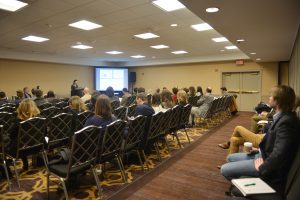
The 2026 Annual Meeting was held in San Francisco, CA from January 7–10 at the Hilton San Francisco Union Square. The academic program began on the morning of Thursday, January 8 and finished on the afternoon of Saturday, January 10. Sessions were scheduled within morning, midday, and afternoon blocks. Paper order within a session may not reflect the final time slots. Please check the annual meeting app and printed program for exact order and times.
Organizer(s): Sarah W. Kansa, Open Context, and Eric C. Kansa, Open Context
Panelists: Ann Glennie, College of the Holy Cross, James Newhard, College of Charleston, Adam T. Rabinowitz, University of Texas at Austin, and Anthony Tuck, University of Massachusetts Amherst
Organizer(s): Emily Wiley, Rutgers University, and Corinne Muller, Penn Cultural Heritage Center, Penn Museum
Panelists: Ayman al-Nabo, Idleb Antiquities Center, Claudia Bührig, Damascus Branch Office and Research Center of the DAI, Ammar Kannawi, Syrians for Heritage (SIMAT), Brian I. Daniels, Penn Cultural Heritage Center, and Corinne Muller, Penn Cultural Heritage Center
Evolving Monsters: The Developing Role and Symbolism of Sirens in Archaic Greek Art
Theodoros Mazis, University of Oxford
‘Orientalizing’ or Natural History? Griffin Protomes as New Life Forms
Guy Hedreen, Williams College
The Deconstructed sēma: Statue Burials in Early Democratic Attica
Peter A. Thompson, NYU–IFA/Oxford
Through the Eyes of a Child: Growing Up in an Ancient Greek House
Laurel Fricker, University of Michigan
SEG 34.664, SEG 38.658, and the Putative Heroön of Philip II at Philippoi
Paul A. Iversen, Case Western Reserve University
Echoes of Harmony: The Golden Ratio in Greek and Roman Theater Architecture
Dov Tamarkin, Tel Aviv University
Progress to Paikuli: An Archaeological and Literary Reconstruction of Narseh’s Processional Route of 293 CE
Mark K. Gradoni, University of California, Irvine, Melissa DePierro, University of California, Irvine, Carlo Cereti University of California, Irvine, Giulio Maresca, Sapienza Universita di Roma, and Gianfilippo Terribili, Sapienza Universita di Roma
“Ancient temples collapsed”: Rewriting a Procession to Convert Hadrian’s Mausoleum in the Christian Historical Memory of Rome
Kearstin Jacobson, University of Texas at Austin
Movement and Presence in Heritage Tourism: The Footsteps of Saint Paul Cultural Route in Corinth, Greece
Hannah L. Lents, The University of Texas at Austin
George Finlay’s Deme: Archaeology and Foreign Land Ownership in Nineteenth-Century Greece
Sebastian Marshall, University of St Andrews
Two Decades Towards the Creation of the Parrhasian Heritage Park of the Peloponnesos
David Gilman Romano, Parrhasian Heritage Foundation, Mary E. Voyatzis, Parrhasian Heritage Foundation, Mark Davison, Parrhasian Heritage Foundation, Panagiota Pantzou,
Organizer(s): Nicholas Cahill, University of Wisconsin-Madison
Step-by-step: Urban terracing practices in Lydian Sardis
Güzin Eren, Boston University
The Palaces of Croesus and of his Ancestors
William Bruce, University of Kansas
An Extramural Lydian Neighborhood at Sardis
Eric Hensley, University of Wisconsin-Madison
Tracing Tombs around Sardis
Leyla Uğurer, Cornell University, Susanne Ebbinghaus, Harvard University, and Annetta Alexandridis, Cornell University
Is this the End?: Parsing Out Cycles of Use, Reuse and Destruction in Late Roman Central Sardis
Frances Gallart Marqués, Sardis Expedition
Measuring the Immeasurable: The Curvatures of the Temple of Artemis at Sardis
Fikret Yegül, University of California – Santa Barbara, and Philip Stinson, Kansas University
Fleshing out the Historical Production of Egyptian Blue
Hilary Becker, Binghamton University, Tyler Rust, Independent Scholar, and Jeffrey T. Pietras, Binghamton University
Crumbs of Evidence: Considering Fragmentary Evidence for Bread Production at Poggio Civitate
Nora Donoghue, Gonzaga University
Advertising Producers on Luxury Vessels: Imagistic Script and Workshop Makers’ Marks on late Roman Portable Objects
Hallie G. Meredith, Washington State University
Made in Motion: Craft Mobility between Satricum and Pofi in Pre-Roman Lazio
Martina Revello Lami, Leiden University
The Production of Roman Period Marble Statuettes in Phrygia and The Agents Routing to Its Expansion
Veli Kose, Ankara University
Archaeological Invetigations of the Ancient Maya Granite Quarry-Workshops of the Mountain Pine Ridge, Belize
Jon Spenard, California State University San Marcos
Organizer(s): Shannon Dunn, AJA, Bryn Mawr College, and Luke Madson, Rutgers, The State University of New Jersey
Tainaron as a Place of Refuge
Chelsea Gardner, Acadia University
Gytheio, Emporia, and Religious Change in Hellenistic Laconia and Sparta
Luke Madson, Rutgers, The State University of New Jersey
The Bronze Tainiai from the Sanctuary of Apollo Hyperteleatas in Laconia
Nicolette Pavlides, University of Edinburgh
Exploring Evolving Identities in Ancient Geronthrai
Elizabeth Langridge-Noti, UC San Diego, Mieke Prent, Vrije Universiteit Amsterdam (Free University, Amsterdam), Els Hom, Independent Scholar, and Stuart Thorne, Independent Scholar
Selinous: a new Classical-Hellenistic fortified acropolis in the western foothills of the Parnon
Mieke Prent, Vrije Universiteit Amsterdam, Athanasios Themos, Epigraphic Museum, Athens, Eleni Zavvou, Epigraphic Museum, Athens, and Stuart MacVeagh Thorne, Independent Scholar
Walnut Maidens and Murdered Men: Evolving Myths and Toponyms in a Lakonian Border Town
Shannon Dunn, Bryn Mawr College
Sponsored by: AIA Numismatics Interest Group
Organizer(s): Benjamin Hellings, Yale University Art Gallery
Discussant: Fae Amiro, University of Western Ontario
The Coinage of Expelled Populations in Classical Greece: Mobility, Circulation, Identity
James Hua, Oxford University
All Rhodes Lead to Rome: A Geographic Study of the Circulation of Rhodian Coinage in the Late Roman Republic
Araceli Rizzo, Columbia University
Coins on the March: the Hoards of the Anonymous Coins of the Civil Wars 68-69 CE
Elizabeth Fajardo, University of California, Berkeley
Changing Representations: The Iconography of Maternal Power in the Numismatics of Julia Domna Across the Roman Empire [WITHDRAWN]
Grace Niehaus, University of Victoria
Sponsored by: Penn Cultural Heritage Center
Organizer(s): Alyssa C. Thiel, Penn Cultural Heritage Center and Brian I. Daniels, University of Pennsylvania, Penn Cultural Heritage Center
Panelists: Patty Gerstenblith, Center for Art, Museum & Cultural Heritage Law, María José Buerba Romero Valdés, Office of the Legal Adviser, Ministry of Foreign Affairs, Virginia Hermann, U.S. Department of State, and Daniel Healey, Worcester Art Museum
Sponsored by: Roman Provincial Archaeology Interest Group (RPAIG)
Organizer(s): Colin Omilanowski, University of Arizona, and Anne Hunnell Chen, Bard College
Panelists: Rob Collins, Newcastle University, Erin Peters, Appalachian State University, Sarah Craft, Florida State University, Alice Lynn McMichael, Barnard College, Blair Fowlkes Childs, Columbia University, Zoé Elise Thomas, University of Texas at Austin, and Michelle Heeman, Stanford University
Sponsored by: Etruscan Interest Group
Organizer(s): Alexandra A. Carpino, Northern Arizona University, Daniele F. Maras, Museo Archeologico Nazionale di Firenze, and Richard De Puma, The University of Iowa
Panelists: Daniele F. Maras, Museo Archeologico Nazionale di Firenze, Luana Toniolo, Museo Nazionale Etrusco di Villa Giulia, Nancy de Grummond, Florida State University, Alexander Ekserdjian, Yale University, Kristine Bøggild Johannsen, Thorvaldsens Museum, Bodil Bundgaard Rasmussen, The National Museum of Denmark,Cecilie Brøns, Ny Carlsberg Glyptotek, Vinnie Nørskov, Aarhus University, Renée Dreyfus, Fine Arts Museums of San Francisco, de Young / Legion of Honor, and Lisa C. Pieraccini, University of California Berkeley
The Midas Monument in Historical Context
Mark Munn, The Pennsylvania State University
Tracing Zoroastrian Funerary Practices in Petra: Insights into Cross-Cultural Exchange
Jennifer Ramsay, State University of New York (SUNY) Brockport, and Björn Anderson, University of Iowa
Kyphi Discovered at Tell Timai, Egypt
Robert J Littman, University of Hawaii at Manoa, and Jay Silverstein, Nottingham Trent University
Sarapis Beyond Egypt: An Exploration of Serapea in Asia Minor
Laryssa A. Shipley, University of Arizona
Sponsored by: Student Affairs Interest Group
Organizer(s): Allison A. Davis, University of North Carolina at Chapel Hill, and Wendy Vencel, North Carolina State University
Panelists: William Loder, Independent Scholar, Adin White, Chico State University, Joel Christensen, CUNY, Jennifer Sacher, Hesperia, American School of Classical Studies at Athens, Natalie Susmann, Brandeis University, and Dani McIvor, Exec Director, The Alliance for Historic Hillsborough
Rural Life in Inland Sicily: Preliminary Results of the Khora of Archaic Morgantina Project (KAMP)
Kevin Ennis, Indiana University Bloomington, Alex Moskowitz, Amherst College, Helen Wong, University of Pennsylvania, and Danielle Perry, University of Pennsylvania
The Life and Death of a Life-Sized Limestone Woman at Morgantina
William Pedrick, Princeton University, and Kevin Ennis, Indiana University
Epigraphy, Topography, and Politics in the Agora of Hellenistic Morgantina: A New Decree of the Council
Randall Souza, Seattle University
Building Memories: Materiality and Funerary Monuments in Fourth-to-First Century BCE Sicily
Claire C. Challancin, American University of Rome
For the Love of Gods: Eroticism, Pursuit, and the Divine in the Art of Selinunte
Douglas Braun, Institute of Fine Arts, NYU
Organizer(s): Gregor Kalas, University of Tennessee, Knoxville, and Colin Whiting, Dumbarton Oaks
The Architectural Design of Late Antique Rome: Metrology and Acoustics on the Eastern Caelian
Gianluca Foschi, Newcastle University, Paolo Liverani, and Ian Haynes
Constantius II and Constantina in Rome: Dynastic Unity and Christian Piety
Michele Renee Salzman, University of California, Riverside
The Transformed Radiance of Rome’s Late Antique Audience Halls
Gregor Kalas, University of Tennessee at Knoxville
Governing Rome at the End of Empire
Alessandro Battaglia, New York University
(Re)Visualizing a Sanctuary: The Cave of the Nymphs and Pan at Daphni
Caroline L. Carter, University of Virginia
Digitally Reconstructing the Eastern Workshops of the Athenian Agora: Visualizing Commerce and Architecture During and After the Peloponnesian War
Aspasia Efstathiou, University of Thessaly-ASCSA
Breathing Life into Stone: Using 3D Technology to “Resurrect” Classical Grave Monuments
Stephanie Polos, University of Virginia
Managing the Interpretation of Ancient Spaces Using 3D Simulations: A Case-Study in the Colosseum
Zackary Hegarty, Indiana University
Staging Senses: Art, Architecture, Theatricality, and Sensory Experience at the Serapeum of Hadrian’s Villa in Tivoli
Myat Thinzar Aung, The University of Texas at San Antonio
Excavations in the Monumental Center of Tharros, Sardinia
Steven J.R. Ellis, University of Cincinnati, and Eric E. Poehler, UMASS, Amherst
Fieldwork Report: Excavations at the Lago di Venere, Pantelleria (Italy)
Carrie Murray, Brock University, Eóin O’Donoghue, Brandeis University, Kate Kreindler, University of Virginia, and Maxine Anastasi, University of Malta
City of Caelestis: The Memory of the Tophet and Civic Identity in Roman Carthage
Christopher Saladin, Rowan University
Towards an Archaeology of Visible and Invisible Horticultural Labor: Archaeological Evidence for Gardeners and Gardening at the Casa della Regina Carolina, Pompeii
Kaja Tally-Schumacher, Harvard University, Caitie Barrett, Cornell University, Annalisa Marzano, University of Bologna, Kathryn Gleason, Cornell University, and Lee Graña, University of Bologna
Artificial Lighting Systems in Post-Earthquake Pompeian Gardens
Emily Lime, University of North Carolina, Chapel Hill
An Architectural History of Villa A, Oplontis (Torre Annunziata, Italy)
Michael L. Thomas, The University of Texas at Dallas
Ancient Philological Restorations in the House of Orion (V, 2) at Pompeii
Brittany C. Proffitt, University of Missouri- Columbia
Sponsored by: Museums and Exhibitions Committee
Organizer(s): Sarah Lepinski, The Metropolitan Museum of Art, Lisa Anderson-Zhu, The Walters Art Museum
Panelists: Seth Pevnick, Cleveland Museum of Art, Jessica Powers, San Antonio Museum of Art, Lynley McAlpine, San Antonio Museum of Art, Carolyn M. Laferrière, Princeton University Art Museum, MaryKate Cleary, Princeton University Art Museum, Jens Daehner, J. Paul Getty Museum, and Maya Muratov, The Metropolitan Museum of Art
Complex Context: Examining the Exhibition of Repatriated Artifacts in Turkish Museums
Skylar Masuda, Fulbright Türkiye
Constructing Early Helladic Askitario
Kyle A. Jazwa, Maastricht University
Welcome to the Neighborhood: Reassessing Pompeii’s Urban Structure and Identity with Radial Distance Analysis
Matthew D. Selheimer, University of Leicester / Lone Star College
An Experiment on the Performance of Pigments between Encaustic and Tempera Applications
Abigail Chapman, University of Missouri Columbia
Fleeting Reign, Enduring Fabric: An Antoninianus of Tacitus with Textile Remains
Arielle Suskin, Case Western Reserve University, and Clara Pinchbeck, Case Western Reserve University
Finding Shipwrecks: Archaeological and Environmental Variables for Predictive Modeling in the Eastern Mediterranean
Cassidy J. Robertson, AIA Niagara Peninsula Society
The Pantheon: Porch Design and Divine Narrative
Richard A. Etlin, University of Maryland
An Unidentified Glyph of the Obeliscus Tiberinus
Robert S. Wagman, University of Florida, Andrew G. Nichols, University of Florida, and William N. Bruce, University of Kansas
Reassessing Bronze Age Settlement at Torre Mordillo: Results from the 2025 Excavation
Ilaria Battiloro, Mount Allison University, Mattia D’Acri, Princeton University, Nicholas Cullen, Stanford University, Olivia Foran, Queen’s University, Giuseppe Lucarelli, Università della Tuscia, Simone Giosué Madeo, Università di Genova, and Parrish Wr
Eroding Prehistory: Predicting River Migration and Site Loss at Altar de Sacrificios
Jill Onken, University of Arizona
The Xiongnu Occupancy of Baga Gazaryn Chuluu, Mongolia
Mark E. Hall, Independent Scholar, Chunag Amartuvshin, National University of Mongolia, Michelle Hrivnyak, Western Michigan University, William Honeychurch, Yale University, and Albert Nelson, University of Michigan
The Use of Obsidian in Late Iron Age in Sardinia: A Recent Discovery at Nuraghe S’Urachi
Robert H. Tykot, University of South Florida, Peter van Dommelen, Brown University, and Julia Gustafson, University of Cambridge
A DEM for Seven Hills: Reconstructing Republican Rome’s Topography
Kurtis A. Butler, University of Missouri
The Melanes Monolith: A Multidisciplinary Analysis of a Colossal Architectural Block on Naxos
Maya Parfitt, College of William & Mary, Devon Keesee, College of William & Mary / University of St. Andrews, and Jessica Paga, College of William & Mary
The Roman Terracotta Masks of Corinth: The Assemblage from East of Theater
Emmanuel Aprilakis, Rutgers University / Texas A&M University
Two Late Bronze Age Double Pit Graves from the Athenian Agora
Trevor Van Damme, University of Warwick
Secondary Glass Production in Rough Cilicia
Paige S. Daniels, University of Colorado Boulder
Forgotten Frankoklisi: A Frankish Tower-Chapel in Mani
Christos Zigoumis, Carleton University
Preliminary Results from the Faunal Remains of Tharros (OR, Sardinia)
Bailey Franzoi, University of Michigan
Revolutionizing Rock Art Documentation: A Multi-Stage Digital and Analytical Workflow Northern Saudi Arabia
Norah Alqahtani, Inventory Specialist, and Nada Mesfer Alradhan, Heritage Commission, Ministry of Culture, Saudi Arabia
Ritual or Refuse Disposal? A Zooarchaeological look at the Crossroads Enclosure (Athenian Agora)
Katie Tardio, Bucknell University, and Jacqueline Meier, University of North Florida
Antiquity and Heritage in the 21st Century Berber Pottery of Sejnane
Paul Dambowic, Pratt Institute
Archaeology in Montenegro: Historical Legacies and Contemporary Challenges
Dušan Medin, University Donja Gorica, Faculty for Culture and Tourism
Mapping and Excavating a Pre-Colonial African Kingdom
James Bloom, Ethical Culture Fieldston School
The Quantitative and the Quotidian: The Embodied Mathematics of Women’s Labor in Classical Greece
Katherine B. Harrington, UNC Greensboro
Conservation Through Innovation: Integrated Archaeological Methods at Crnobuki
Jessica M. Morris, Cal Poly Humboldt
Putting Objects to Work: Using Artifacts to Foster Museum Literacy and Museum-Going Identities
Jen Thum, Harvard Art Museums
Sponsored by: MAPMA
Organizer(s): Fotini Kondyli, University of Virginia, and Angelo Castrorao Barba, Escuela de Estudios Árabes (EEA), Granada, Spain
Islamic Landscapes in Transition: Comparing Patterns of Change in Sicily and al-Andalus between Late Antiquity and the Early Middle Ages
Angelo Castrorao Barba, School of Arabic Studies EEA, Spanish National Research Council CSIC, Granada
Reassessing the Islamic Cemetery at the Domus Romana of Rabat: Archaeological Legacy and Digital Innovation
David Cardona, Heritage Malta, and Davide Tanasi, University of South Florida
Medieval Alpine Archaeology: Power, Production, and Environment between Italy and Switzerland (8th–13th Century)
Federico Zoni, Università degli studi di Bergamo
Archaeology of Monastic Landscapes: Reconstructing Sacred Space and Environment at Kosmosoteira in Byzantine Thrace
Fotini Kondyli, University of Virginia, Georgios Makris, University of British Columbia, Görkem Günay, Koç University, Dimitra Sikalidou, Aristotle University of Thessaloniki, and Justin Mann, Dumbarton Oaks
Contextualizing Fortifications: A Report on the Third Season of the Medieval Roman Archaeological Survey of Kalymnos
Drosos Kardulias, University of Michigan
Fieldwork at the 16th-century Fortress of Achillio in Southern Mani, Greece: Survey, LiDAR, and Photogrammetry
Rebecca Seifried, University of Massachusetts Amherst, Philip Sapirstein, University of Toronto, Chelsea A.M. Gardner, Acadia University, and William Parkinson, Field Museum; University of Illinois at Chicago
Organizer(s): Valeria Riedemann Lorca, University of Washington, and Karolina Sekita, Tel-Aviv University
Discussant: Luigi Todisco, Università degli Studi di Bari
New Observations on the Preserved Sculptural Decoration of Hypogeal Tombs from Canosa
Luigi Todisco, Università degli Studi di Bari
The Funerary Hypogea of Daunia between the Fifth and the Second centuries BCE. Architecture, Paintings, Funerary Rituals and Assemblages
Andrea Celestino Montanaro, National Research Council of Italy, Institute for Heritage Science – Lecce
Burial, Population, and Identity in Pre-Roman Southern Apulia
Giovanni Mastronuzzi, Università del Salento, Valeria Melissano, Università del Salento, Giacomo Vizzino, Università del Salento, Foteini Gkrizi, University of Thessaly, and Giorgia Tulumello, National Archaeological Museum of Reggio Calabria
Family Burials at Roccagloriosa. Structure, Decoration, Intent
Helena Fracchia, University of Alberta, and Maurizio Gualtieri, University of Alberta
Theoretical Perspectives and New Approaches on the Interpretation of Necropoleis and Funerary Chamber Tombs of Etruria and Campania
Mariassunta Cuozzo, Università del Molise Campobasso
The Forgotten Tombs. Etruscan Sarcophagi in Context.
Laura Nazim, Ruhr-Universität Bochum
Funerary Landscapes and Political Authority. Chamber Tombs and Necropoleis in the Middle and Lower Tiber Valley
Maria Cristina Biella, Sapienza Università di Roma
No Need to BYOC: An Analysis of Handleless Cups, Tripod Cookpots, and Commensality at Bronze Age Ayia Irini, Kea
Natalie Abell, University of Michigan, Jami Baxley Craig, Florida State University, Lauren Alberti, University of Michigan, and Christine Weber
A Picture is Worth a Thousand Words: Mycenaean Pictorial Pottery as a Social Strategy
Sophie Cushman, University of California, Berkeley
Rethinking Mycenaean Palaeography
Theodore M. S. Nash, University of Michigan
The Damos at Ancient Pylos: The Case for Marx’s ‘Primitive’ Communism
Ian Tewksbury, Santa Clara University
Squatters in the Mansion: The LH IIIC Late Reoccupation Phase at Koukounaries, Paros
Jason Earle, The Institute for Aegean Prehistory
Reconsidering Nichoria: Continuity from the Late Bronze Age to the Early Iron Age
Allison A. Davis, University of North Carolina at Chapel Hill
Sponsored by: Anatolian Archaeology Interest Group
Organizer(s): Omur Harmansah, University of Illinois at Chicago
Discussant: Jennie Bradbury, Bryn Mawr College
Introduction: Yalburt Yaylası Archaeological Landscape Research Project 2010-2021
Omur Harmansah, University of Illinois at Chicago
The Performance of Hydrologic Control: a Late Hittite Dam that Could Never Hold Water
Ben Marsh, Bucknell University
Between a Settlement and a Hard Place: Biography of the Second Millennium BCE Upland Site at Yalburt Yaylası
Müge Durusu-Tanrıöver, Temple University
Palimpsests of Pastoralism and the Sacred: the Karst Uplands above Yalburt Yaylası
Peri Johnson, University of Illinois at Chicago
Placing Toriaion in its Historical Landscape, Recontextualizing an Epigraphic Dossier
Noah Kaye, Michigan State University
Vegetation Cover as a Guide to Archaeological Context in Landscape Survey
Bochay Drum, Independent Researcher
Ecofacts Between Sites
Shannon Martino, Morton College
Ionians Abroad: New Evidence for Greek Mercenaries in the Levant
Aaron Burke, University of California, Los Angeles
Archaic Finewares from the Sanctuary of Isthmia
Angela Ziskowski, Coe College
Petite mais puissante: The Corinthian Pottery Assemblage at Marseille
Haley Bertram, Ohio University
Negotiating Identity Through Clay: Hellenistic Pottery and Cultural Interaction in the Seleucid East
Ileana De Giuseppe, University of California, Irvine
Value on the Vine: An Archaeo-textual Approach to the Study of High Value Wines in the Hellenistic and Early Roman Mediterranean
Sarah T. Wilker, De Anza College, and Rachel E. Dubit, Dartmouth College
‘These Very Curious Fragments’: Eros, Kosmesis, and Burgon’s Lebes Gamikos
Sheramy Bundrick, University of South Florida
Face Down: Iconographic Censorship and the Mutilation of Hector on Attic Vases
Keren Freidenreich, The Graduate Center, CUNY
Sleeping Flasks, Waiting Lamps: Self-Reflexive Servile Objects of Ptolemaic Egypt
Charlotte R.F. Mandy, Columbia University
YOUR FACE IS AS A BOOK: Figurine Heads from Tell Hadidi
Jennifer Fueger, University of Wisconsin-Milwaukee
Omphalos Bowls at Iron Age Gordion: Individuality, Standardization, and Status
Braden W. Cordivari, Institute for the Study of the Ancient World, New York University
Making Wonder: Workmanship and the Cross-Cultural Appeal of Late Antique Iranian Silver Vessels
Arvin Maghsoudlou, Los Angeles County Museum of Art
In the Presence of the King: Proprioception, Protocol, and the Architecture of Etiquette at Persepolis
Neville McFerrin, University of North Texas
Motherhood and Political Agency in Etruscan Women’s Votive Inscriptions during Roman Expansion
Claudia Paparella, University of Toronto
The Agora Valley Project at Morgantina, Sicily: Report on the 2024–2025 Field Seasons
Christy Schirmer, Wesleyan University, Anne Truetzel, Davidson College, William Pedrick, Princeton University, Alex Moskowitz, Amherst College, Claire Challancin, American University of Rome, Sheridan Marsh, University of Pennsylvania, Phoebe Thompson, University of Pennsylvania, Kevin Ennis, Indiana University, and Alex Walthall, University of Texas at Austin
The Cult of Sabazius at Pompeii: The 2021-2025 Fieldwork Seasons in the Complesso dei Riti Magici
Anna Anguissola, University of Pisa, Italy, and Riccardo Olivito, IMT School of Advanced Studies Lucca, Italy
The Ritual Lives of Oysters: Marine Resource Exploitation and Deposition in Roman Britain
Avner Goldstein, Boston College
Provincial Possibilities: Comparing “Altar Habits” in Roman Britain and Syria
Blair K. Betik, Yale University
The Cult of Jupiter and Hercules Saxanus: Two Altars from Slovenia
Patricia A. Butz, University of California Riverside
The Spatial Politics of Lycian Tomb Monuments and their Adaptation at the End of Antiquity
Allison B. Kidd, The British Museum
Reading Between the Lines: Naming Subelite Households in Pompeii I.14
Laura Malagrino, Oxford University
Writing on the Walls, Standing in the Forum: The Agency of Intermediate Bodies in Pompeii
Simone Ciambelli, Università di Bologna / Brown University
An Appetite for Metal: The Consumption of Bronze Kitchenwares in Pompeii
Aaron D. Brown, Stanford University
Platonism in Pompeiian Paintings: Behind the Wrestling of Eros and Pan
Emily Wiley, Rutgers University
Carthage in Pompeii: The Dido Fresco from the Casa del Meleagro
Marguerite C. Knapp, AIA Western MA Society
Sponsored by: Hellenic Ministry of Culture
Organizer(s): Anastasia Gadolou, Hellenic Ministry of Culture, Archaeological Musuem of Thessaloniki, and Andreas Vlachopoulos, University of Ioannina
The Project of Restoration and Enhancement of the Archaeological Site of Petres in Florina: Connecting the Local Community with its Cultural Heritage
Elpiniki Naoum, Hellenic Ministry of Culture, Ephorate of Antiquities of Pella
Connecting the Past with the Present: How the Enhancement of the Emblematic Ancient Theater and its Surrounding Monuments in the Phrourion Hill of Larissa in Thessaly, Central Greece, has Transformed the Life and Identity of its Citizens
Stavroula Sdrolia, Hellenic Ministry of Culture, Ephorate of Antiquities of Larissa, and Giorgos Toufexis, Hellenic Ministry of Culture
Innovating Cultural Heritage Preservation and Visitor Engagement: The Role of RFID Technology at the Archaeological Museum of Thessaloniki
Evangelia Tsagaraki, Hellenic Ministry of Culture, Department of Metallurgy of the Archaeological Museum of Thessaloniki, Dimitrios Karolidis, Department of Conservation of the Archaeological Museum of Thessaloniki, and Aggeliki Moneda, Department of Digital Transformation of the Archaeological Museum of Thessaloniki
The New Archaeological Museum at Chania in Crete: A Reservoir of Knowledge and Experiences.
Eleni Papadopoulou, Head of the Ephorate of Antiquities of Chania
The Dynamic of Cultural Routes in the Protection and Communication of Cultural Heritage
Anastasia Gadolou, Director General of the Archaeological Museum of Thessaloniki, and Elena Kountouri, Directorate of Prehistoric and Classical Antiquities and the Ephorate of Antiquities of Athens
Reconsidering the “Tiberius Relief”: Recarved or Not?
John Pollini, University of Southern California
Late Roman Reused Coin Pendants and the Performative Potential of Jewelry
Elisha A. Dumser, University of Akron
A Colossal Zeus at Ancient Corinth
Aileen Ajootian, The University of Mississippi
Panelists: Lorenz Baumer, University of Geneva, Angeliki Simosi, Ephorate of Underwater Archaeology, Greece, Deborah Carlson, Texas A&M University, Justin Leidwanger, Stanford University, William Murray, University of South Florida, Harun Ozdas, Dokuz Eylul University, and Cemal Pulak, Texas A&M University
Re-building Bronze Age Heritage: Results of the AIA Nancy Wilkie Emergency Fund for Heritage Preservation at Tell Atchana, Alalakh (Hatay, Türkiye)
Murat Akar, Hatay Mustafa Kemal University
Unearthing Ethics: Displaying and Researching Human Remains
Yona Siero, None, independent
Choosing to Forget in Burial Studies
Megan M. Matheny, Saint Louis University
From the Ashes: Rapid Response Conservation and Community Heritage After the 2025 Los Angeles Fires
Kristine Garroway, Hebrew Union College, Kiernan Graves, AIA Member at Large, Site & Studio Conservation, LLC, and Margalit Schindler, AIA Member at Large, Pearl Preservation
Sponsored by the AIA Committee on Research and Academic Affairs
Organizer(s): James Newhard, College of Charleston and Joanne Murphy, University of North Carolina-Greensboro
Panelists: Carrier Galsworthy, Conestoga College, Catherine Foster, Argus Cultural Property Consultants, Steve Karacic, Chronicle Heritage, Inc.. Jen Thum, Harvard University, and Rachel Dewan, Skagway Public Library, U.S. Committee of the Blue Shield
Excavating a Hellenistic Military Community: Report on the 2025 Season at Pyla-Vigla, Cyprus
Melanie Godsey, Trinity University, Thomas Landvatter, Reed College, and Brandon Olson, Metropolitan State University of Denver
Matohasanaj Archaeological Project: Results from the Second Field Season
Erin Pitt, Sweet Briar College, Sabina Veseli, Albanian Institute of Archaeology, and Mirgen Shametaj, Sweet Briar College
Recent Excavations at Markova Kula: A Hellenistic Fortress in the Demir Kapija (Iron Gate) Gorge
Ordanche Petrov, Institute of Old Slavic Culture – Prilep, North Macedonia, Justin N. Carlson, Cal Poly Humboldt, Arcata, and Nick A. M. Angeloff, Cal Poly Humboldt
Fieldwork at Phoenix (Carian Chersonese) 2025
Asil Yaman, University of Pennsylvania
Death, Wealth, and the Landscape at Jebel Khalid, Syria
Helen C. Wong, University of Pennsylvania, and Erin M. Brantmayer, The University of Texas
Türkmen-Karahöyük 2025 Results from Field 6
Cory Crawford, Ohio University, and Dominik Lukas, University of Chicago
The Excavation at Megalos Peristeres Cave (Crete): A Preliminary Report
Thomas F. Strasser, Providence College, Andreas Darlas, Ministry of Culture (Greece), and Miriam Clinton, Rhodes College
Shaking Earth, Shaking Sea: The Theran Eruption and the Making of a Tsunami God
Giulia Paglione, University of Cincinnati, and Paolo Sabattini, University of California, Los Angeles
Knossos in the Final Palatial and Postpalatial Periods: Investigating the Decline of an Urban Landscape
Alice Crowe, Florida State University
Using the Archive as Subject: The Cases of the North-East House and the North Pillar Crypt at Knossos
Renee Trepagnier, University of Bristol and Ashmolean Museum
Lyktos Archeological Project (Crete): The Results of ISAW/NYU’s Fieldwork in 2024
Antonis Kotsonas, New York University, Cicek Beeby, Brown University, Sarah Norvell, Princeton University, Dominic Pollard, University of Cambridge, Filippos Roussos, University of Oxford, Christina Stefanou, New York University, and Valia Tsikritea, University of Cincinnati
Hierapytna’s Northern Expansion: A Hellenistic Beacon Tower at Mochlos (Crete)
Natalia Vogeikoff-Brogan, American School of Classical Studies at Athens
Sponsored by: AIA Gold Medal Committee
Organizer(s): Lora Holland Goldthwaite, University of North Carolina at Chapel Hill, and Alexandra A. Carpino, Northern Arizona University
“The glory of Philadelphia”: Pre-Roman Objects, American Museums, and Etruscan Studies
Hilary Becker, Binghamton University, and Jeffrey Becker, Binghamton University
Introducing the Etruscans: Emeline Hill Richardson and The Etruscans: Their Art and Civilization in post-war America
Laurel Taylor, University of North Carolina at Asheville
Scholarship on the Margins: Bonfante, Brendel, and the Power of Etruscan Studies
Francesco de Angelis, Columbia University
The Man from Murlo: The Legacy of Kyle Meredith Phillips
Ingrid Edlund-Berry, University of Texas at Austin, and Anthony Tuck, University of Massachusetts, Amherst
Mario Del Chiaro: Pioneering the Etruscans in California and Beyond
Lisa C. Pieraccini, University of California, Berkeley
Etruscan Mirrors in US Collections
Alexandra A. Carpino, Northern Arizona University
Military Bath-Houses as Indicators of Cultural Identity and Garrison Size: Evidence from Roman Britain’s Northern Frontier
James Kenneth, The University of Western Ontario
From Conquered to Conquerors: The Triumphant Rider on Military Funerary Stelae in Roman Britain
Madeline P. Newquist, Case Western Reserve University
Pannonian Pots for Sarmatian Stew? Cooking and Cuisine in Rome’s Danubian Borderland
Timothy C. Hart, University of Massachusetts Amherst
Outsiders at Intercisa? An Image of Breastfeeding on the Roman Danube Frontier
Nicola Barham, University of Michigan
disiecta membra: Building the Evidence for Roman Stone Architecture in Germany
Catherine Teitz, Johannes Gutenberg-Universität Mainz, and Johannes Lipps, Johannes Gutenberg-Universität Mainz
Sponsored by: Roman Provincial Archaeology Interest Group (RPAIG) and AIA Subcommittee on Climate Change
Organizer(s): Matthew Schueller, The College of William & Mary, and Andrew Welser, Duke University
Discussant: Amanda Gaggioli, University of Memphis
Roman Land Management at Magna Fort: Archaeological and Palaeoecological Evidence for Land Utilization
Franki Gillis, The Vindolanda Trust, Robert McCulloch, University of Edinburgh, and Rachel Frame, The Vindolanda Trust
Ditches and Drainage on the Roman Frontier: Controlling Water Movement at Vindolanda
Elizabeth M. Greene, University of Western Ontario, and Andrew Birley, The Vindolanda Trust
Silver, the Olive, and the Guadalquivir: Human-Driven Environmental Change in Hispania Baetica
Andrew Welser, Duke University
Riverside Erosion, Rising Groundwater, and Desiccation at Roman Stobi
Matthew Schueller, The College of William & Mary
Overcoming Resource Scarcity on the Edge of Empire: The Innovative Construction of Roman-style Baths in Arabia
Craig Harvey, University of Alberta
Sponsored by: Friends of Numismatics
Organizer(s): Roberta Stewart, Dartmouth College, and Fae Amiro, Western University
Discussant: Nathan Elkins, American Numismatic Society
Pale Sulfur for Broken Glass: Sulfur as Small Change?
Elliott Piros, Loyola Marymount University
Pierced and Cut: Contextualizing Small Change on the Roman Frontier in the First Century CE
Benjamin Hellings, Yale University Art Gallery
Imperial Women’s Portraits on Provincial Small Coinage during the Flavian-Trajanic Period: Importance and Significance
Raffaella Bucolo, University of Verona
The Emperor’s New Hair: Non-canonical Hairstyles of Augustus on Small Change in the Roman Province of Hispania
Francesca Lam-March, King’ College London
Uncovering Tarsus’ Small Change: A New Look at Pseudo-Autonomous Coinage
Campbell Orchard, Digital Curator of Greek and Roman Provincial Coins, University of Warwick / University of Oxford, Ashmolean Museum, Heberden Coin Room).
Sponsored by: First-Generation Low-Income Federation and the Committee on Contingent Faculty
Organizer(s): Ashley Eckhardt, American School of Classical Studies at Athens, and Katie Tardio, Bucknell University
Panelists: Naomi Campa, University of Texas at Austin, Matthew Chaldekas, Eberhard Karls Universität Tübingen, CJ Rice, Vassar College, Leticia R. Rodriguez, University of Houston, and Jeremy Swist, Michigan State University
Organizer(s): Helaine Blumenthal, Wiki Education Foundation, and Andres Vera, Wiki Education Foundation
Panelists: Chelsea Gardner, Acadia University, Geoff Emberling, University of Michigan, Ann Glennie, College of the Holy Cross, Katie Rask, The Ohio State University, Victoria Austen, University of Illinois Urbana Champaign, and Andres Vera, Wiki Education Foundation
Morere Alio Die: Consecratio Antoniniani and the Nearness of Death
Dylan MW Plemper, Emory University
‘Monumentum Memoriae’: Finding the Viewer in Late Antique Roman Sarcophagi
Camille Blanco, Brown University
A False-Bottom Lekythos from Princeton: Artistry, Artifice, and Symbolic Form
Paige Walworth, Princeton University
Mycenaean Regionalism: Late Helladic III Ceramic Distribution In Palatial Versus Non-Palatial Contexts
Luke Lomax, University of Toronto
Sardis: A Millennium of Adaptation
Jasper Chen, Columbia University
Rewriting a Dynasty: How One Coin Can Reshape Our Understanding of the Early Ptolemies
Sophia Ying, Carleton College
Sponsored by: Sponsored by the Society for Late Antiquity (SLA), Co-sponsored by the Medieval & Post-Medieval Archaeology AIA Interest Group
Organizer(s): Amelia R. Brown, Macquarie University, and Colin Whiting, Dumbarton Oaks
Panelists: Carly Maris, Wilmington College, Jessica Plant, Clare College, University of Cambridge, Amelia R. Brown, Macquarie University, Lorenzo Livorsi, University of Bamberg, and Mark Letteney, University of Washington
Are you Lonesome Tonight? Amedeo Maiuri and the Beginnings of Archaeology in the Dodecanese
Athena Hadji, College Year in Athens
Royal Residences: the Role of Ancient Traditions in the Formation of Warsaw’s Palace and Garden Complexes
Hubert Kowalski, University of Warsaw, Arkadiusz Cegliński, University of Warsaw, Monika Dunajko-Ceglińska, University of Warsaw, and Wiesław Małkowski, University of Warsaw
More than Grand Tour Memorabilia, Princeton Library’s First Numismatic Collection
Valentina Follo, American Academy in Rome
The Use of Greek and Roman Material Culture in Star Trek: Strange New Worlds
Kristen Seaman, University of Oregon
The Archaeometrical Study of Collective Cremation Deposits
Paula Becerra Fuello, University of Granada
aDNA Findings from Hellenistic and Roman Period Tombs in Cyrene and El Djaghbub, Libya
Victoria Moses, Brown University, Alison Barton, Harvard University, Oliva Menozzi,University of Chieti-Pescara, Michaela Lucci, University of Chieti-Pescara, Ruggero D’Anastasiou, University of Chieti-Pescara, Alfredo Coppa, Sapienza University, David Reich, Harvard University, and Michael McCormick, Harvard University
Echoes of Past Lives: A Multidisciplinary Microhistory of a Group of Roman-Period Burials at Histria, Romania
Adam Rabinowitz, The University of Texas at Austin, Elijah Fleming, University of Minnesota Duluth, Amber Kearns, The University of Texas at Austin, Erin Keenan-Early, The University of Texas at Austin, Katherine Reinberger, Center for Applied Isotope Stu
Genetic Evidence for Shifting and Contracting Mobility in Vandal and Byzantine Carthage, North Africa
Reed Johnston Morgan, Harvard University, Hamden Ben Romdhane, INP-Tunis, Najd Chalghoumi, INP-Tunis, Ralf Bockmann, Independent Scholar, Susan Stevens, Randolph University, John Humphrey, JRA, Jeremy Rossiter, University of Alberta, Harald Ringbauer, Ind
Karya Ossuary Project: Analysis of a 20th Century Skeletal Sample from Central Greece
Kaitlyn Stiles, Kleinfelder, Inc., and Petros Kounouklas, Greek Archaeological Service
Archaic Greek Altar Deposits: Ritual or Rubbish?
Jackson N. Miller, University of North Carolina at Chapel Hill
Bodies, Bears, and the Night: Liminality in the arkteia at Brauron
Ginevra Miglierina, University of Michigan
The Athenian Asklepieion and the Theater of Dionysus: Eye-Shaped Votives in Context
Alessandra Migliara, The Graduate Center, CUNY
The Sanctuary of Aphrodite Ourania Revisited: The Development of an Athenian Public Cult in the Archaic Period
Brian Martens, University of St Andrews
Running in Circles: The Diffusion of the Ruler Cult Tholos from Hellenistic Monarchs to the Roman Imperial Dynasty
Tarryn Andrews, Western University
Omnium municipum colonorum suorum censum agito: Tracing Colonial Networks in Late-Republican Italy with the Municipal Census
Drew A. Davis, University of Toronto
Ancient Kassandreia: Contextualizing a Roman Colony in Macedonia
Elise Poppen, Indiana University
The Villa as Minor Center: Combining Approaches to Stratified Landscapes
A. Bryce Deskins, Florida State University
Pushing up Vines: Botanical Symbolism in Roman Funerary Verse
Marina Cavichiolo Grochocki, Arizona State University
Sculpting Social Worlds: The Production and Significance of Travertine Sarcophagi at Hierapolis of Phrygia
Anna Anguissola, University of Pisa, Italy
A New Sarcophagus for a Roman General: Ancient Typology and Modern Reinterpretation
Alessia Di Santi, Scuola Normale Superiore, Pisa
Polyxena in Phrygia: Anatolian backgrounds of the Granicus River Sarcophagus
Sarah P. Morris, UCLA
Sponsored by: Ancient Painting and Decorative Media Interest Group
Organizer(s): Angela Bosco, Università di Bologna, and Hilary Becker, Binghamton University, and Antonella Coralini, Università di Bologna
From the Conservation of Materials to the Restoration of Memory: Material Archaeology on the Wall-paintings of Herculaneum
Angela Bosco, Università di Bologna, Marina Caso, Parco Archeologico di Ercolano, and Francesco Armignacco, Parco Archeologico di Ercolano
Unveiling Ancient Mastery: A Multi-Analytical Study of Roman Wall Painting Techniques from the Hypogean Villa of Positano
Sara Iafrate, Istituto Centrale per il Restauro, Raffaella Bonaudo, Soprintendenza Archeologia Belle Arti e Paesaggio per le Province di Salerno e Avellino, Manuel Giandomenico, Università di Roma La Sapienza; Istituto Centrale per il Restauro, Giancarlo
Function, Technical Process, Archaeometry and Digital Restitution: Problem and Methodological Approaches in Hispania in Roman Wall Painting
Gonzalo Castillo Alcántara, Universidad de Córdoba, Irene Loschi, Universidad de Sevilla, and Alicia Fernández Díaz, Universidad de Murcia
The First Example of a “non finito” in the Baetica Province: the Roman Wall Paintings from the Room K in the Domus I (Plaza de Armas del Alcázar Real, Écija, Seville, Spain)
Irene Loschi, Universidad de Sevilla
Quantifying the “Rich Female Grave”: Grave Good Wealth in Iron Age and Early Archaic Period Athens
Delaney R. Fisher, University of Texas at Austin
The Corrupted Sea: An Archaeological View of Maritime Plastics in Southeast Sicily
Sophia Wu, Stanford University, Nicole Constantine, Stanford University, Elizabeth Greene, Brock University, and Justin Leidwanger, Stanford University
Leather Bags as Writing Tablet Carriers from Vindolanda Roman Fort (UK)
Elizabeth M. Greene, University of Western Ontario, Alexander Meyer, University of Western Ontario, and Anna Willi, The British Museum
Nuraghe S’Urachi in the Second Century BCE: Insights from Area H
Anna Soifer, University of Puget Sound, Laura Martín Burgos, Independent Scholar, and Enrique Díes Cusí, Independent Scholar
Revisiting the Argive Heraion: The Old Temple Restored as Apteral, Split-Cella, In Antis Naos
Richard M. Economakis, University of Notre Dame
Mapping Heritage: A Digital Prototype for Baalbek, Lebanon.
Nehme Abou Rjeily, Lebanese University
Application of 3D Scanning to Excavation-Grade Coins
Andrew Victor Rivadeneira, University of Arizona, and Lauren Tomanelli, University of Arizona
Native American Occupation of the San Francisco Bay Area: The Last 2000 Years
Anya Dalal, Castilleja School
Stone by Stone: The Post-Herulian Wall and the Building Blocks of Lifecycles
Katrina Kuxhausen-DeRose, University of California Los Angeles
Mauretanian and Roman Period Chronology of Hinterland Sites in the Loukkos Valley, Northern Morocco
Christopher S. Jazwa, University of Nevada, Reno, Aomar Akerraz, Institut National des Sciences de l’Archéologie et du Patrimoine, Layla Es-Sadra, Mohammad V University, Rabat, Fadwa Benjafaar, INSAP, Stephen Collins-Elliott, University of Tennessee, Knox
The Materiality of Contemporary Displacement across the ‘Calabrian Route’
Michelle Heeman, Stanford University, Elizabeth S. Greene, Brock University, and Justin Leidwanger, Stanford University
Rieti and the Velino Valley: New Interpretations of Old and New Data
Gabriele Colantoni, University of Rochester, and Carlo Virili, Sapienza Università di Roma
Casting Iron Objects from the Marzamemi 2 “Church Wreck”: Evidence for a Navis Lapidaria?
Robert L. Muñiz, Stanford University, Justin Leidwanger, Stanford University, Elizabeth S. Greene, Brock University, and Andrea Gobbi, Acrobatica Group
PPMx: A Web-Based AI Solution for Searching Pompei Pitture e Mosaici by Image and Caption Similarity
David Fredrick, University of Arkansas, Cindy Roullet, indie game developer, France, and Cade DuPont, Software Engineer III, Walmart Global Tech
Remote Sensing and the Rural Hinterland of Acholla (Tunisia)
J. Andrew Dufton, Dickinson College, Siobhan Morgan, Dickinson College, Nichole Sheldrick, University of Leicester, Nesrine Nasr, Institut National du Patrimoine, Susan E. Alcock, University of Oklahoma, and Rached Hamdi, Institut National du Patrimoine,
Visualizing Power: Experiencing the Elite Landscape of Late Helladic I Mitrou in VR
Justin C. Langlois, University of Tennessee Knoxville
Digital Tools for Teaching and Learning about Etruscan Mirrors
Illizt Castillo, Bryn Mawr College
The Use of Butchered Meat in Roman Ritual: A Look at Mithras-Worship
Brigitte Keslinke, University of Pennsylvania
Just Another Pretty Face? Using Comparative Analysis to Explore the Role of Female Symposiasts in Red Figure Vase Paintings
Madison Poole, Brock University
First Evidence for Byzantine through Ottoman Plant Use at the Athenian Agora
John M. Marston, Boston University, Owen Lannon, Woods Hole Oceanographic Institution, Angela Zhang, Oxford University, and Anne Johnakin, Boston University
Hubs of Control: Podere Cannicci as an Administrative and Redistributive Center in Late Hellenistic Etruria
Alessandro Sebastiani, University at Buffalo, Edoardo Vanni, Università per Stranieri Siena, Fabiana Fabbri, Independent Scholar, Marta De Pari, Università degli Studi di Bari Aldo Moro, and Michael McCabe III, University of Leiden
Dynamic Transitions at the Etrusco-Roman Site at Pian di Mealla: Results from 2024 and 2025 Seasons of the Archaeological Reconnaissance Ficulle Project
Joey Williams, University of Oklahoma, Rhodora G. Vennarucci, Denison University, Jenny Weigel, Florida State University, Sue Alcock, University of Oklahoma, Claudio Bizzarro, Parque Arqueológico Ambiental de Orvieto, and Tom Keep, Getty Research Institut
Makeshift Marketplaces in the Roman City
Caitlin A. Knortz, Princeton University
Architecture and Urbanization in Roman Coastal Cities: Function, Integration, and Identity – The Case of Elaiussa Sebaste (TÜRKİYE)
HATİCE ASENA KIZILARSLANOĞLU, Kastamonu University
Questioning the Quadrifrons: Harbor Arches in an Expanded Field
Crystal Rosenthal, University of Texas at Austin
The Freedman’s Journey: Reconstructing the First Recorded Roman Encounter with Sri Lanka
Nimesh Fonseka, University of Maryland, and Stefan Woehlke, University of Maryland
A Newly Discovered Intact Early Etruscan Tomb in Northern Lazio
Jamie D. Aprile, Baylor University
100 Years of San Giuliano’s Necropolis – Landscape Changes, Rock-Cut Tombs, and Survey from 1925 to 2025
Anna Catherine Gibbs, University of Tennessee, Knoxville
An Etruscan Sanctuary by the Arno? Results of the 2024 and 2025 Seasons of the Montereggi Project
Jessica Tilley, Centre College, Andrea De Giorgi, Florida State University, Agnese Pittari, Archeorete, Giovanni Millemaci, Archeorete, and Catherine Uritis, Florida State University
Exploring the Oenotrian Settlement at Incoronata “Greca” (MT, Italy): New Findings from the 2025 Field Season
Sveva Savelli, Saint Mary’s University, and Spencer Pope, McMaster University
Sicily: Rocchicella di Mineo (ancient Palikè) – Field Seasons 2024 and 2025
Brian E. McConnell, Florida Atlantic University, Emma Buckingham, University of Missouri Columbia, Laura Maniscalco, Florida Atlantic University, Katelin McCullough, Hollins University, Michela Ursino, Soprintendenza BB.CC.AA. di Catania, Abigail Chapman,
Archaic and Medieval households at Segesta, Sicily: Results of the 2025 season of the Arizona Sicily Project Excavations
Emma Blake, University of Arizona, Robert Schon, University of Arizona, Alena Wigodner, University of Maryland, Victoria Moses, Brown University, Lauren Tomanelli, University of Arizona, and Nicholas Cullen, Stanford University
Techno-Archaeology of Landscapes: New Surveys and Remote Sensing in Cortona and Valdichiana
Maurizio Forte, Duke University, Antonio LoPiano, Boston College, and Nevio Danelon, Sapienza University
New Funerary Tumuli at Mitrou, Central Greece
Aleydis Van de Moortel, University of Tennessee, Amanda Iacobelli, Independent Scholar, Francesca Nani, University of Pisa, Italy, and Nicolas Lissarrague, Institute for Society and Humanities, Université Polytechnique Hauts-de-France, Valenciennes
Hellanion Oros on Aegina, between Refuge Site and Peak Sanctuary: Excavation and Survey 2021-2025
Tobias Krapf, Swiss School of Archaeolgy in Greece, Stella Chryssoulaki, Archaeological Museum of Herakleion, Leonidas Vokotopoulos, Independent Researcher, Sophia Michalopoulou, Ephorate of Antiquities of Piraeus and Islands, and Jérôme André, University
Excavations and Activities in the Athenian Agora: 2023-2025
John K. Papadopoulos, University of California, Los Angeles, and Debby Sneed, California State University, Long Beach
Perachora Peninsula Archaeological Project 2025: Closer Study of the Landscape around the Sanctuary of Hera
Susan Lupack, Macquarie University, Panagiota Kasimi, Ephoreia of the Corinthia, Barbora Weissova, Charles University, Sarah James, University of Colorado, Boulder, and Matthew Skuse, British School at Athens
Lechaion Harbor and Settlement Land Project: Results of the 2025 Field Season
Paul D. Scotton, California State University Long Beach, Georgios Spyropoulis, Corinthian Ephorate of Antiquities, and Katherine Harrington, University of North Carolina Greensboro
Southern Mani Archaeological Project 2025: Porto Kagio
William Parkinson, Field Museum, Chelsea A. M. Gardner, Acadia University, Rebecca Seifried, University of Massachusetts Amherst, Shannon Dunn, Bryn Mawr College, Phil Sapirstein, University of Toronto, Sarah Murray, University of Toronto, and Mo Snyder,
The Metamorphosis of Faith in Philia, Thessaly: The Sanctuary of Itonia Athina from Polytheism to Christianity. Field Report for the 2025 Season.
Mark D. Hammond, Case Western Reserve University, Katerina Ragkou, Philipps University of Marburg, and Maria Vaiopoulou, Karditsa Ephorate of Antiquities
The Abdera Urban Plan Project (AUPP): Results of the 2025 excavation season
Maria Papaioannou, University of New Brunswick, Maria Chrysafi, Ephorate of Antiquities of Xanthi, and Nikos Papadopoulos, FORTH Institute for Mediterranean Studies
Sponsored by: AIA Coroplastic Studies Interest Group
Organizer(s): Rebecca Miller Ammerman, Colgate University, Alexandra Katherina Sofroniew, University of California, Davis, and Andrew Farinholt Ward, Fairfield University
Women and the City: Some Thoughts on the Significance of the Female Terracottas from Anavlochos, Crete
Florence Gaignerot-Driessen, University of Cincinnati
Hydriaphoroi at the Boundaries of the Sanctuary of the Great Gods
Amanda C. Ball, NYU Institute for the Study of the Ancient World
Between a Rock and a Hard Place: On the Fungibility of ‘Tanagra’ Figurines
Emily C. Mohr, Duke University
Surrounded by Smoke. Reclining Terracotta Figurines in Pompeian Censers and Their Significance in Domestic Rituals
Johannes Eber, University of Zurich, Institute for Archaeology
Iberian Figurative Terracottas: Landscape Perspectives, Contextual Analysis and Sacred Significance
Mireia López-Bertran, University of València, Spain, and Jaime Vives-Ferrándiz Sánchez, Museum of Prehistory, València, Spain
Articulating Clay Cult in Roman Africa: Terracotta Statues, Production, and Worship
Matthew M. McCarty, University of British Columbia, Vancouver
Sponsored by: The Digital Archaeology Interest Group and The Women in Archaeology Interest Group
Organizer(s): David M. Wheeler, UC Davis
Panelists: Carla Schroer, Cultural Heritage Imaging, Mark Mudge, Cultural Heritage Imaging, Amelia Eichengreen, University of Michigan, Kimiko Adler, New York University, James Newhard, College of Charleston, Kacey Hadick , CyArk, Anne Chen, Bard College, Alexandra F. Morris, University of Lincoln, Jon M. Frey, Michigan State University, and Rita Lucarelli, University of California, Berkeley
Organizer(s): Andrew Ward, Fairfield University, Rebecca Salem, Institute of Fine Arts, New York University, and Clemente Marconi, Institute of Fine Arts, New York University
Discussant: Ortwin Dally, Leitender Direktor, Deutsches Archäologisches Institut Abteilung Rom.
Selinunte and its Main Urban Sanctuary: Introduction and Project Overview
Clemente Marconi, Institute of Fine Arts–NYU and University of Milan, and Rosalia Pumo, Institute of Fine Arts–NYU
20 Years of Architectural Investigations at Selinunte: Building Knowledge for Building Knowledge
Rebecca Salem, Institute of Fine Arts–NYU, and Caterina Minniti, Simmons University
Virtual Reconstruction and the Experience of the Sacred in Selinunte’s Main Urban Sanctuary
Massimo Limoncelli, University of Palermo, and Giovanni Lovisetto, Emory University
Between Primary and Secondary: Construction Rituals and Sacred Trash in Selinunte’s Main Urban Sanctuary
Andrew Farinholt Ward, Fairfield University, and Andrea Bertaiola, University of Venice
The Pottery’s Voice: Ceramic Assemblages and Ritual Practices in Temple R at Selinunte
Claudia Lambrugo, University of Milan, and Alessandro Pace, University of Milan
The Many Lives of Bones
Megan Gatton, Institute of Fine Arts–NYU, and Arianna Romano, University of Palermo.
Sponsored by: East Europe and Eurasia Interest Group
Organizer(s): Owen Doonan, California State University Northridge
Late Iron Age Hillforts between the Eastern Carpathians and Prut (Fifth-Third centuries BCE). An Overview
Alexandru Berzovan, Romanian Academy, Institute of Archaeology in Iași
Iron Age Hillforts in Sinop province, Türkiye
Owen Doonan, California State University Northridge, Alexander Bauer, Queens College, CUNY, Nicole Rose, Northern Arizona University, and Berk Suleyman, University of Pennsylvania
Engineering the Colchian Marshes: New Insights into the LBA/EIA Settlement System in the Kutaisi Archaeological Landscape Zone
Jacek Hamburg, Krukowski Polish-Georgian Interdisciplinary Research Center, Roland Isakadze, National Agency for Cultural Heritage Preservation of Georgia, Leszek Leczynski, Faculty of Oceanography and Geography, University of Gdansk, Rafal Bienkowski, S
Bilsk Hillfort in the Eighth-Sixth Centuries BCE: Origins of the Largest Fortified Settlement of Scythia
Iryna Shramko, V.N. Karazin Kharkiv National University
New Results from the Study of the Getic Capital Helis, Northeastern Thrace
Daniela Stoyanova, Sofia university St. Kl. Ohridski, Sofia, Bulgaria
Past and Future of an Archaic Acropolis in the Southern Black Sea Region: Akalan Citadel (Samsun)
Michael Deniz Yilmaz, Ondokuz Mayıs University
The Bilsk Hillfort: The Largest Fortified Settlement of Scythia in the Fifth-Fourth Centuries BC.E
Stanislav Zadnikov, V.N.Karazin Kharkiv National University
Sponsored by: Roman Provincial Archaeology Interest Group; Archaeology of North Africa Interest Group
Organizer(s): Andrea Gatzke, SUNY New Paltz, and Katelin McCullough, Hollins University
Rooted in Place: The Spatial Commemoration of Agricultural Workers in the Roman Provinces
Jessica Venner, Institute of Classical Studies, School of Advanced Study, University of London
Communities and Their Inscriptions in Late Antique Mauretania Caesariensis
Antonello Vilella, “G. d’Annunzio” University of Chieti-Pescara
Whose Space? Language Choice & Urban Landscapes in Roman Anatolia
Andrea Gatzke, SUNY New Paltz
The Baquates in Mauretania Tingitana : A Spatial Approach to an Epigraphic Corpus (Second-Third Centuries CE)
Néjat Brahmi, École Normale Supérieure (Paris)
We the Huntsmen: Collective Dedication and Group Identity in the Space of Corinthian Amphitheater (IG 4. 365)
Tianqi Zhu, University of Cincinnati
Priestesses at Thugga and Claiming Space: Local Expressions of a Regional Preference?
Katelin McCullough, Hollins University
Organizer(s): Anne H. Kontokosta, New York University, and Peter De Staebler, Pratt Institute
Panelists: Ann Kuttner, University of Pennsylvania, Rachel Kousser, City University of New York. Verity Platt, Cornell University, Rachel Patt, University of Notre Dame, Elizabeth McGowan, Williams College, Elizabeth Marlowe, Colgate University, Erin Peters, Appalachian State University, Sebastian Heath, Institute for the Study of the Ancient World, New York University, and Anne Chen, Bard College
Organizer(s): Andrea De Giorgi, Florida State University, and Allison E. Smith
A Bath for No One: Cosa’s Public Bathhouse and its Role in Reassessing Life at the Town
Allison Smith, Davidson College
Importing Wares to a Ghost Town: A Reassessment of the Ceramics from Cosa
Christina Cha, Florida State University, and Rebecca Frank, Colby College
The Epigraphic Evidence from Imperial Cosa: Brick Stamps, Coins, Inscriptions
Melissa Ludke, Grand Valley State University, Christie Villareal, University of Delaware, and Christina Cha, Florida State University
Cosa’s Commercial Areas
Maximilian Rönnberg, University of Freiburg
The Basilica of Cosa, Revisited
Andrea De Giorgi, Florida State University
Carts and Commerce: New Insights on Economic Infrastructure at Cosa
David Picker-Kille, Florida State University, Melissa Ludke, Grand Valley State University, and Clara Schmidt, Universität Freiburg
Integrating Uncertainty in the Reconstruction of Archaeological Buildings: A Monte Carlo Analysis of the Toumba Building at Lefkandi
Alessandro Pierattini, University of Notre Dame, and Daniele E. Schiavazzi, University of Notre Dame
Broadening Least-Cost Paths: Iterating the Roads East of Rome
Gabriel J. Martinez, University of Missouri
The Monumental Price of Safety: Assessing the Threat posed by Fortifications to Community Stability via Labor Cost Analyses
Kevin S. Lee, The University of Texas at Austin
The Archaeology of Italic Mercenaries in Fourth-Century BCE Sicily: the case study of Polizzello Mountain (Caltanissetta)
Mara McNiff, University of Texas, and Davide Tanasi, University of South Florida
Monetary Networks and Political Shifts: A Quantitative and Qualitative Study of Colophonian and Clarian Coinage
Recep C. Mert, Columbia University
Testing Beazley
Amy C. Smith, University of Reading, and Armand Leroi, Imperial College
Shared Values and Celebrated Pasts: The Politics of Gifting and Displaying Archaeological Objects and Replicas at the United Nations
Elizabeth R. Macaulay, The Graduate Center, The City University of New York
A Belly Handled Amphora for the US Ambassador to Greece at Nikaia (Kokkinia): Invoking Antiquity and its Values at the Onset of Greece’s “right-wing terror”
Nassos Papalexandrou, The University of Texas at Austin
A Monumental Effort: Rhetoric and Realities of the UNESCO Campaign to Save the Monuments of Nubia
Grace Saunders, University of Colorado, Boulder
Portraying Macedonia: Traveling Exhibitions as Greek Cultural Diplomacy during the Cold War
Yusi Liu, Bryn Mawr College
Philadelphia Gunboat Research Initiative (PGRI) – A Revitalized Approach to Conservation of American Revolutionary War Artifacts
Carolyn Kennedy, Texas A&M University
A Roman Sailor in New Orleans
Susann S. Lusnia, Tulane University
Provenance and the Mutability of Metal
David Schneller, Department of Art History, UCLA
Bronzeworking in Argilos: Technology Rooted in Tradition?
Justine Lefebvre, Université de Montréal
Sanctuary of Zeus, Lykaion Mountain (Arcadia). Bronze inscribed sheet from the Bath-Complex
Anna Vasiliki Karapanagiotou, Ephorate of Antiquities of Piraeus and Islands, Garyfallia Smerou, Ephorate of Antiquities of Arkadia, Georgia Karamargiou, Hellenic National Archaeological Museum, and Nelly Kladouri, Hellenic National Archaeological Museum
Fake Gold, Lethal Blade: Reassessing the Depositional History of a (Celtic?) Iron Sword from Nemea
Jesse Obert, University of South Florida
Crowning Connections: Gold and Gilded Wreaths as Tokens of Social Experience in Fourth-3rd Centuries BCE Northern Greece
Ellen M. Archie, Emory University
An Object Itinerary from Laurion to Kalaureia, or: How To Do an Archaeology of Slavery in Classical and Hellenistic Greece
Sara Eriksson, UC Berkeley
Sponsored by: Roman Provincial Archaeology Interest Group
Organizer(s): Tatiana Ivleva, Newcastle University, and Alena Wigodner, University of Maryland
Discussant: Sarah Levin-Richardson, University of Washington
Queer Families: Same-sex and Polygamous Unions on Funerary Reliefs in the Roman Northwest Provinces
Tatiana Ivleva, Newcastle University
Femme, Foreigner, Freak: Gender and Identity Expression in Visual Depictions of the Priests of Magna Mater
Gabriel Key, University of Michigan, Ann Arbor
Queering Sanctuaries: Finding Meaning in Sex and Gender Ambiguity in Gallo-Roman Healing Votives
Alena Wigodner, University of Maryland
“Seu tu deus es, potes esse Cupido”: Hermaphroditus and Cupid Statues as Representations of Roman Castration Practice
Laurence Drayton, Princeton University
Suspending Sexual Segregation: Queering Monastic Burial in Late Roman Egypt
Camille Leon Angelo, University of Alabama
Organizer(s): Thea De Armond, New Mexico State University, and Lindsay Der, University of British Columbia
The Tigrai War: Impacts on Cultural Heritage and Archaeological Research
Yemane Meresa, University of Rovira i Virgili, A. Catherine D’Andrea, Simon Fraser University, Guesh Tsehay, Tigrai Culture and Tourism Bureau, Hagos Gebremariam, Adigrat University, and Elizabeth Peterson, Royal British Columbia Museum
Archaeology, Heritage, and Community during War: The Jebel Barkal Archaeological Project, Sudan
Sami Elamin, National Corporation for Antiquities and Museums, Sudan, and Geoff Emberling, Kelsey Museum of Archaeology, University of Michigan
Looted Coins, Scholarship, and Heritage Preservation in Contemporary Ukraine
Mark Pyzyk, Getty Research Institute, and Vasyl Orlyk, Central Ukrainian Technical University
Ethnogenesis and Monitoring Imperiled Cultural Heritage in Post-War Nagorno-Karabakh
Salpi Bocchieriyan, Caucasus Heritage Watch
Safeguarding for Whom? Examining the Beneficiaries of Disruptive Technologies in the Conservation of Sites Destroyed by Armed Conflict
Lindsay Der, University of British Columbia
Recreating at a Site of Atrocity in Central Europe
Thea De Armond, New Mexico State University
Sponsored by: Ancient Figure-Decorated Pottery Interest Group
Organizer(s): Danielle Bennett, Museum of Fine Arts, Houston, Mark Stansbury-O’Donnell, University of St. Thomas, and Liz Neill, Boston University
Vase-apathy? Charles Townley’s Vase Collection
Ollie Croker, British Museum
Vulci, Nola, and Warwickshire: the Ancient Greek Pottery Collection at Charlecote Park (National Trust of England, Wales, and Northern Ireland)
Abigail Allan, University of Oxford / the National Trust
Provenance, Provenience, and Style in the Study of South Italian Painted Vases
Savannah Sather Marquardt, Yale University
Mending Vases: Amphorae from Orvieto in the University of Pennsylvania Museum
Ann Blair Brownlee, University of Pennsylvania Museum
Uncovering the Provenance (and Provenience) of Greek Figured Pottery Confiscated, Traded Stolen, or Collected during the Nazi Period
Irene Bald Romano, University of Arizona
Repatriation behind the Scenes: The Case of the Almagià Vases in San Antonio
Lynley J. McAlpine, San Antonio Museum of Art, and Jessica Powers, San Antonio Museum of Art
Organizer(s): Samuel Holzman, Princeton University, Phil Stinson, University of Kansas, and Alessandro Pierattini, University of Notre Dame
Traveling Architects and Crews: Mobility and Jobsites in the Construction of Classical Temples
Margaret M. Miles, University of California, Irvine
Living and Working as a Foreign Stonemason in Sixth Century BCE Persia
Ehsan Behbahani-Nia, University of Wisconsin-Madison
“Pausanias the stonemason to Asklepios:” Trade as Identity or Patient History?
Samuel Holzman, Princeton University
Communal Building and Community Building at the Gallo-Roman Construction Site
John Sigmier, Princeton University
(De)constructing the Human Factor on Ancient Worksites: Rethinking Workforce Size and Labor Organization
Natalia Toma, Technical University Darmstadt, Germany
Constructing Meaning: Anicia Juliana, “the building loving woman”
Diane Favro, UCLA
Organizer(s): Rodney D. Reeves, Florida State University, and Elijah Watson, Florida State University
Organizer(s): Sarah Norvell, Princeton University, and Hannah Smagh, Pennsylvania State University
Discussant: Katie Rask, Ohio State University
Touch me, See me, Speak to me: A Sensory Approach to God-Mortal Relationships at Epidaurus
Sarah Eisen, Northwestern University
Material Microtheologies: Crafting Elysium in Athens and Abydos
Colleen Kron, Max-Weber-Kolleg, University of Erfurt
Between Subjugation and Salvation: Religious Experiences of the Enslaved in Classical and Hellenistic Greece
Figen Geerts, New York University
Talking with Gods: Kinesthetics, Divergent Thinking, and Oracular Consultation at Delphi
Jessica Paga, William & Mary
From Territorial Claims to Affective Encounters: Rethinking Tomb Cult in Early Iron Age Crete
Sarah Norvell, Princeton University
Between the Sacred and Everyday: Lived Religion and Object Agency in Greek Domestic Religion
Hannah Smagh, Pennsylvania State University
Embodied Curses: Ritual Binding in Ancient Greece
Giovanni Lovisetto, Emory University
Sponsored by: AIA Outreach & Education Committee
Organizer(s): Jen Thum, Harvard Art Museums, and Meredith Langlitz, AIA
Sponsored by: Roman Provincial Archaeology Interest Group
Organizer(s): Alex Hagler, University of British Columbia, and Marlee Miller, Institute of Fine Arts, New York University
Discussant: Erica Rowan, Royal Holloway, University College London
An Introduction to the Archaeology of Foodways within the Roman Provinces
Katie Breyer, Bryn Mawr College
Local Wine and Oil Trade during the Roman Empire: New Evidence from Southwestern Sicily
Fabrizio Ducati, Aix Marseille University, Roger J.A. Wilson, University of British Columbia, Claudio Capelli, Aix Marseille University, Tomoo Mukai, Aix Marseille University, Filippo Pisciotta, Aix Marseille University, and Maria Serena Rizzo, Parco Arch
Blurring Boundaries: Dining at the Roadside Shrine of Higham Ferrers
Alex Hagler, University of British Columbia
Dining with Death: Food in the World of Gladiators and Munera
Marlee Miller, Institute of Fine Arts, New York University
Mobility, Urbanization, and the Formation of Greek Cities in Comparative Perspective
Naoíse Mac Sweeney, University of Vienna, Eleni Kopanaki, University of Vienna, Jana Mokrišová, Brown University, and Francesco Quondam, University of Vienna
Dividing the Land, Defining the Home: Property Delineation and Colonial Identity in the Greek World
Christine Davidson, Trent University
Localism and the Zone Bilingual
Denver Graninger, University of California, Riverside and American School of Classical Studies at Athens
Beyond the Frontier: A Spatial Analysis of Iapygian–Greek Interactions in Taranto
Raffaele Rizzo, University of Salento
Womanhood in Metapontion: Acculturation through the Lens of Lucanian Vase Painting and Grave Goods (430–370 B.C.E.)
Gizelle G. Winter, University of Notre Dame
Performing Power: A New Sensory Investigation of the Etruscan Painted Tomb at Tarquinia
Jacqueline K. Ortoleva, University of Oxford, and Maurizio Forte, Duke University
Banquet of the Dead: Etruscanizing the Tomba dello Sgabello Attic Vases
Sara Miller, AIA Member at Large
Ancient Face Paint: Reconstructing Etruscan Antefix Polychromy
Riley Glickman, University of Pennsylvania
Telephos and the Deer on the Tuscania Mirror, Tomb 1 n. 33
Lora Holland Goldthwaite, University of North Carolina at Chapel Hill
Parmenides and the Etruscans
Victoria Hsu, CUNY Graduate Center
(Re)inventing at the Wheel: Methods, Challenges, and Opportunities for Integrating Experimental Archaeology into Undergraduate Coursework
Kat Moore, University of Arizona
“As if the Pieces of the Past were in our Hands”: Non-Linear Digital Public Archaeology with 3D Models on Sketchfab
Matthew D. Howland, Wichita State University, Brady Liss, University of Vermont, Ian W.N. Jones, New York University, Anthony Tamberino, University of California San Diego, Mohammad Najjar, UCSD Laboratory of Levantine and Cyber-Archaeology, and Thomas E.
Beyond the Stakeholder: Local Teachers, Migration, and Digital Agency in Sardis
Ece Erlat, University of North Carolina at Chapel Hill
Organizer(s): Michael Anthony Fowler, East Tennessee State University, and Astrid Lindenlauf, Bryn Mawr College
Discussant: Susan I. Rotroff, Washington University in St. Louis
Demon ekolese: Ancient Repairs on Athenian Pottery from Empúries (Spain)
Diana Rodríguez Pérez, University of Oxford
Making-do in Ancient Etruria: Mended Pottery in Context and Gradations of Value
Amanda Reiterman, University of California, Santa Cruz
The Cutting Edge: The Reutilization of Greek Potsherds as Scrapers, Cutters, and Impromptu Weapons
Astrid Lindenlauf, Bryn Mawr College
Sherds for the Afterlife or an Afterlife for Sherds? Fragmentation and Reuse of Potsherds in Central Apulian Graves (Fifth-Fourth centuries BCE)
Bice Peruzzi, Rutgers University
The Afterlives of an Attic Black Glaze Bowl from Dōros
Becky Martin, Boston University
Infrastructure, Production, and Continuity: The 2025 Season of the Coriglia Excavation Project
William Ramundt, University at Buffalo, and Amanda K. Chen, Kansas City Art Institute
Investigating a Roman City in Central Marche: The Sentinum City Archaeological Research Project
Amanda K. Chen, Kansas City Art Institute, Matthew Notarian, Hiram College, and William Ramundt, University at Buffalo
The 2024 and 2025 Field Seasons of the Libarna Urban Landscapes Project (LULP)
Katherine V. Huntley, Boise State University, Alexis M. Christensen, University of Utah, Richard Chadwick, Independent Researcher, Alexis Mosley, Network Archaeology, Hannah Russ, Achaeology.biz, and Melania Semeraro, Museo Archeologico di Chieri
Rapolt La Vie: The Excavations at a Villa Rustica in Rapoltu Mare, Romania
Nina Andersen, Archaeotek Canada, John Powers Chamness, Archaeotek Canada, Jamieson Livingston, Archaeotek Canada, Jamie Bone, Archaeotek Canada, Steve Batiuk, Archaeotek Canada, Marius Barbu, Muzeul Civilizației Dacice și Romane, and Angelica Bălos, Roma
Piecing Together the Past: Legacy Data from the Archaic-Classical Cemetery at Isthmia
Ulrike Krotscheck, The Evergreen State College
Republican Feasts and Dumps: Examining Structured Deposits in Gabii’s Cuniculi
Laura M. Banducci, Carleton University, P.E.Wright, University of South Carolina, J.M. Evans, Kalamazoo College, and A. Gallone, John Cabot University
Intentional Deposition of Single Silver Denarii in Late Republican Italy
Olivia Graves, Cornell University
Excavating the Archive: Rediscovery and Recontextualization of the Villa della Pisanella Assemblage
Susanna Faas-Bush, University of California, Berkeley
A New Monumental Complex at Gabii Revealed: Results of the 2025 season of the Gabii Project
Marcello Mogetta, University of Missouri, Laura Banducci, Carleton University, Anna Gallone, Gabii Project, Tyler Johnson, University of Michigan, Andrew Johnston, Yale University, Laura Motta, University of Michigan, Nic Terrenato, University of Michigan
Report on the 2024/2025 Seasons of the MSU Excavations at Isthmia
Jon M Frey, Michigan State University, Michael Arvanitis, Guideline GEO, Morgan Manuszak, University College Dublin, and Lita Tzortzopoulou-Gregory, Australian Archaeological Institute at Athens
The EAA/MYA surveys of the Amphipolitan hinterland
Javier Martínez Jiménez, University of Granada
Between Land and Sea: A Maritime Landscape in Northern Lebanon
Jennie Bradbury, Bryn Mawr College, and Lucy Semaan, Honor Frost Foundation