Affiliation: Butler University
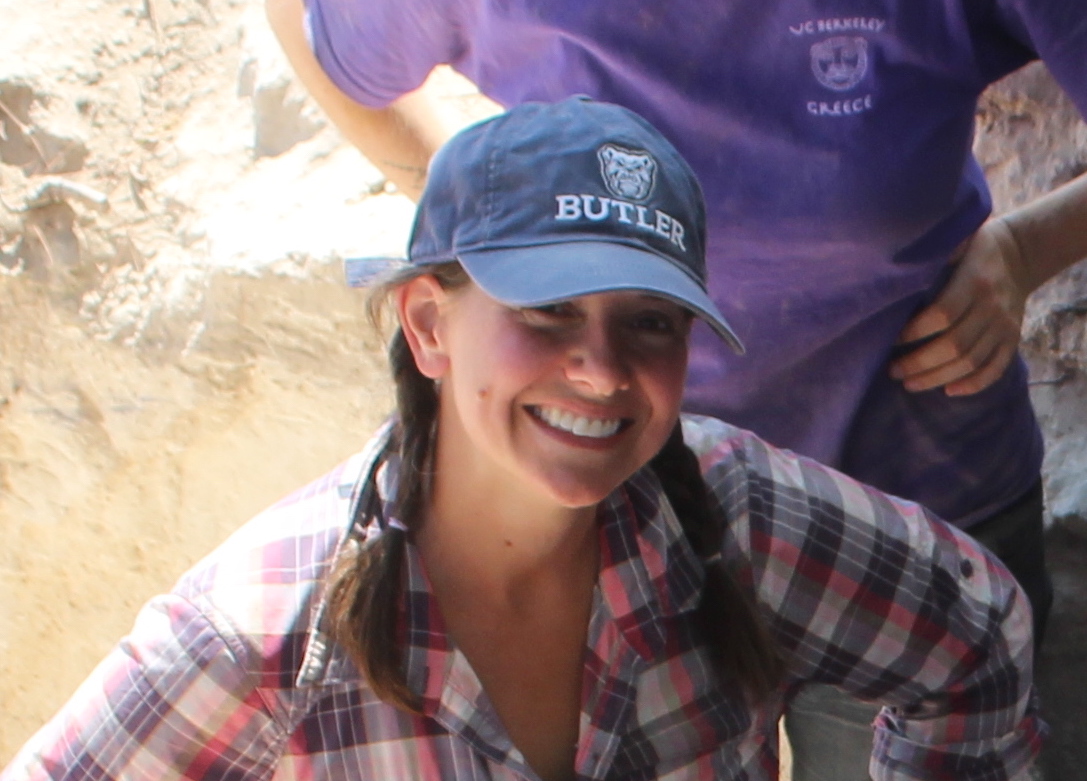
Lynne Kvapil is an archaeologist and Professor of Classics at Butler University in Indianapolis, Indiana, with a PhD from the University of Cincinnati. Her research focuses on the Mycenaean Greeks, especially mortuary practices, ceramic production, and farming. She has worked on numerous projects in the northeastern Peloponnese including Petsas House in the settlement of Mycenae, Korfos-Kalamianos on the Saronic Gulf, and the cemetery at ancient Aidonia. Her research in these areas aim to expand our understanding of the experiences of regular people, like farmers and craftspeople, in the Late Bronze Age Aegean. She is currently co-directing new excavations at Tsoungiza, a prehistoric settlement near the Sanctuary of Zeus at Nemea and publishing the prehistoric survey material from the Nemea Valley Archaeological Project.
Technological change has consequences not just on structures or statistics, but for real people. And it was no different in Mycenaean Greece. Labor, in prehistory was not static – there were a variety of mechanisms that enacted slow and rapid changes to the nature of the workforce, its organization, and the distribution of work – not unlike what we see today.
This talk addresses changes to the nature of work and the labor force in Late Bronze Age in Greece when Mycenaean palatial society was at its height (c. 1400-1200 BCE). Archaeological and documentary evidence suggest that, at this time, there were significant changes in farm technology supported by the Mycenaean Greek palace states, such as the widespread adoption of the oxen-driven plow. Plow technology would have changed the approach to farming in ways that resonated deeply in Mycenaean Greek society, including causing large-scale unemployment and shifting the sexual division of labor in ways that continued to ripple through ancient Greek society into the historical period.
Selected Bibliography
“Terraced Fields, Farming, and Farmers at the settlements of Kalamianos and Stiri, Greece”, in Europe’s Early Fieldscapes. Archaeologies of Prehistoric Land Allotment (Themes in Contemporary Archaeology). S. Arnoldussen, R. Johnston, and M. Løvschal (eds). Cham, Switzerland: Springer: 2021: 104-114.
Excavations of chamber tombs at the Mycenaean Greek cemetery at Aidonia by the Tombs of Aidonia Preservation, Heritage, and explOration Synergasia (TAPHOS) have revealed a long history of use spanning the entirely of the Late Bronze Age (c. 16th-12th centuries BCE). Many tombs at Aidonia were reused over centuries. Some earlier burials consisted of curated inhumations of deceased individuals laid out with ornate adornments, vessels, and weapons. Anyone entering the tomb would encounter a spectacle that referenced the glory of the past embodied in the burials of each individual. This paper explores how the living constructed, reconstructed, and communicated ideas about death and the dead each time the tomb was entered. The complexity of the burial practices is illustrated through case studies of two tombs that were subject to careful excavation including bioarchaeological approaches, pXRF analysis of metal finds, and aDNA analysis. The result is an important understanding of Mycenaean Greek burial practices that were constantly negotiating and renegotiating the power of the past.
Selected Bibliography
Kvapil, K., Shelton, K. 2019, Among the Ancestors at Aidonia, in Borgna, E., Caloi, I., Carinci, F.M., Laffineur, R. (eds), MNEME. Past and Memory in the Aegean Bronze Age: Proceedings of the 17th International Aegean Conference, University of Udine, Department of Humanities and Cultural Heritage, Ca’ Foscari University of Venice, Department of Humanities, 17-21 April 2018, Leuven, 293-299.
https://nemeacenter.berkeley.edu/fieldwork-aidonia/
In 1993, journalist Rita Reif published an article in the New York Times called “Rare Gold Baubles: Small, Ancient and Radiant.” Reif’s article set off a chain of events that would bring a little-known Mycenaean Greek cemetery near the village of Aidonia into the spotlight. The resulting cultural heritage case brought to light a story of tomb robbers, smugglers, eagle-eyed archaeologists, and an ill-fated donkey. In the end, archaeology won the day (sort of), and the so-called ‘Aidonia Treasure’ was repatriated to Greece.
Twenty years later, attention – and looters – returned to Aidonia, prompting the initiation of a new archaeological project aimed at investigating and protecting the site. The Tombs of Aidonia Preservation, Heritage, and explOration Synergasia (TAPHOS) began with the goal of conducting systematic excavation at the Late Bronze Age (1600-1100 BCE) cemetery. In the process, the project has uncovered new information about the Mycenaean Greek burials. This talk will introduce the audience to the dramatic archaeological discovery of the site, describe the work that TAPHOS has completed over the last decade, and outline findings that are changing the way scholars understand the lives and deaths of the Mycenaean Greeks.
Selected Bibliography
Kvapil, K., Shelton, K. 2019, Among the Ancestors at Aidonia, in Borgna, E., Caloi, I., Carinci, F.M., Laffineur, R. (eds), MNEME. Past and Memory in the Aegean Bronze Age: Proceedings of the 17th International Aegean Conference, University of Udine, Department of Humanities and Cultural Heritage, Ca’ Foscari University of Venice, Department of Humanities, 17-21 April 2018, Leuven, 293-299.
https://nemeacenter.berkeley.edu/fieldwork-aidonia/