

AIA Tours: land

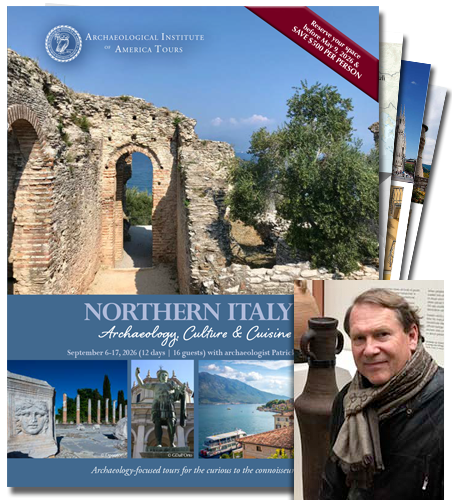
Northern Italy: Archaeology, Culture & Cuisine

Tour Dates: September 6-17, 2026 (12 Days)

Tour Leader(s): Patrick Hunt ,

Journey across northern Italy from west to east, with the dramatic Italian Alps as your constant backdrop and centuries of history unfolding at every stop. From cosmopolitan Milan to the Adriatic port of Trieste, this thoughtfully paced tour explores the rich cultural layers of Lombardy, Veneto, and Friuli Venezia Giulia—regions shaped by Roman foundations, medieval power, and enduring local traditions.

Along the way, discover celebrated cities and lesser-known archaeological sites, savor regional cuisine, and engage deeply with Italy’s diverse landscapes, architecture, and heritage under the guidance award-winning archaeologist Patrick Hunt, whose decades of research and fieldwork in the Alps bring exceptional depth to sites connected with Roman history, Hannibal’s campaigns, and prehistoric Europe.

Highlights:

  • Travel from Milan to Trieste, crossing three distinct northern Italian regions
  • Visit five UNESCO World Heritage Sites:
    • The Rock Drawings of Valcamonica
    • Archaeological Area and the Patriarchal Basilica of Aquileia
    • the Historic Centre of Verona
    • Longobards in Italy: Places of Power (Cividale del Friuli)
    • the Prehistoric Pile Dwellings at Lucone di Polpenazze
  • Visit evocative Roman villas and temples in Sirmione, Desenzano, and Brescia
  • Stand at the site of Hannibal’s first major victory in Italy
  • Experience a wide range of landscapes, including alpine scenery, plains, lakes, and the Adriatic Sea
  • Enjoy an ideal touring pace with 2 nights in Milan, 5 nights on Lake Garda, and 3 nights in Trieste
  • Engage in enriching discussions with your AIA lecturer/host, complemented by excellent regional cuisine

Tour Prices (10 nights)

Per person, double occupancy
15-16 participants $9,645** ($10,145 after May 9, 2026, call for availability).
11-14 participants $10,245** ($10,745 after May 9, 2026, call for availability).
*Single Supplement $2,445

*Single room supplement will be charged when requested or required. With fewer than 11 participants, a small-group surcharge may be added.
**Early Booking Savings of $500 per person until May 9, 2026

Download the detailed brochure.

For advance information or questions, please email us at aia@studytours.org (and include your full name) or call us toll-free at (800) 748-6262 (toll: 603-756-2884). To reserve your space using the online form, click here.

Mosaics at the Basilica in Aquileia

Trieste, Italy

Sirmione, Lake Garda

Ancient Aquileia

The Milan Cathedral

Brescia Castle

Theater at Brescia

Grotte di Catullo, Sirmione

Itinerary


Sunday, September 6, 2026: Depart home for Milan, ITALY

Monday, September 7: Arrive in Milan | Transfer to hotel | Welcome dinner

Tuesday, September 8: Milan: AM at leisure; PM Imperial Palace, Archaeological Museum, San Maurizio al Monastero Maggiore

Wednesday, September 9: Hannibal battle site | Piacenza | Cremona’s Museo del Violino | Desenzano del Garda

Thursday, September 10: Sirmione | Grotte di Catullo | Gorghi’s Roman furnaces | Desenzano del Garda

Friday, September 11: Valcamonica: Naquane Rock Engravings National Park, National Museum of Prehistory | Desenzano del Garda

Saturday, September 12: Brescia | Lucone di Polpenazze | Desenzano del Garda

Sunday, September 13: Bolzano: South Tyrol Museum of Archaeology | Desenzano del Garda

Monday, September 14: Verona | Trieste

Tuesday, September 15: Cividale del Friuli | Trieste

Wednesday, September 16: Aquileia | Trieste | Farewell dinner

Thursday, September 17: Transfer to Venice airport | Fly home

View Detailed Itinerary

(B)= Breakfast, (L)= Lunch, (D)= Dinner

Sunday, September 6, 2026: Depart home for Milan, ITALY

Monday, September 7: Arrive in Milan | Transfer to hotel | Welcome dinner
Upon arrival at Milan Malpensa Airport (MXP), you will be met and transferred as a group to our hotel in the heart of Milan’s historic district. The afternoon is free to relax and perhaps have a stroll to admire the Gothic Cathedral (Duomo). Gather for a welcome aperitivo and dinner. Two nights at the 4-star UNA Hotels Cusani Milano. (D)

Tuesday, September 8: Milan: AM at leisure; PM Imperial Palace, Archaeological Museum, San Maurizio al Monastero Maggiore
Enjoy a leisurely morning to relax or explore local sites on your own. After lunch, meet your expert local guide and enjoy a special tour of the hidden archaeological treasures of Milan, such as the Imperial Palace, symbol of Mediolanum (ancient Milan); the Archaeological Museum, which incorporates substantial remains of the ancient city wall and houses excellent Roman and medieval collections; and the medieval church of San Maurizio al Monastero Maggiore, with its well-preserved frescoes. Dinner is on your own. (B,L)

Wednesday, September 9: Hannibal battle site | Piacenza | Cremona’s Museo del Violino | Desenzano del Garda
This morning we drive to the approximate location of Hannibal’s Battle of the Trebbia River (December 218 B.C.), southwest of Piacenza (ancient Placentia) in the shallow hills around Rivergaro, just before the Trebbia River flows into the Po River. After a look at the landscape and a discussion with our lecturer about the battle, Hannibal’s first major victory in Italy, we will visit (time-permitting) Piacenza’s Museo Civico di Palazzo Farnese. After lunch at leisure in Piacenza, continue to nearby Cremona, the 16th– to 18th-century center of violin-making, and visit the Museo del Violino. Continue on to Desenzano del Garda, on the southern shore of Lake Garda, and check-in to our hotel. Gather for dinner this evening. Five nights at the 4-star Villa Rosa Hotel. (B,D)

Thursday, September 10: Sirmione | Grotte di Catullo | Gorghi’s Roman furnaces | Desenzano del Garda
Start the day with a walk in Sirmione, at the northern tip of Lake Garda’s narrow peninsula, where we find the remains of a large, 1st-century A.D. Roman villa and baths. Known for centuries as the Grotte di Catullo, this is the largest domestic villa in northern Italy. After a visit of the small site museum and lunch at a local restaurant, drive to nearby Lonato del Garda to see the Gorghi’s Roman furnaces – six restored brickworks dating back to the 2nd century A.D. Then, return to Desenzano and visit a well-conserved example of a Roman villa which, although built more than 2,000 years ago, was renovated and completed between the 2nd and 4th centuries A.D. Wooden walkways take us through the villa, over a variety of colorful floor mosaics. Dinner this evening is at leisure. (B,L)

Friday, September 11: Valcamonica: Naquane Rock Engravings National Park, National Museum of Prehistory | Desenzano del Garda
Today we head towards the heart of the Alps for Valcamonica (Valle Camonica), the first Italian site to be included on UNESCO’s World Heritage List. This valley is home to more than 140,000 prehistoric rock engravings (petroglyphs) that span approximately 56 miles and 8,000 years. Our morning will be spent at the Naquane Rock Engravings National Park, which is home to an extraordinary collection of prehistoric rock carvings. Depending on physical fitness, we will split into two groups in order to explore the area at our own paces. Not to be missed is the Minerva Sanctuary, a Roman building with mosaics and painted walls located in a place of stunning natural beauty on the Oglio River. After lunch at a local restaurant, visit the National Museum of Prehistory of Val Camonica (MUPRE), home to one of Europe’s most important collections of rock art. Return to Desenzano for a lecture and the balance of the day and dinner at leisure. (B,L)

Saturday, September 12: Brescia | Lucone di Polpenazze | Desenzano del Garda
This morning, we reach the city of Brescia (ancient Brixia), whose old town was radically restored and re-opened in 2015. Our visit will take us on a journey through time, from the pre-Roman era to the Renaissance. The town’s Roman ruins include Emperor Vespasian’s impressive 1st-century A.D. temple (Tempio Capitolino), plus a 15,000-seat theater, forum, and a stretch of the paved decumanus (east-west oriented road). Later monuments include the 11th-century Duomo Vecchio (built over a 6th-century church); and the Monastero di Santa Giulia and Basilica di San Salvatore, which house the Museo della Città with its range of collections from prehistory to the Venetian era. After an independent lunch, we drive to Lucone di Polpenazze, one of the 19 Italian sites (among the 111 total sites) comprising the UNESCO World Heritage Site of Prehistoric Pile Dwellings (stilt houses) around the Alps. Return to Desenzano and enjoy dinner at a local restaurant. (B,D)

Sunday, September 13: Bolzano: South Tyrol Museum of Archaeology | Desenzano del Garda
This morning we head to Bolzano, a charming town where German and Mediterranean traditions meet. Begin with a visit to the South Tyrol Museum of Archaeology – guided by Prof. Patrick Hunt – to retrace the origins of human history. Three quarters of its permanent exhibition are dedicated to Ötzi the Iceman—a 5,300-year-old Copper Age mummy, remarkably preserved thanks to extraordinary conditions and continuing to reveal invaluable insights into the past. Through artifacts, educational texts, video stations, and multimedia installations, you will uncover the story of this true time traveler. Afterward, enjoy lunch at a traditional restaurant. Return to our hotel in Desenzano, where the balance of the day and dinner are at leisure. (B,L)

Monday, September 14: Verona | Trieste
Today we check out of our hotel and take a motorcoach to Trieste, our home base for the balance of our journey. On the way, stop in Verona to visit the 1st-century A.D. Roman arena, possibly the best-preserved ancient amphitheater, and for a walking tour of the hidden gems of Verona (the city is a UNESCO World Heritage Site). Our lunch today is a typical Veronese meal at Ristorante Maffei, which was built on the site of the 1st-century B.C. Roman Capitol, part of which is visible in its wine cellar and, pending confirmation, we will be able to see. Continuing on to Trieste, we check-in to our hotel and gather for dinner at a local restaurant. Three nights at the 4-star Starhotels Savoia Excelsior Palace. (B,L,D)

Tuesday, September 15: Cividale del Friuli | Trieste
Seven groups of important Lombardic buildings throughout Italy comprise a UNESCO World Heritage Site. Today we learn how the Lombards influenced Italian history, visiting Cividale del Friuli—the region’s most outstanding Lombard capital, established as a duchy in A.D. 569, and still today one of the region’s most picturesque towns. Our city tour includes the Tempietto Longobardo (a “little temple” with superb artwork) and the Archaeological Museum. After lunch at a local restaurant, return to our hotel and enjoy an evening and dinner at leisure. (B,L)

Wednesday, September 16: Aquileia | Trieste | Farewell dinner
Drive this morning to Aquileia, founded by the Romans in 181 B.C., which (as a major trading link to the East) became one of the Roman Empire’s most important cities. The archaeological area and Patriarchal Basilica are a UNESCO World Heritage Site. Most of ancient Aquileia remains unexcavated, and the basilica’s 4th-century mosaics (approx. 7,000 square feet) are extraordinary. Visit the National Archaeological Museum of Aquileia, and then enjoy some time at leisure for an independent lunch. We return to Trieste and enjoy one last afternoon at leisure, before gathering for a farewell dinner at a local restaurant. (B,D)

Thursday, September 17: Transfer to Venice airport | Fly home
Transfer (about two hours) this morning to Venice Marco Polo Airport (VCE) for independent flights homeward. (B)


For reservations or questions, please email us at aia@studytours.org (and include your full name) or call us toll-free at (800) 748-6262 (toll: 603-756-2884). To reserve your space using the online form, click here.

support Us

The AIA is North America's largest and oldest nonprofit organization dedicated to archaeology. The Institute advances awareness, education, fieldwork, preservation, publication, and research of archaeological sites and cultural heritage throughout the world. Your contribution makes a difference.