

AIA Tours: land

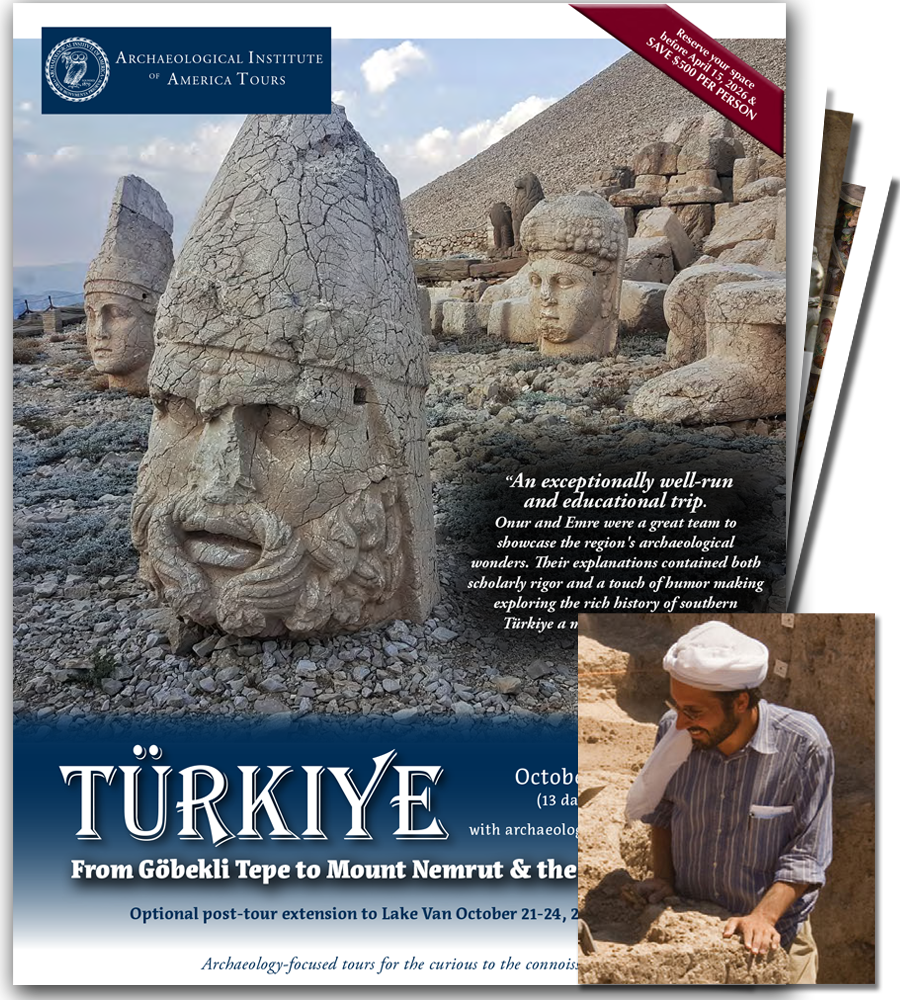
Türkiye: From Göbekli Tepe to Mount Nemrut & the Tigris River

Tour Dates: October 9-21, 2026 (13 days)

Tour Leader(s): Tevfik Emre Şerifoğlu ,

Travel with us beyond classical Türkiye, with its monumental, Greco-Roman ruins and Aegean sea backdrops. Find more history–and prehistory–amid the beauty of southeastern Türkiye, on a route less traveled, between Tarsus, the birthplace of St. Paul, and Diyarbakır, set along the banks of the famous Tigris River that helped form the cradle of civilization. Along the way you will see the world’s earliest monumental temples, dating back over 10,000 years; explore excellent archaeological and mosaic museums; and enjoy diverse architecture, from beehive-style mud houses to rock tombs, and early monasteries to mosques. Enjoy local cuisine, perhaps especially during our two-night stay in Gaziantep, a city famous across Türkiye for its cuisine; and explore bazaars and workshops with local artisans and craftspeople. Our AIA lecturer is intimately familiar with this region’s deep history and diverse cultures.


Highlights include:

  • Göbekli Tepe and Karahan Tepe, two prehistoric sites dating back to 9500-8000 B.C., suggesting that complex societies and monumental architecture existed well before the advent of agriculture
  • The world-famous, 19-foot-tall statues and burial sanctuary of King Nimrod (Antiochus I Theos), at more than 7,000 feet above sea level in Mount Nemrut National Park
  • Karatepe-Aslantaş National Park, Türkiye’s first open-air museum, with well-preserved Hittite ruins and statues dating from the 8th century B.C.
  • Dara, one of the most important trade centers of ancient Mesopotamia, featuring rock tombs dating back to the 5th century A.D.
  • The flooded ancient city of Hasankeyf (flooded in 2020 for dam construction), whose artifacts were removed to the Batman Archaeological Museum that we will visit, and some of whose important structures we will visit at a new, nearby location
  • Diyarbakır’s city walls, the second-longest on Earth (after China’s Great Wall), which contain a castle and a medieval church
  • Fascinating museums, such as the Zeugma Mosaic Museum, the world’s largest mosaic museum, with exquisite Hellenistic Greek and Roman mosaics; and the Haleplibahçe Mosaic Museum, a domed structure protecting a Roman villa complex that was saved from a 2006 urban construction project
  • An optional, post-tour extension to Lake Van, including visits to Van (Tushpa) Castle, center of the Kingdom of Urartu in the 9th to 6th centuries B.C., and the ruins of the Urartian fortress of Sarduri-Hinili at Çavuştepe

Per person, double occupancy
13-16 participants $6,295** ($6,795 after April 15, 2026, call for availability).
10-12 participants $6,795** ($7,295 after April 15, 2026, call for availability).
*Single Supplement $1,085

*Single room supplement will be charged when requested or required.
With fewer than 10 participants, a small-group surcharge may be added.
**Early Booking Savings of $500 per person until April 15, 2026

Per person, double occupancy
12-16 participants $1,995
7-11 participants $2,395
*Single Supplement $245

*Single room supplement will be charged when requested or required.
With fewer than 7 participants, a small-group surcharge may be added.

Download the detailed brochure.

For advance information or questions, please email us at aia@studytours.org (and include your full name) or call us toll-free at (800) 748-6262 (toll: 603-756-2884). To reserve your space using the online form, click here

Mor Gabriel Monastery©NevitDilmen

Mount Nemrut National Park ©katja

Zeynel Bey Tomb, Hasankeyf ©Hamdigumusie

Göbekli Tepe ©Rolfcosar

Mosaic at Zeugma Mosaic Museum, Gaziantep ©Dosseman

Gaziantep Castle ©afa63630

Yesemek ©OrhanErkılıç

Karatepe Sphinx ©Elelicht

Mardin, Türkiye ©BenBender

Karahan Tepe ©MahmutBozarslan

Dara Rock Tombs ©Hamdigumus

Itinerary


Friday, October 9, 2026: Depart home

Saturday, October 10: Tarsus, Türkiye | Transfer to Adana

Sunday, October 11: Tarsus | Adana: Clock Tower, Archaeological Museum | Welcome reception & dinner

Monday, October 12: Karatepe-Aslantaş National Park | Yesemek | Tilmen Höyük | Gaziantep

Tuesday, October 13: Gaziantep: Zeugma Mosaic Museum, Gaziantep Castle

Wednesday, October 14: Kahta | Mount Nemrut National Park | Adiyaman

Thursday, October 15: Göbekli Tepe | Şanlıurfa

Friday, October 16: Karahan Tepe | Şanlıurfa: Archaeological Museum, Haleplibahçe Mosaic Museum

Saturday, October 17: Harran | Mardin

Sunday, October 18: Dara | Midyat: Mor Gabriel Monastery, local bazaars | Mardin

Monday, October 19: Diyarbakır: City walls, Diyarbakır Castle, Grand Mosque, Church of the Virgin Mary

Tuesday, October 20: Batman: Batman Archaeological Museum | Hasankeyf | Diyarbakır | Farewell dinner

Wednesday, October 21: Fly home OR join the post-tour extension


POST -TOUR EXTENSION LAKE VAN

October 21-24, 2026 (4 days)

Wednesday, October 21, 2026: Malabadi Bridge | Çayönü | Ahlat Seljuk Cemetery | Tatvan

Thursday, October 22: Ferry to Akdamar Island, Lake Van | Van: Archaeology Museum, Van Castle

Friday, October 23: Çavuştepe | Van: Silversmith workshop | Farewell dinner

Saturday, October 24: Fly home

View Detailed Itinerary

Breakfast=(B), Lunch=(L), Reception=(R), Dinner=(D)

Friday, October 9, 2026: Depart home
Depart home on flights to Çukurova International Airport (COV) in southern Türkiye.

Saturday, October 10: Tarsus, Türkiye | Transfer to Adana
Upon arrival at Çukurova International Airport (COV) near Tarsus, you will be met and transferred as a group to our hotel in Adana. The remainder of the day is at leisure in Adana, the seventh largest city in Türkiye and the oldest city in the Cilicia region, which dates back 8,000 years. The evening and dinner are at leisure. Two nights at the 5-star Adana Hilton SA.

Sunday, October 11: Tarsus | Adana: Clock Tower, Archaeological Museum | Welcome reception & dinner
After breakfast we drive to nearby Tarsus, the birthplace of St. Paul (born Saul), called “Paul of Tarsus” in the Bible. Despite perhaps this best-known association, American archaeologist Hetty Goldman excavated on the edge of the modern town before and after WWII, and unearthed evidence that settlements have existed there on and off from the Neolithic to Islamic eras. Our visit to Tarsus will include the St. Paul Monument Museum (The Church of St. Paul), which was originally built in the 11th or 12th century A.D. and houses beautiful frescoes. After lunch in Tarsus we drive back to Adana where we see its famous, late 19th-century Clock Tower, and then visit the Adana Museum, dedicated to archaeological finds from throughout the region. We return to our hotel and gather this evening for welcome cocktails and dinner. (B,L,R,D)

Monday, October 12: Karatepe-Aslantaş National Park | Yesemek | Tilmen Höyük | Gaziantep
This morning we set out for Gaziantep, stopping along the way at Karatepe-Aslantaş National Park, Türkiye’s first open-air museum, situated in the Taurus Mountains on the banks of the Ceyhan River. The Park has well-preserved Hittite ruins and statues dating from the 8th century B.C. Continue on to Yesemek Quarry and Sculpture Workshop, established during the Hittite Empire in the 14th century B.C. It is the largest known stonemasonry workshop in the ancient Near East, having produced various types of sculptures that adorned the gates of Hittite cities, palaces, and temples, including sphinxes with female heads and lions’ bodies and lions, some of which were winged. Next, we stop at the mound of Tilmen Höyük, initially settled during the 4th millennium B.C. It was an important fortified city and trading center, where a massive royal palace dating to around 1800 B.C. has been excavated. After lunch we finish our drive to Gaziantep, whose cuisine—especially its pistachio baklava—is famous across Türkiye. We check-in to our hotel and then gather for dinner. Two nights at the 5-star Divan Hotel. (B,L,D)

Tuesday, October 13: Gaziantep: Zeugma Mosaic Museum, Gaziantep Castle
Today we visit the Zeugma Mosaic Museum, the world’s largest mosaic museum, with exquisite Hellenistic Greek and Roman mosaics that were unearthed from Zeugma, said to have been founded by a Macedonian Greek general in the army of Alexander the Great. After lunch we will explore Gaziantep’s old city, which is centered around Gaziantep Castle. The castle has origins dating back to the Hittite period and was expanded over centuries by Romans, Byzantines, and Ottomans. We will stroll through the old bazaars and listen to the craftsmen hammering their copperware. Return to our hotel to freshen up and then gather for dinner. (B,L,D)

Wednesday, October 14: Kahta | Mount Nemrut National Park | Adiyaman
After breakfast we will drive three hours to the town of Kahta, near Mount Nemrut National Park. After lunch we will be wandering in the land of King Nimrod, Antiochus I Theos of Commagene. The Commagene Empire is world-famous thanks to the statues and the grave of King Nimrod at the top of Mount Nemrut National Park, 7,381 feet above sea level. First, we visit the mound of Karaus, “blackbird” in Turkish, where the family of Antiochus I Theos was buried. Our next stop will be the Severan Bridge, built in the 2nd century and recently used for transportation by the local Turkish and Kurdish community. We will ascend Mount Nemrut by minivan to visit Antiochus I Theos’ burial sanctuary, with statues over 19 feet tall. Return to our hotel and gather for dinner. Overnight at the 4-star Park Dedeman Adiyaman hotel. (B,L,D)

Thursday, October 15: Göbekli Tepe | Şanlıurfa
In the morning, we set out for Göbekli Tepe, a UNESCO World Heritage Site that dates back to approximately 9500-8000 B.C. It is situated on a limestone plateau in the foothills of the Taurus Mountains. The site is characterized by large circular structures containing massive, T-shaped, limestone pillars, some of which are up to 16 feet tall and weigh up to 50 tons. These pillars are often decorated with intricate carvings of animals, anthropomorphic figures, and abstract symbols. Göbekli Tepe would have required significant organization and labor, especially considering it was built by hunter-gatherers who had not yet developed agriculture or domesticated animals. Originally interpreted as a sanctuary or ritual site, recent excavations suggest Göbekli Tepe may have been a settlement. Its discovery has led to a reevaluation of the timeline of human history and the relationship between ritual, religion, and the development of settled societies. In the village nearby, we will also visit a newly opened handicraft center that represents Kurdish, Arabic, and Turkish handicrafts, carpets, and rugs. Continue on to Şanlıurfa, where we check-in to our hotel and gather for dinner. Two nights at the 5-star Double Tree by Hilton Şanlıurfa. (B,L,D)

Friday, October 16: Karahan Tepe | Şanlıurfa: Archaeological Museum, Haleplibahçe Mosaic Museum
Like Göbekli Tepe, the site we visit this morning, Karahan Tepe, is another prehistoric site that suggests that complex societies and monumental architecture existed before the advent of agriculture. It contains at least 266 T-shaped pillars similar to those found at Göbekli Tepe, many featuring animals and anthropomorphic figures. What we will see at this site refers to a timeline that is 5,000 years older than Stonehenge and 7,000 years older than the Pyramids at Giza. We will also visit the Şanlıurfa Archaeological Museum and the Haleplibahçe Mosaic Museum. The latter is a domed structure that protects mosaics from a Roman villa complex that were discovered during the 2006 construction of an urban renewal project. The balance of the day and dinner are at leisure. (B,L)

Saturday, October 17: Harran | Mardin
Depart Şanlıurfa this morning and visit Harran, famous for its beehive-style mud houses. It is difficult to believe that this deserted place on the edge of the Syrian Desert was once a major economic, religious, and learning capital. Continue on to Mardin, a city built upon a craggy rock, facing south over the Syrian Desert. It is an important Syrian Christian center with lovely, Syrian-influenced architecture. We will see the citadel and a number of Islamic masterpieces of the 14th and 15th centuries, and stroll through the traditional neighborhood lined with very narrow passages called abbaras. Also visit the Kasımıye Madrassah, completed under the reign of Akkoyunlu ruler Cihangiroğlu Kasım (1457-1502), renowned for its impressive architecture. Two nights at the 4-star Park Dedeman Mardin hotel. (B,L,D)

Sunday, October 18: Dara | Midyat: Mor Gabriel Monastery,
local bazaars | Mardin
One of the most important trade centers of ancient Mesopotamia, the ruins of the ancient city of Dara feature ancient rock tombs dating back to the 5th century A.D. that have been compared to the famed city of Ephesus in western Türkiye. An important settlement along the famed Silk Road, Dara served as the last stronghold of the Byzantine Empire in southeastern Anatolia. Next we visit the city of Midyat and the Assyrians’ biggest Syriac Orthodox monastery. Founded in A.D. 397, Mor Gabriel Monastery is the world’s oldest surviving Syriac Orthodox monastery and the seat of the Metropolitan Bishop of Tur Abdin (Mardin). We return to the center of Midyat, where we will stroll through the bazaars and see silver craftsmen create their world-famous filigree. Return to our hotel in Mardin, where dinner and the evening are at leisure. (B,L)

Monday, October 19: Diyarbakır: City walls, Diyarbakır Castle, Grand Mosque, Church of the Virgin Mary
Set out this morning on a drive to Diyarbakır, one of the largest cities in southeastern Türkiye, situated on the right bank of the Tigris River. We will first stop at Diyarbakır’s city walls, the second-longest city walls on Earth after the Great Wall of China. Diyarbakır’s Castle houses a museum of archaeology and ethnography, a medieval church, and a café with breathtaking views of the Tigris basin. After exploring the inner castle, we will enter the old city to visit the Grand Mosque, which was built in 1091. It is among Türkiye’s largest mosques and can accommodate 5,000 worshippers. Also visit one of Diyarbakır’s old houses, built in a square plan with a garden in the center, using the basalt stone of nearby Karaca Dag, a volcanic mountain. Stroll Diyarbakır’s narrow streets to reach a caravanserai, used as a social center in the middle of the old city, and see an interesting minaret standing in the center of the street that is built on top of four columns. A short walk will take us to the Church of the Virgin Mary, which belongs to the small Assyrian minority of the city. We check-in to our hotel and then gather for dinner this evening. Two nights at the 4-star Ramada Wyndham Diyarbakır hotel. (B,L,D)

Tuesday, October 20: Batman: Batman Archaeological Museum | Hasankeyf | Diyarbakır | Farewell dinner
This morning we drive 1.5 hours to Batman and visit the Batman Archaeological Museum, whose three exhibition halls showcase approximately 450 artifacts, including a collection from the ancient Paleolithic and Neolithic periods, pieces excavated from the Ilisu Dam construction, and items from the ancient city of Hasankeyf, a site we will visit this afternoon. After lunch we drive to Hasankeyf, located on a sheer rock that was eroded by the Tigris River and thought to be one of the world’s oldest continuously inhabited communities, dating back more than 12,000 years. The ancient city of Hasankeyf was flooded in 2020 to allow construction of the Ilisu Dam, so today the majority of the ancient city is underwater. Important structures were moved away from the reservoir area and are exhibited in the newly built museum’s garden. Here we visit the Zeynel Bey Tomb, El Rızık Mosque, and the Hasankeyf Museum near the newly constructed town of Hasankeyf. Return to our hotel in Diyarbakır to freshen up before we gather this evening for a farewell dinner hosted by our lecturer and guide. (B,L,D)

Wednesday, October 21: Fly home OR join the post-tour extension
Transfer as a group this morning to Diyarbakır Airport (DIY) for flights homeward or begin the post-tour extension. (B)


POST -TOUR EXTENSION LAKE VAN

October 21-24, 2026 (4 days)


Wednesday, October 21, 2026: Malabadi Bridge | Çayönü | Ahlat Seljuk Cemetery | Tatvan
This morning we depart Diyarbakır and visit the historic Malabadi Bridge, the world’s longest spanned stone arch bridge and a masterpiece of 12th-century engineering and architecture. Next, we visit the site of Çayönü, a Neolithic settlement that demostrates the shift from nomadic to domesticated life, with evidence of metallurgy, animal domestication, domestic structures, and burials. Our last stop of the day is at Ahlat Seljuk Cemetery, the largest historical Muslim cemetery in Türkiye, with about 9,000 graves from the 11th to 16th centuries, showcasing various medieval tomb types and intricate stone craftsmanship. Continue on to Tatvan, where we check-in to our hotel and gather for dinner. Overnight at the 4-star The Crater Hotel. (B,L,D)

Thursday, October 22: Ferry to Akdamar Island, Lake Van | Van: Archaeology Museum, Van Castle
This morning we will drive to the pier for a short ferry ride to Akdamar Island on Lake Van, home to the church of the Holy Cross and Armenian monastery ruins. Van, in the Lake Van basin, is one of the world’s oldest cities, and was the capital of the Urartian civilization and an important city throughout history due to its location on the Silk Road. After lunch in Van’s city center we visit the Van Archaeology Museum, which displays artifacts from around the area spanning the Paleolithic through Ottoman periods. Continue on to Van (Tushpa) Castle, built on a mound bearing traces of 5,000 years of settlements, but primarily the location of structures from the capital of the Kingdom of Urartu (9th to 6th centuries B.C.). Check-in to our hotel and enjoy an independent dinner. Two nights at the 5-star Elite World Van Hotel. (B,L)

Friday, October 23: Çavuştepe | Van: Silversmith workshop | Farewell dinner
This morning we drive southeast to see the ruins at Çavuştepe: the Urartian fortress of Sarduri-Hinili, which was built in the middle of the 8th century B.C. Situated on two hills, connected by a “saddle” at the western end of Bol Mountain, the site offers a glimpse into the engineering skills and architectural style of the Urartian Kingdom. A recently excavated necropolis also features four distinct grave types: chamber tombs, urn graves, sarcophagi, and simple earthware graves. Return to Van and visit the famous Van silversmith workshop in the Arubani Savat Bazaar. After returning to our hotel to freshen up, we gather this evening for a farewell dinner. (B,D)

Saturday, October 24: Fly home
Transfer as a group this morning to Van International Airport (VAN) for flights homeward. (B)


For reservations or questions, please email us at aia@studytours.org (and include your full name) or call us toll-free at (800) 748-6262 (toll: 603-756-2884). To reserve your space using the online form, click here.

support Us

The AIA is North America's largest and oldest nonprofit organization dedicated to archaeology. The Institute advances awareness, education, fieldwork, preservation, publication, and research of archaeological sites and cultural heritage throughout the world. Your contribution makes a difference.