

AIA Tours: land

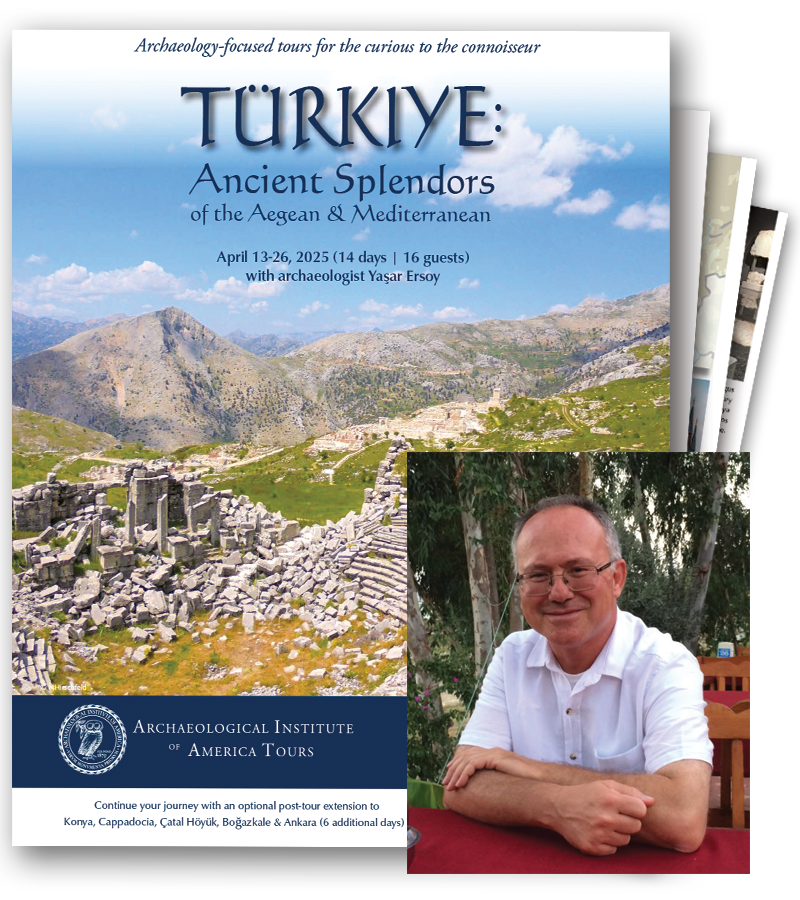
Türkiye: Ancient Splendors of the Aegean & Mediterranean

Tour Dates: April 12-25, 2026 (14 days)

Tour Leader(s): Yaşar Ersoy ,

Many of the most magnificent and best-preserved ancient Greek and Roman sites are found along Türkiye’s beautiful Aegean and Mediterranean coasts. Visit world-famous, plus little-visited yet spectacular, Greco-Roman sites, Byzantine churches, Crusader castles, and Ottoman palaces. Your engaging AIA lecturer/host, Yaşar Ersoy, teaches classical art and archaeology and has been doing fieldwork in Türkiye since 1980. Throughout the program he will offer illustrated talks and informal discussions about the sites you are visiting and their places within the larger ancient Mediterranean world. Along the way, you will enjoy delicious cuisine, comfortable accommodations, and the company of a small group of like-minded fellow travelers. An expert tour manager/local guide will handle logistics and smooth the way.

Highlights:

  • Visit four UNESCO World Heritage Sites:
    • Historic Areas of Istanbul, including the 6th-century Byzantine church-turned-mosque of Hagia Sophia and Topkapi Palace, the imperial residence of the Ottoman sultans
    • Ephesus, the best-preserved classical city in the eastern Mediterranean, whose treasures include ancient villas with splendid frescoes and mosaics, and the 2nd-century A.D. Library of Celsus
    • Aphrodisias, whose Temple of Aphrodite, tetrapylon, large stadium, and baths of Hadrian are unforgettable
    • Hierapolis-Pamukkale, where we see the ruins of the baths and temples of a famous 2nd-century B.C. thermal spa
  • Marvel at a variety of Greco-Roman sites, including:
    • Sardis, former capital of the Lydian Empire and King Croesus, who was defeated by Persian king Cyrus the Great in 546 B.C.
    • Didyma’s 7th-century B.C. Temple of Apollo, one of the leading oracles in the ancient world; and the 4th-century B.C. Temple of Athena at Priene, which became the classical model of Greek city planning
    • Magnesia on the Meander, renowned for its Artemis cult, which has the ruins of a well-preserved theater and a stadium that could seat 30,000 spectators
    • Kibyra, with its magnificent stadium, odeon covered with a Medusa mosaic, late Roman bath, and underground tombs
    • Sagalassos, a rarely visited and recently excavated site at an elevation of 5,000 feet, with breathtaking views
    • Aspendos, with one of the best-preserved ancient theaters in the world, renowned for its acoustics; and Perge, with its splendid theater, stadium, and enormous Hellenistic and Roman gates
  • Explore several fine museum collections, including Istanbul’s Archaeological Museum, Burdur’s Archaeological Museum, and the Antalya Archaeological Museum
  • Two flights within Türkiye are included to maximize your time
  • An optional extension to central Türkiye is available, including three UNESCO World Heritage Sites: Göreme National Park and the Rock Sites of Cappadocia; Hattusha: the Hittite Capital; and the Neolithic Site of Çatalhöyük. Also visit Ankara, with its superb Museum of Anatolian Civilizations and Konya, the famous center of Sufi mystic Rumi and his followers

Tour Pricing (12 nights)

Per Person, Double Occupancy
13-16 Participants $7,595
10-12 Participants $7,995
Single Supplement (limited availability) $1,175

A single supplement will be charged when requested or required.
With fewer than 10 participants on the main tour, a small group surcharge may be added

Optional Post-tour Extension (5 additional nights)
Per Person, Double Occupancy
13-16 Participants $3,695
8-12 Participants $3,895
5-7 Participants $4,395
Single Supplement (limited availability) $1,085

A single supplement will be charged when requested or required.
With fewer than 5 participants on the extension, a small group surcharge may be added.

Download the detailed brochure.

For advance information or questions, please email us at aia@studytours.org (and include your full name) or call us toll-free at (800) 748-6262 (toll: 603-756-2884). To reserve your space using the online form, click here.

Antalya at sunset

Istanbul

Library of Celsus, Ephesus

Sagalassos

Priene

Perge

Çatal Höyük

Göreme National Park, Cappadocia

Itinerary


Sunday, April 12, 2026: Depart home for Istanbul, Türkiye

Monday, April 13: Arrive Istanbul

Tuesday, April 14: Istanbul: Underground Cistern, Hagia Sophia, Archaeological Museum, Welcome reception and dinner

Wednesday, April 15: Istanbul: Topkapi Palace, Rüstem Pasha Mosque, Kariye Mosque

Thursday, April 16: Fly to Izmir | Sardis | Kuşadasi

Friday, April 17: Ephesus | Selçuk Archaeological Museum | Kuşadasi

Saturday, April 18: Priene | Miletus | Didyma | Kuşadasi

Sunday, April 19: Magnesia on the Meander | Aphrodisias | Pamukkale

Monday, April 20: Hierapolis | Laodicea | Pamukkale

Tuesday, April 21: Kibyra | Burdur Archaeology Museum | Ağlasun

Wednesday, April 22: Sagalassos | Antalya

Thursday, April 23: Perge | Aspendos | Antalya: Farewell dinner

Friday, April 24: Antalya Archaeological Museum | Fly to Istanbul OR Begin post-tour extension

Saturday, April 25: Transfer to Istanbul airport | Fly home

Optional Post-Tour Extension
Konya, Cappadocia, Çatalhöyük, Boğazkale, Alacahöyük, and Ankara

April 24-30, 2026 (6 additional days)

ITINERARY

Breakfast=(B), Lunch=(L), Dinner=(D)

Friday, April 24, 2026: Drive to Konya

Saturday, April 25: Konya: Mevlâna Museum | Çatalhöyük | Sultan Han caravanserai | Cappadocia

Sunday & Monday, April 26 & 27: Cappadocia: Göreme Valley, Zelve Valley, Pasabag Monks Valley, Uchisar Castle

Tuesday, April 28: Boğazkale (Hattusha) | Alacahöyük | Ankara

Wednesday, April 29: Ankara: Museum of Anatolian Civilizations, Farewell lunch | Fly to Istanbul

Thursday, April 30: Fly home

View Detailed Itinerary

Sunday, April 12, 2026: Depart home for Istanbul, Türkiye

Monday, April 13: Arrive Istanbul
Upon arrival at Istanbul International Airport (IST), you are met and transferred to our hotel in Sultanahmet, the oldest district of Istanbul and the center of the ancient Greek colony of Byzantium, founded in 700 B.C. This became Constantinople, capital of the Byzantine Empire, and then the capital of the Ottoman Empire. “Historic Areas of Istanbul” are a designated UNESCO World Heritage Site. Almost all of the major sites we will see are within walking distance of our hotel, whose rooftop terrace and indoor restaurant provide splendid views. Meet your tour manager, who will offer suggestions for dinner and provide the schedule for the next day. Three nights at the 4-star Armada Hotel.

Tuesday, April 14: Istanbul: Underground Cistern, Hagia Sophia, Archaeological Museum, Welcome reception and dinner
Spend the day exploring ancient monuments of Istanbul on foot, beginning with Yerebatan Saray, one of the grand underground cisterns that were an important source of water for the city during Byzantine and Ottoman times. Sensitively restored, the cistern is now equipped with meandering walkways above the water, plus atmospheric illumination and music. Next visit Hagia Sophia, now a mosque. It was built by the Byzantine Emperor Justinian in the 6th century and reigned as the grandest church in Christendom for nearly 1,000 years, until the Ottoman conquest of Constantinople in 1453. After lunch at a local restaurant, explore the Archaeological Museum, which features one of the world’s richest collections of Greco-Roman antiquities. Enjoy a reception overlooking Istanbul before our welcome dinner. (B,L,R,D)

Wednesday, April 15: Istanbul: Topkapi Palace, Rüstem Pasha Mosque, Kariye Mosque
Explore Topkapi Palace, the imperial residence of the Ottoman sultans, including a visit to its Harem. Topkapi is the most extensive and fascinating monument of Turkish civil architecture in existence in that, besides its historical and architectural interest, it houses extraordinary collections of porcelain, armor, fabric, jewelry, miniatures, calligraphy, and many other precious objects that once belonged to the sultans and their court. After lunch, we visit the small, but exquisite, 16th-century Rüstem Pasha Mosque, an example of the Ottomans’ best architecture and tile work. We then visit the Kariye Mosque (formerly the 4th-century Byzantine Church of St. Saviour in Chora), renowned for its stunning, 14th-century mosaics and frescoes. En route to our hotel, we will drive slowly past the remains of the 5th-century Theodosian Walls that protected Constantinople for more than a thousand years. The balance of the day and dinner are at leisure. Those interested may be dropped off at the Grand Bazaar for independent exploration and return to our hotel on their own (a 10-minute taxi ride or a 25-minute walk). (B,L)

Thursday, April 16: Fly to Izmir | Sardis | Kuşadasi
Take a short, morning flight from Istanbul to Izmir. Drive to ancient Sardis, which dates back to the Neolithic period and was the former capital of the Lydian Empire. Most of the structural remains date from the Hellenistic and Byzantine periods. Continue on to our hotel in Kuşadasi, on the Aegean coast. Three nights at the 5-star DoubleTree by Hilton Kuşadasi. (B,L,D)

Friday, April 17: Ephesus | Selçuk Archaeological Museum | Kuşadasi
Spend the day exploring Ephesus, a UNESCO World Heritage Site and the best-preserved classical city in the eastern Mediterranean, which provides compelling insights into life in Hellenistic and Roman times. At its peak, it was the largest Greco-Roman city in Asia Minor with a population of 250,000 and an infrastructure that included street lights, running water, a huge stadium and theater, and the marble-paved Arcadian Way leading down to the magnificent Library of Celsus. Ephesus has been extensively excavated and restored. Take a private tour of its Terrace Houses—villas of the wealthy, filled with colorful wall frescoes and intricate mosaic floors. After lunch, continue on to the Selçuk Archaeological Museum, one of the best regional museums in Türkiye. It houses a large collection of artifacts found at Ephesus and in the surrounding area. Return to our hotel and gather this evening for dinner. (B,L,D)

Saturday, April 18: Priene | Miletus | Didyma | Kuşadasi
Explore the valley of the Meander River (now known as the Büyük Menderes River) and three great Ionian cities. Priene is the oldest and best example of a Hellenistic city, and was laid out by the famous architect Hippodamus. Next we stop at Miletus, which has an impressive theater, stadium, three agoras, baths, and a bouleuterion (Senate House). Time permitting, we will visit the Miletus Museum. Lastly, visit the massive Temple of Apollo at Didyma that was one of the leading oracles in the ancient Greek world and is remarkable for its huge size and unique plan. Return to our hotel and gather for dinner. (B,L,D)

Sunday, April 19: Magnesia on the Meander | Aphrodisias | Pamukkale
We drive today through the most fertile land of Türkiye stopping first to visit Magnesia on the Meander, a prominent ancient Greek city, renowned for its Artemis cult and strategic location along an important trade route. We will see the remains of the Artemis temple and altar, a Roman basilica, a well-preserved theater, a large stadium that could seat 30,000 spectators, and the ruins of two gymnasia. Next we visit Aphrodisias, a UNESCO World Heritage Site and one of the most beautiful and exciting archaeological sites in Türkiye. The stadium is the best preserved in Asia Minor, while the Temple of Aphrodite, the tetrapylon, and baths of Hadrian make Aphrodisias unforgettable. Drive to Pamukkale, where we check-in to our hotel this evening, and you may choose to take advantage of the hotel’s thermal baths. Two nights at the 5-star Doğa Thermal Health & Spa Hotel. (B,L,D)

Monday, April 20: Hierapolis | Laodicea | Pamukkale
Today we will visit two sites near our hotel, beginning with the UNESCO World Heritage Site (together with the travertine terraces of Pamukkale) of Hierapolis, originally a Phrygian cult center of the Anatolian mother goddess of Cybele. At the end of the 2nd century B.C., the kings of Pergamon established the thermal spa of Hierapolis, and today the ruins of a stadium, baths, temples, a gymnasium, two theaters, and a bouleuterion remain. A short drive then brings us to Laodicea, an impressive site that has been on the UNESCO World Heritage Tentative List since 2013 and comprises Anatolia’s largest stadium, two theaters, four baths, five agoras, temples, churches, and much more. Return to our hotel in Pamukkale and then gather for dinner. (B,L,D)

Tuesday, April 21: Kibyra | Burdur Archaeology Museum | Ağlasun
This morning we depart for Kibyra, a 2,300-year-old city that has been on the UNESCO World Heritage Tentative List since 2016. It is known for its magnificent, 10,400-person stadium, odeon covered with a Medusa mosaic, late Roman bath, agoras, and underground chamber tombs. Then we visit the Burdur Archaeology Museum, a small but impressive museum with artifacts from sites throughout the region, including Sagalassos. Continue to Ağlasun, where we check-in to our hotel and gather for dinner. Overnight at the 4-star Sagalassos Lodge & Spa. (B,L,D)

Wednesday, April 22: Sagalassos | Antalya
Drive high up into the mountains to ancient Sagalassos. Well off the main tourist routes, Sagalassos has been extensively excavated, and now visible are a library with mosaic flooring, temples, baths, and the residences of what was once the largest city in Pisidia. As impressive as the ruins, however, are the breathtaking views from 5,000 feet. Continue driving to the Mediterranean coast, where we check-in to our charming hotel in the heart of old Antalya. Two nights at the 5-star Akra Hotel. (B,L,D)

Thursday, April 23: Perge | Aspendos | Antalya: Farewell dinner
We begin the day with an excursion to Perge, where we explore the great theater, stadium, enormous Hellenistic and Roman gates, and colonnaded street. Continue on to what is perhaps the best-preserved ancient theater in the world, located in the ancient city of Aspendos. Having thoroughly tested the near-perfect acoustics in the theater, we circle the ancient acropolis to see some remarkably well-preserved sections of the aqueduct that supplied the ancient citizens with their water. Return to our hotel in Antalya and freshen up before our farewell dinner at an exclusive restaurant. (B,L,D)

Friday, April 24: Antalya Archaeological Museum | Fly to Istanbul OR Begin post-tour extension
This morning we visit the Antalya Archaeological Museum and its newly opened Perge Hall, displaying artifacts from the site we visited yesterday. After an independent lunch, guests booked on the optional extension will depart for Konya. The rest of the group has the remainder of the afternoon at leisure in Antalya, until we transfer to the airport for our evening flight to Istanbul. Upon arrival, we check-in to a comfortable hotel conveniently located at the airport. Dinner is on your own. Overnight at the 4-star Hampton by Hilton Istanbul Airport Arnavutköy. (B)

Saturday, April 25: Fly home
After breakfast, transfer to Istanbul International Airport (IST) for flights homeward. A representative will accompany you until the passport control desk. (B)

Optional Post-Tour Extension
Konya, Cappadocia, Çatalhöyük, Boğazkale, Alacahöyük, and Ankara

April 24-30, 2026 (6 additional days)

ITINERARY

Breakfast=(B), Lunch=(L), Dinner=(D)

Friday, April 24, 2026: Drive to Konya
After the morning visit to the Antalya Archaeological Museum with the main tour group, and an independent lunch, guests booked on the optional extension will depart Antalya on a scenic, 4.5-hour drive through the Taurus Mountains. Arrive at the vast Anatolian plateau in Konya, home to splendid Seljuk monuments, check-in to our hotel, and gather for dinner. Overnight at the 5-star Dedeman Konya Hotel. (B,D)

Saturday, April 25: Konya: Mevlâna Museum | Çatalhöyük | Sultan Han caravanserai | Cappadocia
This morning we visit the Mevlâna Museum, the former lodge of the whirling dervishes and location of the tomb of the famed mystic/philosopher and theologian Celaleddin Rumi (later known as Mevlâna). It is one of the top pilgrimage centers in Türkiye. Depart Konya on a one-hour drive to the Neolithic site of Çatalhöyük, a UNESCO World Heritage Site and possibly the most important archaeological site in Türkiye. Discovered by James Mellart and excavated in the 1960s, it has revealed that the Neolithic and Bronze Age cultures located here were remarkably advanced. Since 1993 an international team of archaeologists has been carrying out new excavations and research to shed more light on the people that inhabited the site. Continuing along the ancient trade route to Cappadocia, we will visit en route the Sultan Han caravanserai, stopping place for the camel caravans that traversed the ancient Silk Road. Built in the 13th century, it is the largest caravanserai of its period in Türkiye. Drive onward to Cappadocia, where we check-in to our hotel. Three nights at the 5-star Barceló Cappadocia. (B,L,D)

Sunday & Monday, April 26 & 27: Cappadocia: Göreme Valley, Zelve Valley, Pasabag Monks Valley, Uchisar Castle
An optional, early morning hot-air balloon ride will be available at additional cost. Spend two days exploring Cappadocia’s lunar-like landscape of soft, porous rock called tuff, or tufa, that was formed over time from volcanic ash. Erosion over the centuries formed fantastic geologic shapes, and early Christian settlers carved chapels, churches, dwellings, and numerous other structures into the soft rock. “Göreme National Park and the Rock Sites of Cappadocia” are together a UNESCO World Heritage Site. In the Göreme Valley, explore the open-air museum’s cave churches, including the famous Karanlik Kilise (Dark Church) with its extraordinary 11th-century murals; a monastic retreat in the Zelve Valley; and Pasabag Monks Valley with its fascinating Fairy Chimneys. Visit one of the area’s underground cities—a maze of tunnels and chambers carved out as places of refuge from hostile invaders. They contain storehouses, stables, sleeping rooms, kitchens, and even cemeteries. Visit Uchisar Castle, created by hollowing out natural caves (creating rooms and passageways) in a tall outcropping of volcanic rock that is visible for miles. Those who are interested may choose to visit a pottery center and a high-quality rug shop. (B,L,D both days)

Tuesday, April 28: Boğazkale (Hattusha) | Alacahöyük | Ankara
Depart Cappadocia early this morning and drive to Ankara, stopping en route for lunch. Along the way we visit Boğazkale, where we find the ruins of Hattusha, capital of the Hittite Empire 2,300 years ago. This UNESCO World Heritage Site includes the ruins of the Great Temple, the best-preserved Hittite temple of the 13th century B.C.; and the famous rock sanctuary of Yazilikaya, an open-air temple, whose chambers in the bedrock are decorated with the most striking examples of Hittite relief art. We will visit the nearby Boğazkale Museum with important Hittite artifacts, including royal seals, pottery, sculptures, armor, cuneiform tablets, and two original sphinx statues that once guarded the Sphinx Gate at Hattusha. Next we visit Alacahöyük, where we will see Bronze Age burials, a Hittite settlement, and its museum. Continue on to Ankara, chosen as the capital of the new Republic of Türkiye by its founder and first president, Mustafa Kemal Atatürk, in the 1920s. Check-in to our hotel and gather for dinner. Overnight at the 4-star Divan Çukurhan hotel. (B,L,D)

Wednesday, April 29: Ankara: Museum of Anatolian Civilizations, Farewell lunch | Fly to Istanbul
Enjoy a morning visit to the superb Museum of Anatolian Civilizations. Located in an old area of the city near the Citadel, the museum houses archaeological finds from the many civilizations of Anatolia and has a particularly strong Hittite collection. Delight in a festive farewell lunch before we transfer to the airport for a late afternoon flight to Istanbul. Upon arrival, check-in to our comfortable, convenient airport hotel. Dinner is on your own tonight. Overnight at the 4-star Hampton by Hilton Istanbul Airport Arnavutköy. (B,L)

Thursday, April 30: Fly home
After breakfast, transfer to Istanbul International Airport (IST) for flights homeward. (B)


For reservations or questions, please email us at aia@studytours.org (and include your full name) or call us toll-free at (800) 748-6262 (toll: 603-756-2884). To reserve your space using the online form, click here.

support Us

The AIA is North America's largest and oldest nonprofit organization dedicated to archaeology. The Institute advances awareness, education, fieldwork, preservation, publication, and research of archaeological sites and cultural heritage throughout the world. Your contribution makes a difference.