
AIA Tours: land

Tunisia: Phoenicians to Romans, Mosaics to Mosques

Tour Dates: October 1-14, 2026 (14 days)

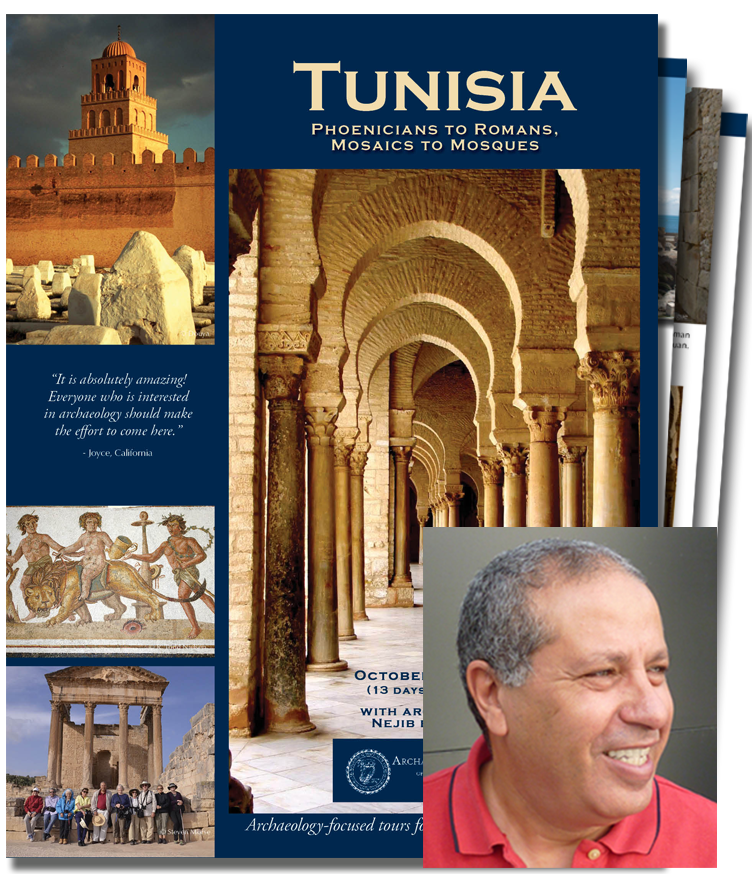
Tour Leader(s): Nejib ben Lazreg ,

Join us for a comprehensive, expert-led exploration of Tunisia, a country whose layered history has shaped the Mediterranean world for more than three millennia. Traveling with archaeologist and AIA study leader Nejib ben Lazreg, we will experience all seven of Tunisia’s cultural UNESCO World Heritage Sites, explore fabled cities of the Phoenicians, Romans, and early Islamic dynasties, and enjoy the comfort of exceptional accommodations throughout. From four nights along the Tunis coast to immersive visits in Dougga, Bulla Regia, Kairouan, El Djem, and Sousse, this itinerary offers an ideal balance of archaeological discovery, cultural enrichment, and thoughtful pacing. Along the way, we will benefit from Nejib ben Lazreg’s deep expertise, gaining context and insight that bring Tunisia’s monumental past vividly to life.

Highlights:

  • Travel and learn with study leader/guide and archaeologist Nejib ben Lazreg and up to 16 guests.
  • Visit all seven of Tunisia’s cultural UNESCO World Heritage Sites. Explore fabled Carthage, including the Antonine Baths and the cisterns. Spend three full days in and around Tunis, including a visit to the Bardo Museum, featuring exquisite exhibits of Roman and Byzantine mosaics.
  • See the beautiful Cape Bon coast and the Punic site of Kerkouane.
  • Marvel at Bulla Regia, a well-preserved site featuring underground Roman villas, a museum, a Temple of Apollo, and a 2nd-century theater.
  • Tour Dougga, established prior to the Romans, with its 3,500 seat theater; Temples of Saturn, Augustan Piety, and Mercury; and Capitol.
  • Discover Kairouan, the fourth holiest city in the Muslim world, founded in A.D. 670, with its carpet, leather, brass, and spice vendors; and its Great Mosque with a three-tiered minaret.
  • Visit El Djem, one of Tunisia’s most extraordinary sites, with a marvelous, 30,000-seat, ancient amphitheater and a museum that houses lovely mosaics.
  • Visit the Roman city of Sbeitla (Sufetula), one of North Africa’s best-preserved Roman cities, including several stunning 2nd-century A.D. temples and mosaic-covered Byzantine baptisteries.
  • Wander through Thuburbo Majus, a sprawling site occupied in turn by Berbers, Phoenicians, and Romans. The imperial remains include the Forum, Temple of Mercury, and sunken winter baths.

“Nejib was at his best on the sites, pointing out the various features of baths, temples, houses, etc., teaching us to ‘read’ the site for ourselves. I learned a ton.” – M.C., Iowa


TOUR PRICING (12 nights)
per person, double occupancy

12-16 participants $8,645
9-11 participants $9,245
Single Supplement $3,245

Single room supplement will be charged when requested or required. With fewer than 9 participants a small group surcharge may be added.

To reserve your space using the online form, click here.

Download the detailed brochure.

For reservations or questions, please email us at aia@studytours.org (and include your full name) or call us toll-free at (800) 748-6262 (toll: 603-756-2884).

The Great Mosque at Kairouan, founded in A.D. 670. © Marek Szarejko

Bulla Regia theater arcades © Pradigue

The Arch of Alexander Severus at Dougga © Bernard Gagnon

Mosaic detail on display at the Bardo Museum © R. Todd Nielsen

AIA study leader Nejib ben Lazreg and travelers at Bulla Regia © Jane Waldbaum

Thuburbo Majus © Patrick Giraud

El Djem Amphitheater © Agnieszka Wolska

Itinerary


Thursday, October 1, 2026: Depart home

Friday, October 2: Arrive Tunis, Tunisia | Welcome dinner

Saturday, October 3: Tunis: Bardo Museum | Carthage | Tunis

Sunday, October 4: Nabeul Museum | Cape Bon Peninsula: Kelibia, Kerkouane | Tunis

Monday, October 5: Oudna | Tunis: Medina walking tour

Tuesday, October 6: Dougga | Bulla Regia | Tabarka

Wednesday, October 7: Tabarka: AM walking tour, PM at leisure

Thursday, October 8: Chemtou Museum | Kairouan

Friday, October 9: Kairouan: Walking tour

Saturday, October 10: Sbeitla | Mactar | Kairouan

Sunday, October 11: Kairouan | El Djem | Mahdia

Monday, October 12: Sousse: Walking tour, PM at leisure

Tuesday, October 13: Sousse Archaeological Museum | Thuburbo Majus | Tunis | Farewell dinner

Wednesday, October 14: Fly home

View Detailed Itinerary

(B)= Breakfast, (L)= Lunch, (D)= Dinner

Thursday, October 1, 2026: Depart home

Friday, October 2: Arrive Tunis, Tunisia | Welcome dinner
Arrive today at Tunis-Carthage International Airport (TUN), where you will be met and transferred to our luxurious beachfront hotel. Enjoy a welcome dinner hosted by AIA study leader Nejib ben Lazreg and your tour manager. Four nights at the 5-star Four Seasons Hotel Tunis. (D)

Saturday, October 3: Tunis: Bardo Museum | Carthage | Tunis
Begin the day with an introductory lecture. Then visit the world-famous Bardo, whose earliest exhibits (Punic) date to the 7th century B.C., and whose most exquisite exhibits (Roman and Byzantine) are mosaics from sites all over Tunisia, many virtually intact. After lunch we explore the vast site of Carthage, founded in 814 B.C. by the Phoenicians and sacked by the Romans in 146 B.C. It was not until the 1st century A.D. that Rome rebuilt the city, and within a few years it expanded and prospered to the point where it was second only to Rome. Our visit of this UNESCO World Heritage Site will include the tophets (cemeteries of children), Punic ports, Antonine Baths, Byrsa Hill, and cisterns. Return to our hotel and gather for dinner. (B,L,D)

Sunday, October 4: Nabeul Museum | Cape Bon Peninsula: Kelibia, Kerkouane | Tunis
Set out early this morning for the Cape Bon Peninsula, stopping first at Nabeul’s small but interesting archaeological museum. Continue north to the coastal town of Kelibia, where we enjoy lunch. The Cape Bon Peninsula is a fertile agricultural region that was developed by the French as the heart of Tunisia’s wine industry. After lunch we will enjoy scenic stops and visit the UNESCO World Heritage Site of Kerkouane, one of the most important ancient Punic cities. Return to Tunis, where the balance of the day is at leisure. Restaurant suggestions for dinner will be provided, as there are many enjoyable dining options. (B,L)

Monday, October 5: Oudna | Tunis: Medina walking tour
This morning we drive to Oudna (Roman Uthina), one of Tunisia’s more recently excavated sites that is still a work in progress. See the fine amphitheater and nearly a dozen villas with many mosaics, cisterns, and storage areas. After lunch we return to Tunis and take an in-depth walking tour of its medina, the historic heart of the city and a UNESCO World Heritage Site, viewing from the outside the architecture of the Zitouna mosque and the nearby Hamouda Pasha and Hussein Day mosques. Return to our hotel, where we gather later for dinner. (B,L,D)

Tuesday, October 6: Dougga | Bulla Regia | Tabarka
Depart Tunis, driving through a fertile land that was part of the granary of Rome, and arrive at Dougga (ancient Thugga), Tunisia’s most extensive archaeological site. Covering some 60 acres on a steep slope some 2,000 feet above the plain, Dougga was known as the “city of temples” and today is a UNESCO World Heritage Site. Visit the theater, which accommodated almost 3,500 people; the Temple of Saturn, under which was found evidence of a pre-Roman sanctuary dedicated to the Carthaginian god Baal; the Temples of Augustan Piety and Mercury; and the grandest structure—the Capitol that was dedicated to the gods Jupiter, Juno, and Minerva, and to the glory of co-emperors Marcus Aurelius and Lucius Verus. After lunch we drive to Bulla Regia, an unusual and very well-preserved site that features underground Roman villas; a Temple of Apollo, the oldest extant structure on the site; and a 2nd-century theater. Continue driving to the seaside town of Tabarka, where we check-in to our luxurious hotel and gather for dinner. Two nights at the 5-star La Cigale Tabarka Hôtel. (B,L,D)

Wednesday, October 7: Tabarka: AM walking tour, PM at leisure
Enjoy a morning lecture followed by a walking tour in the coastal village of Tabarka. After lunch we return to our hotel, located along a sandy beach, to relax and enjoy its amenities. Dinner is on your own. (B,L)

Thursday, October 8: Chemtou Museum | Kairouan
This morning we depart Tabarka and travel to Kairouan. Along the way we visit the Chemtou Museum, which has exhibits on the quarrying and transportation of marble, a small section of the original Roman road that was used to transport the marble, and more. Once home to ancient North Africa’s largest marble quarry, Chemtou was incorporated into Roman Africa in 46 B.C. We have lunch en route and check-in to our hotel in Kairouan before we gather this evening for dinner. Three nights at the 5-star Hôtel La Kasbah Kairouan. (B,L,D)

Friday, October 9: Kairouan: Walking tour
Kairouan’s location along the old caravan routes provided a base for a flourishing crafts industry, which lives on today in its rugs and textiles. This morning, we walk through the heart of this UNESCO World Heritage Site’s medina, past sellers of carpets, leather goods, brass works, and spices to the Great Mosque, which has been rebuilt several times since its original construction in the 7th century. Return to our hotel in Kairouan and then gather for dinner. (B,L,D)

Saturday, October 10: Sbeitla | Mactar | Kairouan
This morning we drive to the Roman city of Sbeitla (Sufetula) to see Diocletian’s arch, forum, capitol, theater, and Christian churches. After lunch we visit the Roman city of Mactar to see the forum, Trajan’s Arch, Caracalla’s Baths, churches, and dolmens. Return to our hotel and have dinner. (B,L,D)

Sunday, October 11: Kairouan | El Djem | Mahdia
This morning we set out on a drive to El Djem, another UNESCO World Heritage Site and one of the most extraordinary sites in Tunisia thanks to the marvelous, 3rd-century A.D. amphitheater in the heart of the town. Nearby is the museum of El Djem, which houses some lovely mosaics and the remains of some recently excavated luxury villas. After lunch we drive to Mahdia, on the Mediterranean coast, and visit the Mahdia Museum which displays Punic, Roman, and Byzantine artifacts, and has as a section on underwater archaeology. The museum also focuses on Tunisian traditions. Overnight at the 4-star Mahdia Palace. (B,L,D)

Monday, October 12: Sousse: Walking tour, PM at leisure
We drive north to visit the UNESCO World Heritage Site of Sousse, long a thriving trading center and a major port today. Our walking tour through town will include (from the outside) the Great Mosque, originally constructed in A.D. 850; the 9th-century ribat (fortification and religious building); and the souk, which is dominated by woolworkers. After lunch, the balance of the day is at leisure to enjoy our hotel’s amenities and/or explore independently the nearby city center. Dining suggestions will be provided. Overnight at the 5-star Mövenpick Resort & Marine Spa. (B,L)

Tuesday, October 13: Sousse Archaeological Museum | Thuburbo Majus | Tunis | Farewell dinner
Inside the 11th-century kasbah we tour the Sousse Archaeological Museum, which houses one of the country’s best collections of 2nd– and 3rd-century Roman mosaics. From Sousse we travel inland to the vast, sprawling site of Thuburbo Majus, one of Tunisia’s best-preserved sites. It was occupied in turn by the Berbers, Phoenicians, and Romans. Its imperial remains are typical of a Roman city and include the towering, 2nd-century A.D. capitol and forum. Continue on to Tunis and check-in to our luxurious hotel, conveniently located near the airport. This evening, we gather for a farewell dinner at one of Tunis’ finest restaurants. Overnight at the 5-star Sheraton Tunis Hotel. (B,L,D)

Wednesday, October 14: Fly home
Transfer this morning to Tunis-Carthage International Airport (TUN) for flights homeward. (B)


For reservations or questions, please email us at aia@studytours.org (and include your full name) or call us toll-free at (800) 748-6262 (toll: 603-756-2884). To reserve your space using the online form, click here.

support Us

The AIA is North America's largest and oldest nonprofit organization dedicated to archaeology. The Institute advances awareness, education, fieldwork, preservation, publication, and research of archaeological sites and cultural heritage throughout the world. Your contribution makes a difference.