

AIA Tours: land

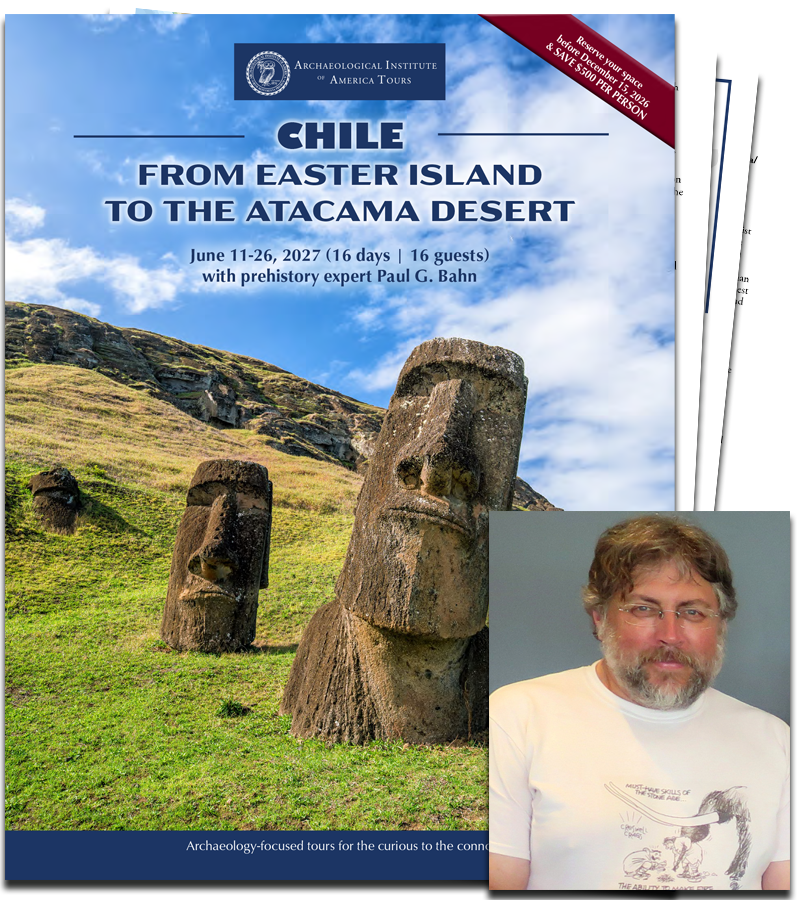
Chile: From Easter Island to the Atacama Desert

Tour Dates: June 11-26, 2027 (16 days)

Tour Leader(s): Paul G. Bahn ,

Join an expert-led journey around Easter Island (Rapa Nui) and through northern Chile to explore Polynesian and pre-Columbian archaeology and history, guided by renowned prehistorian and longtime AIA tour leader Paul Bahn. Marvel at some of the most remarkable reminders of the local ancient cultures—such as moai (monumental statues) and geoglyphs (figures etched into or built on the Earth’s surface)—in person, with expert insights that bring their contexts to life.
We will mull over the organization, engineering, artistry, and transportation methods involved in the production of the famous moai. And as we view the wide variety of geoglyphs scattered across the landscape of northern Chile, we will consider how they reflect ancient peoples’ mobility via caravan routes and exchange networks, ceremony or ritual, and/or communication as route markers and visual expressions of long-distance social interactions across vast desert. Along the way, we will also learn about such significant modern concerns as archaeological and historic preservation, environmental recovery, and the reconnection of Rapa Nui with the wider Polynesian world. With all logistics managed by a dedicated tour manager, you are free to focus fully on exploration and learning.

Highlights:

  • Spend four nights on Rapa Nui, seeing not only many moai and ahu (ceremonial platforms) but also Hanga Roa, the island’s only urban settlement; Tahai Ceremonial Complex, one of the island’s most important sites; Ahu Akivi, whose seven moai are unique in that they are inland and face the ocean; Anakena Beach, said to be where Polynesians first set foot on Rapa Nui; and Papa Vaka, whose marine petroglyphs are typical rock art of the northern coast.
  • Spend five nights in the Atacama Desert area, viewing a variety of geoglyphs such as those in the Lluta Valley, known as the best-preserved in the region; Chiza, where some of its hundreds of figures reach up to 300 feet in size; the Atacama Giant, which is the world’s largest prehistoric, anthropomorphic geoglyph; and Pintados, where more than 350 figures are spread over nearly 2.5 miles.
  • Enjoy a tour and lunch at Santa Rita Winery, ranked “best winery in the world” by Forbes, plus visit the interesting Andean Museum on the winery’s property.
  • Learn about the ancient Chinchorro culture, known for its very early, sophisticated mummification process, at sites such as the Colón 10 Museum, where 32 mummies may be viewed with their burial goods in situ.
  • Visit Valparaíso, Chile’s unofficial cultural capital: a bohemian harbor town filled with faded mansions, cobblestone streets, and lively street art.
  • This exclusive, small-group tour is limited to just 16 participants. Contact us to reserve your space on this unique program.

Tour Pricing (14 nights)

*Single room supplement will be charged when requested or required.
With fewer than 10 participants, a small-group surcharge may be added.
**Early Booking Savings of $500 per person until December 15, 2026

Download the brochure.

To reserve your space using the online form, click here.

For reservations or questions, please email us at aia@studytours.org (and include your full name) or call us toll-free at (800) 748-6262 (toll: 603-756-2884).


Itinerary


Friday, June 11, 2027: Depart home

Saturday, June 12: Arrive Santiago, Chile | Welcome lunch | Santiago: Chilean Museum of Pre-Columbian Art

Sunday, June 13: Viña del Mar: Fonck Museum | Valparaíso | Santiago

Monday, June 14: Fly to Rapa Nui (Easter Island) | Hanga Roa: Walking tour

Tuesday, June 15: Rapa Nui: Tahai Ceremonial Complex, Center for Asia-Pasifika/Rapa Nui-Chile Studies, Ahu Akivi | Hanga Roa

Wednesday, June 16: Rapa Nui: Hanga Te’e, Ranu Raraku Volcano, Ahu Tongariki, Papa Vaka, Puna Pau | Hanga Roa

Thursday, June 17: Rapa Nui: Anakena Beach, Vinapu, Orongo | Hanga Roa

Friday, June 18: Rapa Nui: AM at leisure | Fly to Santiago

Saturday, June 19: Santiago: Santa Rita Winery, Museo Andino | Fly to Arica

Sunday, June 20: Arica: City center tour, Colón 10 Museum, San Miguel de Azapa Archaeological Museum | Azapa Valley geoglyphs | Lluta Valley geoglyphs | Arica

Monday, June 21: Chinchorro Culture commemorative site | Chiza geoglyphs |  Tiliviche | Ariquilda | Atacama Giant geoglyph | Pica

Tuesday, June 22: Humberstone | Pintados geoglyphs | Pica

Wednesday, June 23: Chug-Chug geoglyphs | Yerbas Buenas petroglyphs | San Pedro de Atacama

Thursday, June 24: San Pedro de Atacama: AM at leisure; PM Tulor

Friday, June 25: Toconao | Quebrada de Jere | Salar de Atacama | Valle de la Luna | San Pedro de Atacama | Farewell dinner

Saturday, June 26: Piedra de la Coca | Fly home

View Detailed Itinerary

(B)= Breakfast, (L)= Lunch, (D)= Dinner

Friday, June 11, 2027: Depart home

Saturday, June 12: Arrive Santiago, Chile | Welcome lunch | Santiago: Chilean Museum of Pre-Columbian Art
Arrive at Santiago’s Arturo Merino Benítez International Airport (SCL), where you will be met and transferred as a group (time TBD) to our hotel for an early check in. After a welcome lunch, we visit the Chilean Museum of Pre-Columbian Art, whose collections introduce major Andean traditions, such as the Chinchorro culture’s early, sophisticated mummification process, and will provide us with a broad South American archaeological framework for our upcoming site visits. Dinner is at leisure. Two nights at the 5-star Hotel Magnolia Santiago. (L)

Sunday, June 13: Viña del Mar: Fonck Museum | Valparaíso | Santiago
After breakfast, we drive to Viña del Mar to visit the Fonck Museum, an archaeology and history museum with exhibits on Rapa Nui (Easter Island) and indigenous Chilean cultures. The museum provides an introduction to what we will see on Rapa Nui, and allows for a critical discussion of archaeological collections, museum interpretation, cultural heritage, and repatriation before our departure to the island. After lunch, we take a short drive to Valparaíso, a UNESCO World Heritage Site and the “jewel of the Pacific Ocean.” It is Chile’s unofficial cultural capital—home to eclectic architecture, multi-colored houses, and a lively street art scene. We return to Santiago, where we gather for dinner. (B,L,D)

Monday, June 14: Fly to Rapa Nui (Easter Island) | Hanga Roa: Walking tour
Early this morning we transfer to the airport for our flight to Rapa Nui. Upon arrival, we are transferred to our hotel to settle in. Gather for a walking tour of Hanga Roa village, the only urban settlement on the island. More than 90% of the population lives in the village, which is located between the volcanoes Rano Kau and Maunga Terevaka. Four nights at the 3-star Hotel Taha Tai. (B,L,D)

Tuesday, June 15: Rapa Nui: Tahai Ceremonial Complex, Center for Asia-Pasifika/Rapa Nui-Chile Studies, Ahu Akivi | Hanga Roa
After breakfast, we visit the Tahai Ceremonial Complex, one of Rapa Nui’s most important archaeological sites. This restored complex features ceremonial platforms (ahu), a traditional boat ramp, and several moai (megalithic statues often placed on ahu). After lunch, we visit Dr. Sonia Haoa Cardinali’s new research center: the Center for Asia-Pasifika/Rapa Nui-Chile Studies. Dr. Haoa Cardinali is a Rapanui archaeologist renowned for her work preserving and studying the cultural heritage of Rapa Nui. The center focuses on archaeological conservation and the indigenous heritage of Rapa Nui within the greater Asian-Pacific context. Next, we visit Ahu Akivi, the site of seven restored moai. They are significant because they are the only moai built inland rather than along the coast, and are the only moai that face the ocean. They are located on the highest point of the island, on the side of the Maunga Terevaka volcano. Return to our hotel and gather this evening for dinner. (B,L,D)

Wednesday, June 16: Rapa Nui: Hanga Te’e, Ranu Raraku Volcano, Ahu Tongariki, Papa Vaka, Puna Pau | Hanga Roa
This morning we begin our day with a visit to Hanga Te’e, home to reconstructed, traditional, boat-shaped houses and stone chicken shelters that help us to understand the everyday life of the island’s early inhabitants. Next, we visit the Ranu Raraku quarry, on the slope of an extinct volcanic crater, where the majority of the moai were carved. Here, hundreds of sculptures can be viewed in different stages of production. After lunch, we visit Ahu Tongariki, the largest and most impressive ahu on Rapa Nui, with 15 restored moai standing side by side. Next, we visit Papa Vaka, with marine petroglyphs (carvings or inscriptions on rocks)—in this case of fish, turtles, a canoe, and more—that are typical of the rock art of the north coast of Rapa Nui. We conclude our day with a visit to Puna Pau, a volcanic quarry from which was extracted the source of the reddish, cylindrical topknots (pukao) that were found on some of the moai. Return to our hotel and gather this evening for dinner. (B,L,D)

Thursday, June 17: Rapa Nui: Anakena Beach, Vinapu, Orongo | Hanga Roa
Today we visit Anakena Beach, a white coral sand beach known as the cradle of history and culture of Rapa Nui, as it is said to be the place where Polynesians first set foot on the island, led by King Hotu Matu’a. Archaeological excavations here have uncovered some of the island’s earliest evidence of human occupation, such as Ahu Ature Huki (with one moai) and Ahu Nau Nau (with seven moai). After lunch and a short drive we visit Vinapu, an archaeological complex with three ahu. The ahu construction here is different here than anywhere else on Rapa Nui, as the massive stones are very smooth, regularly shaped, and fit together perfectly, very similar to Inca stone construction. Next, we visit Orongo, a spectacular ceremonial village built on the rim of the Rano Kau volcano crater. The walls of the more than 50 stone houses are flat stone slabs, and their roofs are earth-covered arches, such that they appear semi-subterranean. In the 18th and 19th centuries, the Tangata Manu (Birdman cult) was centered here and people of the time left behind petroglyphs between the top of the cliff and the edge of the crater. We return to Hanga Roa and enjoy an evening walk through the village before dinner. (B,L,D)

Friday, June 18: Rapa Nui: AM at leisure | Fly to Santiago
This morning, enjoy free time to relax before our flight to Santiago. Upon a late arrival in Santiago, we check-in to our hotel that is conveniently located at the airport. Overnight at the 4-star Holiday Inn Santiago – Airport Terminal hotel. (B)

Saturday, June 19: Santiago: Santa Rita Winery, Museo Andino | Fly to Arica
This morning we check out of our hotel and enjoy a visit to Santa Rita Winery, which Forbes said was ranked the best winery in the world. After a tour and lunch, we visit the Museo Andino (Andean Museum), located on the grounds of the winery. The museum houses a collection of more than 3,000 archaeological and ethnographic pre-Columbian artifacts. This evening we take a flight to Arica where, upon arrival, we are transferred to our hotel. Two nights at the 5-star Antay Hotel & Spa. (B,L)

Sunday, June 20: Arica: City center tour, Colón 10 Museum, San Miguel de Azapa Archaeological Museum | Azapa Valley geoglyphs | Lluta Valley geoglyphs | Arica
After breakfast, we take a tour of Arica’s historic city center before we visit the Colón 10 Museum, an open-air archaeological museum founded on the site of the mass burial of 32 Chinchorro mummies. The mummies can be viewed in situ through glass, as they were found, with their burial goods. Next, we visit the San Miguel de Azapa Archaeological Museum, which houses a vast collection from 7000 B.C. to the Spanish invasion, plus an excellent exhibit of Chinchorro mummies. On our way to lunch, we stop to view the Azapa Valley geoglyphs (figures etched on the Earth by removing darker topsoil to expose the lighter surface underneath, or by accumulating material on the surface, or by a combination of both). These pre-Columbian geoglyphs depict stylized humans, camelids, and reptiles. After lunch, we view the Lluta Valley geoglyphs, the best-preserved geoglyphs in the region, which include a frog, an eagle, llamas, and humans. Before dinner, we attend a special lecture by Bernardo Arriaza, a Chilean physical anthropologist. (B,L,D)

Monday, June 21: Chinchorro Culture commemorative site | Chiza geoglyphs |  Tiliviche | Ariquilda | Atacama Giant geoglyph | Pica
After checking out of our hotel, we begin our journey south through the Atacama Desert, stopping first at the Chinchorro Culture commemorative site, which honors the ancient Chinchorro people—marine hunter-gatherers who thrived in the arid Atacama Desert from around 5450 B.C. to 890 B.C. As we continue our travels, we view the Chiza geoglyphs, featuring hundreds of figures, some reaching up to 300 feet in size. Drive onward to Tiliviche, a historic hamlet and oasis famous for its geoglyphs of a caravan of llamas; and Ariquilda, an archaeological site known for its nearly 1.25 miles of canyon walls with more than 3,000 petroglyphs of animals and humans. After lunch, we see the Atacama Giant geoglyph (Gigante de Atacama), the world’s largest prehistoric, anthropomorphic geoglyph. Continue on to Pica and check-in to our hotel. Gather for dinner. Two nights at the 4-star Caja Los Andes hotel. (B,L,D)

Tuesday, June 22: Humberstone | Pintados geoglyphs | Pica
This morning, we set out to visit the UNESCO World Heritage Site of Humberstone Saltpeter Works, once a bustling settlement during Chile’s golden age of nitrate, but today a “ghost town.” For over 60 years, beginning in 1880, thousands of “pampinos” lived and worked here in this inhospitable desert environment to produce the fertilizer sodium nitrate that would transform agriculture in North and South America and in Europe. After lunch, we view the Pintados geoglyphs—one of northern Chile’s largest and most concentrated collections of geoglyphs, with more than 350 figures spread over nearly 2.5 miles. This evening we gather for dinner. (B,L,D)

Wednesday, June 23: Chug-Chug geoglyphs | Yerbas Buenas petroglyphs | San Pedro de Atacama
This morning we travel to San Pedro de Atacama, approximately a 5.5-hour drive, stopping along the way to view the Chug-Chug geoglyphs and Yerbas Buenas petroglyphs. A boxed lunch will be provided. The geoglyphs of Chug-Chug are a series of more than 500 geoglyphs of geometric and zoomorphic figures, some of which date back as early as 1000 B.C. The Yerbas Buenas petroglyphs, carved thousands of years ago by pre-Columbian people, include a variety of llamas as well as flamingos, predatory animals, and a monkey. After we arrive in San Pedro de Atacama and check-in to our hotel, we gather for dinner. Three nights at the 3-star Hotel Kimal. (B,L,D)

Thursday, June 24: San Pedro de Atacama: AM at leisure; PM Tulor
After a relaxing morning at leisure and an independent lunch, we set out to visit Tulor, an archaeological site of a former village complex consisting of numerous circular, adobe structures surrounded by a perimeter wall, that was believed to be abandoned around A.D. 300. Return to our hotel and gather for dinner this evening. (B,D)

Friday, June 25: Toconao | Quebrada de Jere | Salar de Atacama | Valle de la Luna | San Pedro de Atacama | Farewell dinner
This morning we visit Toconao, a village dating back more than 12,000 years; and Quebrada de Jere, a ravine located just outside of the village and an oasis where fruits and vegetables are grown. Next, we drive to Salar de Atacama, the largest salt flat in Chile, and most notable for its flamingo reserve. We finish the day in Valle de la Luna (Valley of the Moon), a valley carved by wind and water which created various stone and sand formations that look somewhat similar to the surface of the moon. Return to our hotel in San Pedro de Atacama and gather this evening for our farewell dinner. (B,L,D)

Saturday, June 26: Piedra de la Coca | Fly home
On our last morning together, we visit the remote archaeological site of Piedra de la Coca, famous for ancient petroglyphs dating from A.D. 1000 to 1540. After lunch, we transfer to El Loa Airport in Calama to take a group flight to Santiago’s Arturo Merino Benítez International Airport (SCL), for connections to independent flights homeward. (B,L)


For reservations or questions, please email us at aia@studytours.org (and include your full name) or call us toll-free at (800) 748-6262 (toll: 603-756-2884). To reserve your space using the online form, click here.

support Us

The AIA is North America's largest and oldest nonprofit organization dedicated to archaeology. The Institute advances awareness, education, fieldwork, preservation, publication, and research of archaeological sites and cultural heritage throughout the world. Your contribution makes a difference.