
AIA Tours: land

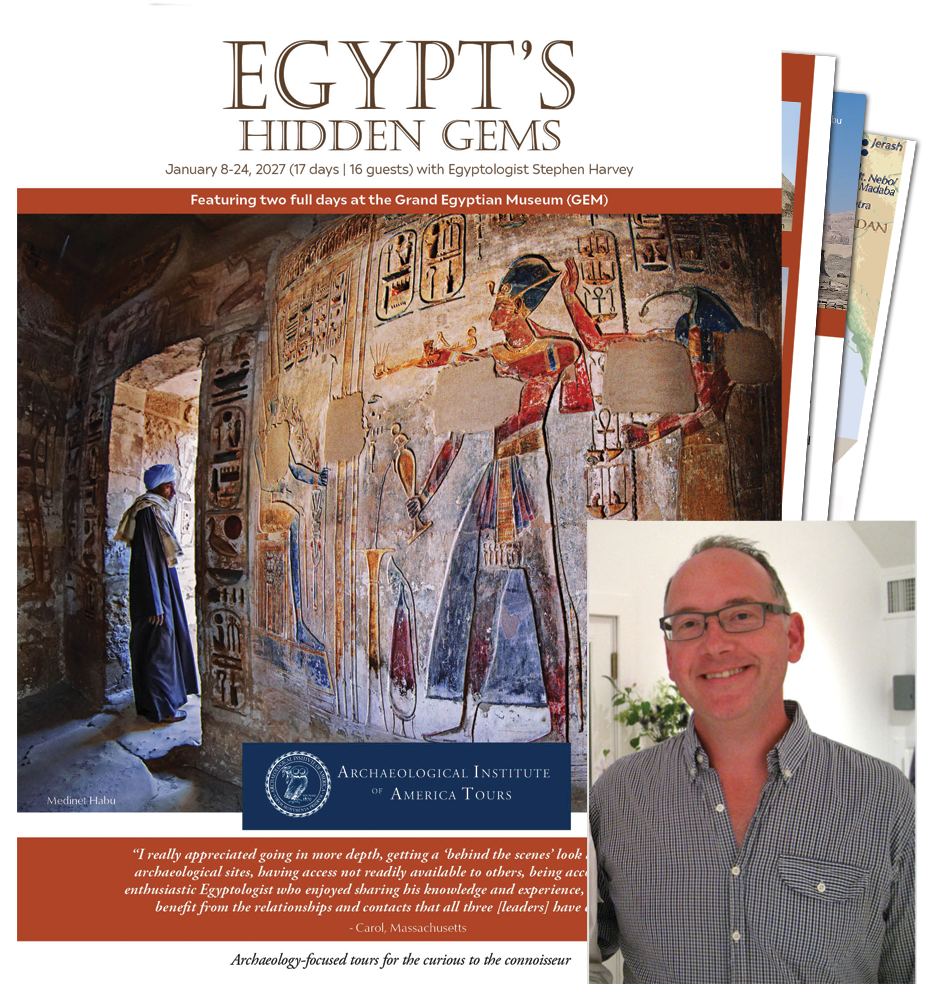
Egypt’s Hidden Gems

Tour Dates: January 8-24, 2027 (17 days)

Tour Leader(s): Stephen Harvey ,

This unique, 17-day itinerary is the perfect trip for those who wish to revisit Egypt and discover lesser-known but spectacular Pharaonic wonders. A group of just 16 guests will travel under the leadership of an exceptional and engaging trio that has been receiving accolades for 20 years: Egyptologist Stephen Harvey, along with an expert local Egyptology guide and a professional tour manager.

“I really appreciated going in more depth, getting a ‘behind the scenes’ look at Egypt and the archaeological sites, having access not readily available to others, being accompanied by an enthusiastic Egyptologist who enjoyed sharing his knowledge and experience, and being able to benefit from the relationships and contacts that all three [leaders] have established.” – Carol, Massachusetts

Highlights are many and varied:

  • Spend a full day discovering the new Grand Egyptian Museum (GEM), plus another full day exploring the iconic masterpieces of the historic Egyptian Museum, as well as the wide-ranging collection of the new National Museum of Egyptian Civilization (NMEC).
  • Gain exclusive access inside the Red Pyramid at Dahshur, enter the burial chamber of the collapsed pyramid at Meidum, and visit two mud-brick pyramids in the Fayoum Oasis.
  • Go behind the scenes at the ancient necropolis of Saqqara to see remarkable new excavations that are not open to the public.
  • Explore the necropoli of Beni Hasan, known for its 39 rock-cut tombs with well-preserved paintings of dancing, acrobatics, juggling, fishing, hunting, and weaving; and Tuna el-Gebel, with huge catacombs housing thousands of mummified ibises and baboons, among other discoveries.
  • Visit Tell el-Amarna, which replaced Thebes (modern Luxor) as the capital of Egypt under the heretic 18th-dynasty Pharaoh Akhenaton, and became significant for its monotheism and distinctive artistic style.
  • Enjoy two in-depth visits to Abydos, where Stephen Harvey has worked since 1993, including visits to the spectacular Temple of Seti I, with its invaluable “Abydos King List” and chapels with exquisite reliefs; and special access to the subterranean Osireion (the symbolic tomb of Osiris), centered around a burial chamber once surrounded by water.
  • Visit Dendera’s Temple of Hathor, renowned for its exquisite columns and a well-preserved, painted astronomical ceiling.
  • In Luxor, visit the evocative Ramesseum, the funerary temple of Ramesses II (“The Great”), as well as the best-preserved temple of ancient Thebes: Medinet Habu, the mortuary temple of Ramesses III. Also discover little-visited tombs of administrators, governors, and minor nobility, featuring detailed scenes of daily life.
  • Enjoy luxurious or best-available accommodations throughout, with at least two nights at each property. Relish three nights at the magnificent boutique Hotel Al Moudira on Luxor’s West Bank and enjoy its 24 acres of palm groves and exotic gardens.

With only 16 spaces available, we urge you to reserve your space today by calling 800-748-6262 or emailing aia@studytours.org.

Tour Prices

Per person, double occupancy (15 nights)
13-16 participants $13,845
10-12 participants $14,745
Single Supplement (limited availability) $4,685

Single room supplement will be charged when requested or required. With fewer than 10 participants a small group surcharge may be applied.

Download the complete brochure.

For reservations, more information, or questions, please email us at aia@studytours.org (and include your full name) or call us toll-free at (800) 748-6262 (toll: 603-756-2884). To reserve your space using the online form, click here.

Boundary stela A, located on the approach to Tuna el-Gebel © Roland Unger

Medinet Habu, the mortuary temple of Ramesses III © Rhikal

Ramesses II in Luxor Temple ©Mohammed Moussa

Ramesseum, Luxor © Marc Ryckaert

Temple of Seti I at Abydos © Olaf Tausch

Black Pyramid of Amenemhat_III © Tekisch

Red Pyramid © Olaf Tausch

Interior of Dendera Temple of Hathor

Itinerary


Friday, January 8, 2027: Fly to Cairo, Egypt

Saturday, January 9: Arrive in Cairo | Private transfer to hotel in Giza

Sunday, January 10: Giza: Grand Egyptian Museum, Optional PM at leisure | Welcome reception & dinner

Monday, January 11: Dahshur: Bent & Red Pyramids | Saqqara excavations | Giza

Tuesday, January 12: Cairo: Egyptian Museum on Tahrir Square, National Museum of Egyptian Civilization

Wednesday, January 13: Meidum | Fayoum (Faiyum) Oasis: Illahun & Hawara

Thursday, January 14: Fayoum Oasis: Kom Aushim, Tunis pottery village

Friday, January 15: Al Minya | Beni Hasan | Tuna el-Gebel

Saturday, January 16: Tell el-Amarna | Tuna el-Gebel

Sunday, January 17: Tuna el-Gebel | Abydos

Monday, January 18: Abydos: Shunet es-Zebib, Kom el-Sultan, Temple of Seti I, Osireion 

Tuesday, January 19: Abydos | Dendera | Luxor

Wednesday, January 20: Ramesseum | Medinet Habu

Thursday, January 21: Tombs of the Nobles | El-Khokha & El-Asassif

Friday, January 22: Luxor: At leisure | Fly to Cairo

Saturday, January 23: Cairo: Mosque of Ibn Tulun, Khan el-Khalili bazaar | Farewell reception & dinner

Sunday, January 24: Fly home

View Detailed Itinerary

Egypt’s Hidden Gems

January 8-24, 2027 (17 days | 16 guests) with Egyptologist Stephen Harvey


Itinerary

(B)= Breakfast, (L)= Lunch, (R)= Reception, (D)= Dinner


Friday, January 8, 2027: Fly to Cairo, Egypt

Saturday, January 9: Arrive in Cairo | Private transfer to hotel in Giza
You will be met upon arrival at Cairo International Airport (CAI) and transferred to the historic Mena House, a palatial hotel set amid 40 acres of gardens, with magnificent views of the adjacent Great Pyramid of Khufu (Cheops). Four nights at the 5-star Marriott Mena House (Pyramid View rooms). (D)

Sunday, January 10: Giza: Grand Egyptian Museum, Optional PM at leisure | Welcome reception & dinner
The Grand Egyptian Museum (GEM), located less than two miles from our hotel, is the world’s largest archaeological museum, spanning over 120 acres and showcasing over 100,000 artifacts from ancient Egypt. We will spend the morning at the Museum with our expert AIA lecturer and Egyptology guide learning about stunning artifacts from various periods of ancient Egyptian history, including the complete Tutankhamen collection and the reconstructed Khufu solar boat. Exhibits are organized thematically across 12 galleries, covering society, kingship, and beliefs from 3100 B.C. to A.D. 400. The museum features a grand atrium with monumental statues such as that of Ramesses II. A staircase lined with pharaonic sculptures leads to a viewing platform offering vistas of the Giza pyramids. After lunch in the Museum, you have the option of returning to our hotel to relax and enjoy its luxurious amenities, or continue your guided visit of the Museum’s galleries. This evening, we gather for a welcome reception and dinner with our three expert tour leaders: AIA lecturer/host, Egyptology guide, and tour manager. (B,L,R,D)

Monday, January 11: Dahshur: Bent & Red Pyramids | Saqqara excavations | Giza
Drive to Dahshur, part of the UNESCO World Heritage Site “Memphis and its Necropolis – the Pyramid Fields from Giza to Dahshur,” where we will learn firsthand about the transition from step-sided to smooth-sided pyramids. See 4th-dynasty Pharaoh Snefru’s Bent Pyramid, whose appearance is due to miscalculations on the structural weight and slope of the blocks. Learning from these mistakes, Snefru went on to build the shorter North (Red) Pyramid, which was the first completed true pyramid. We will have inside access to the Red Pyramid. At Dahshur, we can see from a distance the remains of Amenemhet III’s pyramid, known as the ‘Black Pyramid’ due to the exposed dark color of its mudbrick core. After lunch we enjoy a behind-the-scenes visit to the vast, ancient burial ground of Saqqara to see some of the new excavations (not open to the public) dating to the Old and New Kingdoms. (B,L,D)

Tuesday, January 12: Cairo: Egyptian Museum on Tahrir Square, National Museum of Egyptian Civilization
This morning, we visit the historic Egyptian Museum on Tahrir Square, still a major archaeological museum retaining a dense concentration of iconic masterpieces, including many relevant to several of the more remote sites on this itinerary. After lunch, you have the option of returning to our hotel to relax or visiting the new National Museum of Egyptian Civilization (NMEC) that contains the Royal Mummies Hall, designed as an immersive, tomb‑like space, displaying Egypt’s most important royal mummies. The main chronological gallery provides an overview from prehistory through the modern era. (B,L,D)

Wednesday, January 13: Meidum | Fayoum (Faiyum) Oasis: Illahun & Hawara
This morning we drive south to visit 4th-dynasty Pharaoh Snefru’s collapsed pyramid at Meidum, which represents the transition between step pyramids and true pyramids. Its construction began as a stepped pyramid, but nearer completion the steps were filled in and it was cased with limestone. At some point in (probably) the New Kingdom, it began to collapse and today stands only its three-stepped core amid a pile of rubble from its exterior. We will enter its burial chamber through a corridor that descends 177 feet. Continue driving to the southern edge of the Fayoum Oasis, a region that was popular with Middle Kingdom pharaohs and high officials for hunting and fishing. Here we will visit the mud-brick Illahun pyramid built for 12th-dynasty Pharaoh Senwosret II, and the mud-brick Hawara pyramid built for 12th-dynasty Pharaoh Amenemhet III. Check-in to our hotel and gather for dinner this evening. Two nights at the 3-star Helnan Auberge Fayoum. (B,L,D)

Thursday, January 14: Fayoum Oasis: Kom Aushim, Tunis pottery village
This morning we drive to Kom Aushim (ancient Karanis), the site of a Greco-Roman town with two well-preserved temples, one of which (from the 1st century B.C.) was dedicated to two crocodile gods. Explore its recently opened site museum and an open-air display of columns and statuary from Kiman Faris (Middle Kingdom Crocodilopolis). After lunch in the charming town of Tunis, on the edge of Lake Qaroun, we visit Tunis’s pottery-making village which comprises a number of workshops that create and display their handmade ceramics. Return to our hotel and gather for dinner this evening. (B,L,D)

Friday, January 15: Al Minya | Beni Hasan | Tuna el-Gebel
This morning we drive to Al Minya, located about 150 miles south of Cairo, which offers a glimpse into the unhurried, traditional life along the Nile that has persisted for millennia. After lunch, we drive to the east bank to visit the necropolis of Beni Hasan, known for its 39 rock-cut tombs of 11th– and 12th-dynasty officials. We will undertake an invigorating climb up broad, deep steps to explore some of the tombs in the limestone cliff face. Some of the tombs feature well-preserved paintings of dancing, acrobatics, juggling, fishing, hunting, and weaving. Drive for 40 minutes to our accommodations in Tuna el-Gebel, and gather for dinner this evening. Two nights at the 3-star New Hermopolis Retreat. (B,L,D)

Saturday, January 16: Tell el-Amarna | Tuna el-Gebel
Most of today is dedicated to exploring the famous site of Tell el-Amarna, once called Akhetaton (“horizon of the sun”). The controversial pharaoh Akhenaton (Amenhotep IV) built the city on the Nile’s east bank in the late 18th dynasty, to replace Thebes (modern Luxor) as capital. He established Amarna as the first monotheistic community in ancient Egypt, worshipping the god Aton (the sun). The site today comprises temples, palaces, houses, and more than 25 tombs at the base of a cliff. We will visit some of the richly decorated rock-cut tombs of the nobles, which feature scenes of life in the ancient city represented in the lively style of the Amarna period. We return to our accommodations and gather for dinner. (B,L,D)

Sunday, January 17: Tuna el-Gebel | Abydos
This morning we walk to the site of Tuna el-Gebel, a necropolis with tombs that date from the Late Period to the Ptolemaic era as well as huge catacombs for thousands of mummified ibises and baboons, both of which were considered incarnations of Thoth, the god of writing and wisdom. One of its more fascinating tombs is that of Petosiris, which features lively scenes of daily life and ritual that combine Egyptian, Greek, and Persian artistic styles. The site also includes the ruins of a Christian basilica, and Roman waterworks with a 100-foot-deep well and a water wheel. Recent excavations by a joint Egyptian-German team have uncovered a series of tombs and a mud-brick structure from the Ptolemaic era with more than 50 rooms. Then we drive to Abydos, about 200 miles south of Tuna el-Gebel, and check-in to our simple but conveniently located hotel. Two nights at the 3-star House of Life Abydos hotel. (B,L,D)

Monday, January 18: Abydos: Shunet es-Zebib, Kom el-Sultan, Temple of Seti I, Osireion
Abydos is one of the oldest and most important ancient cities in Egypt, and AIA lecturer Stephen Harvey has worked here since 1993. We will take an in-depth look at this vast site today and tomorrow morning. Begin today with a visit to Shunet es-Zebib, one of the oldest standing massive brick structures in the world, the architecture of which points to some features of later structures, like the Step Pyramid of Djoser at Saqqara. Next explore Kom el-Sultan, another large, Early Dynastic Period mud-brick structure, which includes an early Temple of Osiris where excavations have revealed hundreds of stelae yielding information about the cult of Osiris. The only known statue of Khufu was found here, and recently a portal temple to Ramesses II was excavated.

After lunch we will visit the spectacular Temple of Seti I, where was discovered the “Abydos King List”—the long, invaluable list of pharaohs of the principal dynasties (as recognized by Seti) that was inscribed on a wall. The temple also has seven chapels with exquisite reliefs. We will also be granted private access to the intriguing, subterranean Osireion (symbolic tomb of Osiris), accessible via a 420-foot-long passageway and centered around a burial chamber that was once surrounded by water. Return to our hotel and gather for dinner this evening. (B,L,D)

Tuesday, January 19: Abydos | Dendera | Luxor
Return to Abydos this morning to visit the Temple of Ramesses II. After lunch we drive to Luxor, stopping en route at the Temple of Hathor at Dendera, which has recently been extensively restored, revealing its startlingly well-preserved painted astronomical ceiling and reliefs. Continue on to our beautiful hotel, like a desert oasis embellished with reclaimed materials from historic buildings, surrounded by more than 24 acres of palm groves and exotic gardens. Settle in and gather for dinner. Three nights at the 5-star Hotel Al Moudira. (B,L,D)

Wednesday, January 20: Ramesseum | Medinet Habu
This morning we visit the Ramesseum, the funerary temple of Ramesses II (“The Great”). It is known for its 57-foot-tall seated statue of Ramesses II (of which huge fragments remain), the subject of Percy Bysshe Shelley’s poem “Ozymandias.” It is also renowned for its reliefs, including those depicting the Battle of Kadesh, the Syrian wars, and the Festival of Min. Continue to the best-preserved temple of ancient Thebes: Medinet Habu, the mortuary temple of Ramesses III. It dates from the early 18th dynasty and, besides its impressive size and architectural features, it includes famous reliefs depicting the defeat of the Sea Peoples during Ramesses III’s reign. A Coptic church was later established in the second courtyard of the mortuary temple. Return to our hotel and gather for dinner this evening. (B,L,D)

Thursday, January 21: Tombs of the Nobles | El-Khokha & El-Asassif
Today we see several of the best little-visited sites on Luxor’s West Bank. Located between the Ramesseum and Hatshepsut’s mortuary temple are tombs carved into a rocky hillside dedicated to administrators, governors, and other figures of minor nobility with detailed scenes of their daily lives. Tombs we might visit include those of Rekhmire, Menna, and Nakht. We also will see the lesser-visited necropoli of El-Khokha and El-Asassif with dozens of tombs from many dynasties. (B,L,D)

Friday, January 22: Luxor: At leisure | Fly to Cairo
Aside from a morning lecture and lunch, the morning and afternoon are at leisure to relax and enjoy our luxurious hotel’s property and amenities. It has gardens, palm groves, orchards, a spa (additional cost), and a lovely pool. Late this afternoon we transfer to Luxor’s airport in time for our short flight to Cairo. Upon arrival, we check-in to our well-appointed and convenient airport hotel with fully sound-proofed rooms. Two nights at the 5-star Le Méridien Cairo Airport Hotel. (B,L,D)

Saturday, January 23: Cairo: Mosque of Ibn Tulun, Khan el-Khalili bazaar | Farewell reception & dinner
This morning we visit the 9th-century Mosque of Ibn Tulun, which is both Cairo’s largest mosque in terms of land area and its oldest mosque in its original form; and the adjacent Gayer-Anderson Museum, a superb example of 17th-century domestic architecture with splendid furniture, carpets, curios, and other objects. Enjoy lunch and browsing in Khan el-Khalili, the famous souq (bazaar). This evening, we gather with our AIA lecturer, Egyptology guide, and tour manager for a farewell reception and dinner. (B,L,R,D)

Sunday, January 24: Fly home
Check out this morning and enter the airport (our hotel has direct access to Terminal 3 via footbridge, and a free shuttle to Terminal 2) to catch flights homeward. (B)


For reservations or questions, please email us at aia@studytours.org (and include your full name) or call us toll-free at (800) 748-6262 (toll: 603-756-2884). To reserve your space using the online form, click here.

support Us

The AIA is North America's largest and oldest nonprofit organization dedicated to archaeology. The Institute advances awareness, education, fieldwork, preservation, publication, and research of archaeological sites and cultural heritage throughout the world. Your contribution makes a difference.