

AIA Tours: land

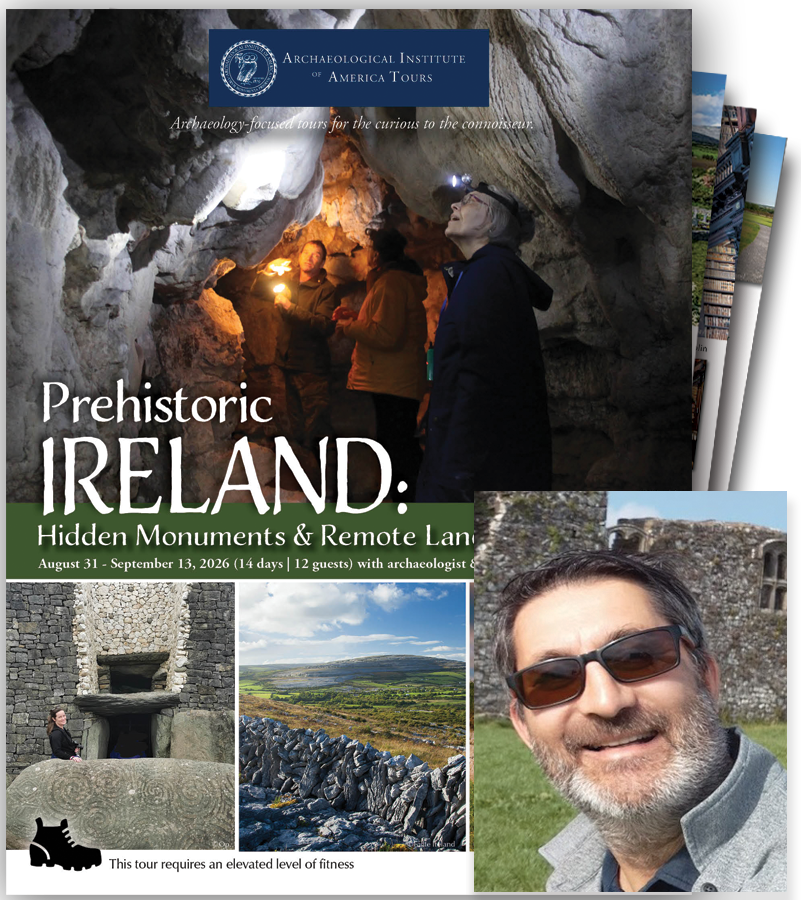
Prehistoric Ireland: Hidden Monuments & Remote Landscapes

Tour Dates: August 31 - September 13, 2026 (14 days)

Tour Leader(s): Stephen Mandal ,

Travel across Ireland to uncover the layers of its past, from the earliest hunter-gatherers to the great passage tomb builders and Iron Age kings. Guided by an esteemed Irish academic—who is both a geologist and an archaeologist—you will experience Ireland’s extraordinary landscapes and archaeological treasures in the company of leading experts, with the dedicated support of a professional tour manager.
Highlights:

  • Explore the Knockroe passage tomb, one of the most significant prehistoric sites in the country, in the company of the archaeologist who excavated it in the 1990s
  • Discover for yourself Lough Gur’s 6,000+ years of human habitation, from an early prehistoric wedge tomb and the Great Grange Circle (Ireland’s largest stone circle), to an Early Christian crannog (man-made island/defended dwelling)
  • Walk the dramatic limestone landscape of the Burren, including Alice and Gwendoline Cave, where a remarkable discovery pushed back the earliest date of human occupation in Ireland 2,500 years; and Poulnabrone dolmen, the earliest dated megalithic tomb in Ireland, built ca. 3800 B.C.Marvel at the iconic Cliffs of Moher, five miles long and 750 feet at their highest point—one of the most amazing views in Ireland
  • Take a ferry to Inis Mór (Inishmore), the largest of the Aran Islands, and climb to the cliff-top Dún Aonghasa (Dún Aengus) stone fort, built ca. 1100 B.C.
  • See the Neolithic passage tomb complexes at Carrowkeel, Carrowmore, Loughcrew (with its solar alignment at the spring and autumn equinoxes), and Fourknocks
  • Visit the UNESCO World Heritage Site of Brú na Bóinne in the Boyne Valley, exploring the 4th-millennium B.C. megalithic passage tombs of Newgrange
  • (the largest passage mound in Europe) and Knowth

Tour Prices (12 nights)

Per person, double occupancy
10-12 participants $10,745
8-9 participants $11,545
Single Supplement (limited availability) $1,745

Single room supplement will be charged when requested or required. With fewer than 8 participants a small group surcharge may be applied.

To reserve your space using the online form, click here.

For reservations or questions, please email us at aia@studytours.org (and include your full name) or call us toll-free at (800)748-6262 (toll: (603)756-2884).

Level of Fitness: This tour requires an elevated level of fitness

HIGHLY ACTIVE: Must be able to walk or be on your feet for most of the day; keep a steady group pace; and navigate uneven terrain, and up and down inclines and steps.

Carrowmore

National Museum Ireland

Grange Stone Circle, Lough Gur

Lough Gur

The Burren

Rock of Cashel

Knowth

Itinerary


Monday, August 31, 2026: Depart home

Tuesday, September 1: Arrive Dublin | Dún Laoghaire | Welcome dinner

Wednesday, September 2: Dublin: National Museum of Ireland, Trinity College | Dún Laoghaire

Thursday, September 3: Knockroe | Rock of Cashel | Limerick

Friday, September 4: Lough Gur | King John’s Castle | Limerick

Saturday, September 5: Alice & Gwendoline Cave | The Burren | Cliffs of Moher | Ballyvaughn

Sunday, September 6: Doolin | Ferry to Inis Mór | Dún Aonghasa | Return ferry to Doolin | Ballyvaughn

Monday, September 7: The Burren: Poulnabrone, Cahercommaun, Parknabinnia | Ballyvaughn

Tuesday, September 8: Rathcroghan | Carrowkeel | Sligo

Wednesday, September 9: Carrowmore | Glencar Waterfall | Creevykeel | Sligo

Thursday, September 10: Corlea Trackway | Hill of Uisneach | Loughcrew | Trim

Friday, September 11: Brú na Bóinne: Newgrange, Knowth | Boyne Valley Wools | Trim

Saturday, September 12: Fourknocks | Hill of Tara | Trim | Farewell dinner

Sunday, September 13: Fly home


View Detailed Itinerary

Monday, August 31, 2026: Depart home
Depart home on independent flights to Dublin, Ireland.

Tuesday, September 1: Arrive Dublin | Dún Laoghaire | Welcome dinner

 3 miles and steep ascent – urban footpaths and some managed and unmanaged trails

Upon arrival at Dublin Airport (DUB), meet your host and tour manager at the airport, and transfer to our hotel. After a light lunch, take an optional walk along Dún Laoghaire sea front along ‘the Metals’ – the route of the railroad built in the early 19th century to transport granite from Dalkey Quarry to Dún Laoghaire to build the harbor. The views from the top across Dublin Bay and the eastern seaboard of Ireland are stunning, giving the area the deserved moniker ‘the Naples of Ireland’. In the evening, we gather for a welcome reception before dinner at our hotel. Two nights at the 4-star Royal Marine Hotel. (L,R,D)

Wednesday, September 2: Dublin: National Museum of Ireland, Trinity College | Dún Laoghaire

 < 1 mile on level ground – urban footpaths

Today we take the short drive into Dublin city center to visit the National Museum of Ireland. A fascinating building, purpose built in 1890, the museum houses an astonishing wealth of artifacts. It is laid out chronologically, so a tour is a perfect opportunity to ground yourself in Irish prehistory (and history). Afterwards, we visit Trinity College Dublin and the Book of Kells to take a glimpse at Ireland in the historic period from the arrival of Christianity in the 5th century A.D. to the establishment of the city by the Vikings in the 9th century A.D. and, subsequently, the Anglo-Normans in the 12th century A.D. Enjoy dinner in the charming heritage town of Dalkey before returning to our hotel. (B,L,D)

Thursday, September 3: Knockroe | Rock of Cashel | Limerick

 1 mile and steep ascent in places – mixed walk; roads, paths, uneven terrain in places

Depart Dublin this morning and head to rural Kilkenny, where we visit Knockroe passage tomb in the company of Professor Muiris O’Sullivan, who excavated the site in the 1990s. The construction of the monument, including the use of stone, setting, and findings of the excavation, make this one of the most significant prehistoric archaeological sites in the country. Afterwards, we continue to the Rock of Cashel, seat of the High Kings of Munster, and the only royal inauguration site in Ireland that was supplanted by Christianity. Continue westward to our hotel in Limerick, where we enjoy a pre-dinner lecture on the Burren landscape. Two nights at the 4-star Strand Hotel. (B,L,D)

Friday, September 4: Lough Gur | King John’s Castle | Limerick

 Overall 2.5 miles and some (optional) steep ascent – in a parkland setting with some rough pathways

This morning we drive the short distance to Lough Gur, a lake that has seen more than 6,000 years of human activity and habitation, from the Stone Age through to the post-medieval period. Highlights of our gentle walk here include the Early Christian ‘crannog’ (a man-made island that served as a defended dwelling); ringforts; an early prehistoric wedge tomb; and the Great Grange Stone Circle, Ireland’s largest stone circle, comprising 113 standing stones. After lunch, take the opportunity to rest a while, or go on a short walk through Limerick and visit the 13th-century A.D. King John’s Castle. Enjoy the evening and dinner at leisure in Limerick. (B,L)

Saturday, September 5: Alice & Gwendoline Cave | The Burren | Cliffs of Moher | Ballyvaughn

 Up to 5 miles with some ascent – mixed walking, on country roads and pathways, and over some uneven, unmarked terrain

Today we depart Limerick and head into the karst limestone landscape of the Burren. Along the way, we stop at Alice and Gwendoline Cave, scene of a remarkable archaeological discovery that established the earliest date of human occupation of Ireland to be 2,500 years earlier than previously thought. After lunch in Ennis, we continue through the Burren National Park, a dramatic landscape renowned for its unusual geology and unique mixture of Artic-Alpine and Mediterranean flora. This limestone wonderland boasts archaeology from the Neolithic, early Christian, and early medieval periods. After lunch we visit the iconic Cliffs of Moher, one of Ireland’s most spectacular sights. Five miles long and 750 feet at their highest point, the Cliffs of Moher offer one of the most amazing views in Ireland. On a clear day, the Aran Islands are visible in Galway Bay, as are the valleys and hills of Connemara. Continue on to Ballyvaughn, where we check-in to our hotel and then gather for dinner. Three nights at the 4-star Monks Hotel. (B,L,D)

Sunday, September 6: Doolin | Ferry to Inis Mór | Dún Aonghasa | Return ferry to Doolin | Ballyvaughn

 3 miles with ascent in places – mixed walks along boardwalks, rough paths, rocky and grassy terrain

This morning we travel the short distance to the fishing port of Doolin, where (weather-permitting) we catch a ferry to Inis Mór (Inishmore), the largest of the Aran Islands. With a population of about 800, the island is famous for its strong Irish culture, loyalty to the Irish language, and a wealth of Iron Age and Christian ancient sites. Perhaps its most notable monument is Dún Aonghasa (Dún Aengus), a semi-circular stone fort built ca. 1100 B.C. at the edge of a 300-foot-high cliff, offering spectacular views out over the Atlantic. The route to the fort is a partly steep and uneven rough limestone pathway. Boots that have ankle support are advised. This walk is unsuitable for those with less-than-optimal stability, and requires a good level of fitness. Our taxi will take us on a tour of the island, and we will spend some time in Kilronan village before returning by ferry to Doolin, where we enjoy dinner in a local pub before returning to our hotel in Ballyvaughan. (B,D)

Monday, September 7: The Burren: Poulnabrone, Cahercommaun, Parknabinnia | Ballyvaughn

 Combined 2 miles with one steep ascent – on footpaths and some rough, unmarked terrain

Today we explore the dramatic Burren, which translates in Irish as either ‘the rocky place’ or, more intriguingly, ‘the fertile rock’. Our first aim will be to understand the formation of this other-worldly landscape, shaped also by human settlement from the time of the first Neolithic farmers who arrived in this area some 6,000 years ago. Visit the iconic Poulnabrone dolmen, a dramatic Neolithic portal tomb and the earliest dated megalithic tomb in Ireland, built ca. 3800 B.C. Also explore Parknabinnia wedge tomb and hike to Cahercommaun hill fort, which was excavated by Hugh O’Neill Hencken of the 1934 Harvard expedition and which he believed dated to the 9th century A.D., but more recent research suggests was established many centuries earlier in prehistory. Enjoy a pub lunch in Lisdoonvarna, home to the annual match-making festival (which will be underway during the tour!), while dinner this evening will be on your own back in Ballyvaughn. (B,L)

Tuesday, September 8: Rathcroghan | Carrowkeel | Sligo

 3 miles walking with steep ascent in places – uneven paths and rocky, uneven terrain; waterproof footwear is crucial

Today, we depart the Burren and head north. In the morning, visit the Royal Site of Rathcroghan, seat of the High Kings of Connaught from at least the Iron Age (Celtic Period). The landscape is as remarkable as the other royal sites of Ireland, with over 200 identified archaeological sites spanning over five millennia of human history. After lunch in the visitor’s center, we will head to county Sligo and be joined by Sam Moore, local archaeologist and lecturer at Atlantic University Sligo (ATU). Together we will climb to the summit of Carrowkeel, a complex of 14 megalithic passage tombs which are one of the foci of Sam’s Ph.D. research. The hike is on steep and uneven ground and boots with ankle support are advised. The hike is unsuitable for those with less-than-optimal stability and requires a good level of fitness. Afterwards, we will drive the short distance to our hotel in Sligo, where we will be joined by another ATU lecturer, Dr. Marion Dowd, who will lead a talk before dinner. Two nights at the 4-star Glasshouse Hotel. (B,L,D)

Wednesday, September 9: Carrowmore | Glencar Waterfall | Creevykeel | Sligo

 3 miles walking – Carrowmore has grassy paths; waterproof footwear is crucial

This morning we drive to Carrowmore, one of the four large passage tomb complexes in Ireland, to discuss their siting, construction, purpose, and extent in this breathtaking landscape, with Sam Moore. After lunch in a local pub, we visit Glencar Waterfall, made famous by William Butler Yeats as it features in his poem “The Stolen Child.” From here, we visit Creevykeel court tomb, completing our quartet of megalithic tombs as classified by De Valera and Ó Nualláin in the 1960s. Time and energy permitting, we may sneak in a few hidden gems along the way! Dinner in Sligo is under your own arrangements this evening. (B,L)

Thursday, September 10: Corlea Trackway | Hill of Uisneach | Loughcrew | Trim

 4 miles and some steep ascent – The walk at Uisneach is along gravel and grassy paths and at Loughcrew is grassy, uneven, and steep in places

This morning we depart Sligo and commence our journey eastward to the Boyne Valley. En route we stop at Corlea Trackway, an Iron Age road built in 148 B.C. Known locally as the Danes’ Road, it is the largest of its kind to have been uncovered in Europe. From here, we drive the short distance to the virtual and spiritual center of Ireland at the Hill of Uisneach, the great meeting place of the ancient chieftains of Ireland. Enjoy a fabulous private tour drawing together the archaeology and mythology of this magical place. After a picnic lunch at the visitors’ center, we will set out for county Meath and the Loughcrew passage tomb complex. This stunning site, with is solar alignment to the spring and autumn equinoxes, is also steeped in Irish mythology. From here, we drive to our hotel in Trim. Three nights at the 4-star Knightsbrook Hotel. (B,L,D)

Friday, September 11: Brú na Bóinne: Newgrange, Knowth | Boyne Valley Wools | Trim

 1.5 miles – gentle walks around the monuments on gravel paths

This morning we visit the UNESCO World Heritage Site of Brú na Bóinne and explore the exhibits at the Visitor Centre. We then visit the 4th-millennium B.C. megalithic passage tombs at Newgrange and Knowth. Newgrange is the largest passage mound in Europe, and encloses an astronomically aligned, 20-yard-long inner passage leading to a cruciform chamber with a corbelled roof. The illumination of the passage and chamber at the winter solstice sunrise is world famous. The Great Mound at Knowth is similar in size to Newgrange and surrounded by 18 smaller satellite mounds; both sites contain the finest megalithic art in Europe. After lunch at the center, we set out for Boyne Valley Wools, a traditional wool craft shop with a flock of Jacob sheep where one can experience the process of spinning wool. We then return to Trim for an evening and dinner at leisure. (B,L)

Saturday, September 12: Fourknocks | Hill of Tara | Trim | Farewell dinner

 1.5 miles – gentle walks on grass and rough tracks, hilly in places at the Hill of Tara
This morning we drive to visit a hidden gem of a site: the passage tomb at Fourknocks. The tomb, accessible by borrowing a key from a local custodian, features a short passage that opens into a spacious, pear-shaped chamber, with three smaller, offset chambers. Excavated from 1952-54, it was concluded that the structure probably had a wooden roof supported by a central pole. The excavations revealed more than 60 burials (cremated and not cremated, adult and child) as well as numerous artifacts, but perhaps the most impressive aspect of the site is the quantity and quality of the megalithic art on display. From Fourknocks, we head west to the seat of the High Kings of Ireland, the Hill of Tara. Its earliest visible monument, the Mound of the Hostages (a passage tomb), was constructed ca. 3000-2500 B.C. Records indicate that more than 140 kings were coronated on the Hill of Tara from the Iron Age through to the arrival of the Anglo-Normans in the late 12th century A.D. From here, we will return to our hotel for a farewell reception and dinner. (B,L,R,D)

Sunday, September 13: Fly home
Transfer as a group (time TBD) to Dublin Airport (DUB) for independent flights homeward. (B)


For reservations or questions, please email us at aia@studytours.org (and include your full name) or call us toll-free at (800) 748-6262 (toll: 603-756-2884). To reserve your space using the online form, click here.

support Us

The AIA is North America's largest and oldest nonprofit organization dedicated to archaeology. The Institute advances awareness, education, fieldwork, preservation, publication, and research of archaeological sites and cultural heritage throughout the world. Your contribution makes a difference.